



The Israeli president’s visit to Addis Ababa reflects Tel Aviv’s desire to redefine its position in Africa and extend its influence beyond the Middle East.
Israeli President Isaac Herzog’s visit to Addis Ababa on 25 February shows that Africa is gaining weight in Israel’s diplomatic calculations. Israel wants to expand its influence beyond the traditional Middle Eastern sphere. With the intention of repositioning itself within the regional and international orders, Israel is joining the global competition for influence in Africa by stepping up its diplomatic activity across the continent.
Herzog’s two-day visit is part of the Israeli strategy of “Returning to Africa”, launched in 2016 to bolster Israel’s political, economic, and security presence on the continent while opening new diplomatic channels to mitigate potential international isolation, particularly amid escalating tensions with Iran and the growing influence of both China and Turkey in Africa.
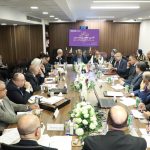
Herzog was received in Addis Ababa in an official ceremony at Bole International Airport by Ethiopian Foreign Minister Gedion Timothewos and Israeli Ambassador Avraham Neguise. He held meetings with Ethiopian President Taye Atske Selassie and Prime Minister Abiy Ahmed.
Discussions between Herzog and Selassie focused on strengthening historical and cultural ties, highlighting the role of the Ethiopian Jewish community, known as Beta Israel, and deepening cooperation between the two peoples. This reflects Israel’s use of religious diplomacy, mobilising social and historical dimensions to build sustainable influence in Africa.
With Prime Minister Ahmed, Herzog focused on partnerships in innovation, trade, agriculture, and food security, as well as water and energy technologies. He spoke about Israel’s interest in transferring its developmental and technological expertise to support Ethiopia in addressing its economic and social challenges. During the talks, Herzog stressed that some parties were attempting to undermine Israeli relations in Africa, affirming, however, that bilateral ties remained stronger than any such efforts.
Herzog also visited the Science Museum and the Friendship Park, signifying the cordial nature of bilateral relations. In a meeting with leaders of the local Jewish community, Herzog described the visit as his fourth to an African state since assuming the presidency, expressing the idea that Israel’s presence in Africa is meant to rebuild ties on firm diplomatic, economic, and cultural foundations.
Herzog’s visit to Ethiopia is part of a broader strategy meant to boost Israel’s presence specifically in the Horn of Africa, a region rich in resources and of considerable geopolitical significance. Ethiopia is regarded as a pivotal state in the African Union and an influential actor in shaping regional and African decisions, particularly on issues related to regional conflicts. Moreover, Ethiopia is a gateway for Israel to secure supportive votes in the United Nations and to confront regional challenges, especially tensions with Iran and its proxies in the Red Sea and the Horn of Africa.
Herzog’s visit also reflects Israel’s desire to promote innovation and trade by showcasing its expertise in agriculture, technology and security, and to extend mutual diplomatic support — an approach rooted in an Israeli strategy that seeks to leverage technological capabilities to build strong relations based on shared interests.
Before landing in Ethiopia, Herzog had been to Zambia and the Democratic Republic of the Congo in an intensified campaign to reopen embassies and conclude strategic cooperation agreements.
Israel’s moves in Addis Ababa are seen as part of the effort to build alliances with key African states to establish a diplomatic and security buffer that strengthens Israel’s position vis-à-vis its regional adversaries. This comes amid ongoing challenges linked to Iran and its regional proxies, particularly with the outbreak of war against Iran following the visit.
Nevertheless, Israel faces a host of challenges in its relations with African states, amplified by the Israeli war on the Gaza Strip. Among the most notable are the African Union’s continued support for the Palestinian cause and the suspension of Israel’s observer status since 2023, in addition to negative perceptions associated with its historical support for the former apartheid regime in South Africa. Collectively, these factors constitute obstacles to Israel’s relations with some African countries and may limit its ability to consolidate influence and sustain a long-term strategic presence in Africa.
On another level, Herzog’s visit to Addis Ababa is significant in the light of the US-Israel war against Iran, which started three days later. The military attack targeted Iranian military facilities and senior regime figures in an attempt to weaken Iran’s regional influence and curb its military capabilities. Iran responded by launching missiles at Israel and US bases in the Gulf, triggering a dangerous regional escalation and heightening concerns over the stability of energy markets, the security of global supplies and broader international stability.
In addition, Israel has recently recognised the Somaliland region, before its Foreign Ministry granted an official letter of acceptance to Somaliland’s first ambassador, Mohamed Haggai. This step opens a new chapter in Israeli influence in the Red Sea region, providing Israel with a strategic foothold from which to monitor developments in the Horn of Africa and counter potential Iranian expansion. It also reflects Israel’s intention to build a network of relations designed to secure sustained influence within regional alliances.
If anything, Herzog’s visit to Addis Ababa reflects Israel’s growing recognition of Africa’s pivotal role in shaping the international power balance. Africa is a platform for expanding diplomatic and strategic support networks through bilateral alliances and development as well as institutional partnerships, allowing Israel to remain an influential actor in international forums while continuously adapting to political and geostrategic shifts.
Herzog’s visit can also be seen as a test for Israel’s ability to manage multidimensional influence. It has become clear that military and technological superiority alone is no longer sufficient; they must be coupled with diplomatic skill and economic and social policies capable of ensuring sustainable relations with African states, especially amid rising regional risks.
The success of Israel’s strategy in Africa could grant it a unique strategic position that limits the influence of competing regional powers. Conversely, any failure could result in diminished influence and the loss of African allies to other states such as China and Turkey, making the management of influence a challenge that requires a careful balance between power, diplomacy, and economics.
The repercussions of the US-Israel war against Iran may have a dual effect on Israel’s influence in Africa. The war might provide Israel with the opportunity to strengthen its influence should Iran and its proxies see their regional role reduced, potentially paving the way to deeper partnerships with Ethiopia and Somaliland as a diplomatic and security bulwark. It may also provide a platform for Israeli support in international forums and in confronting Tehran’s regional allies.
On the other hand, the war may divert Israel’s attention away from Africa because of mounting military commitments, increasing financial and political strain and growing African criticism of Israeli policies in the Palestinian territories. This, in turn, could weaken diplomatic momentum and create opportunities for competitors such as China and Turkey to expand their presence in Africa.
Overall, Herzog’s visit to Ethiopia indicates that Israel wants to redefine its position in Africa and capitalise on existing opportunities to create durable influence, while carefully balancing its ambitions with African, regional, and international sensitivities. In this sense, Israel appears to recognise that Africa is not merely a theatre for competition over alliances, but rather a way to integrate military power with diplomatic and economic tools and consolidate its strategic presence amid the current geopolitical shifts.
Published in cooperation between the Egyptian Center for Strategic Studies, Al-Ahram Weekly, and the English-language portal Ahram Online


