





Egypt’s accession to power: The signal to move
The first attempts came from the far west, when the Brotherhood formed a coalition government in the Kingdom of Morocco under the leadership of one of the Brotherhood’s leaders, Abdelilah Benkirane, after the Brotherhood-affiliated Justice and Development Party won the largest share of the vote in the 2011 elections.
In Tunisia, the Brotherhood-affiliated Ennahda Movement also won the largest share of the vote, securing 89 seats in the October 2011 elections for the National Constituent Assembly, which was entrusted with drafting the Tunisian constitution and administering the country’s affairs during the transitional period. The movement shared the key positions with two other parties in what became known as the “Tunisian Troika.” The Brotherhood obtained the post of Prime Minister, and one of its leading figures, Hamadi Jebali, was appointed to the position. It also secured the post of Deputy Speaker of the Constituent Assembly. In addition, it won 16 ministerial portfolios out of a total of 31 ministries, as well as one Secretary of State position. At that time, the political climate allowed Tunisia’s Brotherhood to achieve further gains.
In Libya, the Muslim Brotherhood hastened to participate in the overthrow of Gaddafi’s rule in 2011 to obtain its share of the inheritance. It quickly established a political party whose name closely resembled those of Brotherhood parties in many countries of the Arab world, calling it the Justice and Construction Party. It contested the 2012 elections for the General National Congress, benefiting from the momentum created by the Brotherhood’s success in Egypt, and its candidates came in second place. Libya’s Brotherhood believed that a large share of the seats of power in Libya would fall to them. With neighbouring Egypt in the hands of their organization, it would not hesitate to extend a helping hand whenever they needed it.
In Mauritania, the Brotherhood-affiliated National Rally for Reform and Development Party intensified its activities throughout the country and engaged in political and media intimidation in preparation for elections that were just around the corner.
Meanwhile, in Algeria, the Brotherhood moved into the ranks of the opposition in June 2012 after having participated in government through the Movement of Society for Peace. A major split emerged among the organization’s leaders following Mohamed Morsi’s accession to power. The Movement of Society for Peace drew closer to the Brotherhood’s headquarters in Egypt, while the Brotherhood-affiliated Movement for Preaching and Change leaned towards the International Organization of the Muslim Brotherhood.
In the Horn of Africa, Djibouti represented the Brotherhood’s first historical expansion outside Egypt. One of Djibouti’s citizens visited the Brotherhood’s headquarters in Cairo and returned to his country to establish a Brotherhood branch there in 1932. The branch played no significant role or exercised any notable influence against the French occupation. Even after the end of colonial rule, the movement continued to be governed by considerations of political interest. When Hosni Mubarak announced his resignation from the presidency in February 2011, this became the spark that launched action against the Djiboutian government. Brotherhood supporters organised protests against Djiboutian President Ismaïl Omar Guelleh, demanding that he step down from power, and continued to incite opposition against him. The Djiboutian president, however, had learned the lesson. He did not respond to their demands; instead, he held presidential elections in the same year and won 81 per cent of the vote.
Although the terrorist organization in Somalia had preceded most of the Brotherhood’s branches outside Egypt in terms of its establishment, Somalia’s tribal environment, its association with Sufism, and the widespread religiosity of the majority of its people did not allow the ideology of the terrorist organization to exercise significant influence. Foreign funding also contributed to repeated divisions within the organization, making tribal affiliation and financial resources the dominant forces governing Somali political life. Nevertheless, after 2011, some of the organization’s leaders reached the offices of President and Prime Minister, including the two former presidents, Sharif Sheikh Ahmed and Hassan Sheikh Mohamud.
Sudan, meanwhile, had been under the rule of the Brotherhood, under the leadership of Omar Al-Bashir, since 30 June 1989.
It appeared that most of the western flank of the Arab world in North Africa and the Horn of Africa had fallen under the grip of the terrorist organization and its branches, yet it remained unable to bend those states to its plans.
As for the eastern part of the Arab world, where the Arab Gulf states are located, these countries are governed by monarchical systems and by more disciplined political structures. Therefore, political movement in the Gulf street is carefully calculated, and it is difficult for movements opposed to the ruling systems to emerge. Nevertheless, the Brotherhood was active in the United Arab Emirates, Kuwait, the Sultanate of Oman, and the Kingdom of Bahrain, where the organization sought to implement its plans. As for the Brotherhood’s relationship with the State of Qatar, it governed and regulated the movement of the Brotherhood. It neither carried out any activity, nor raised its head, nor stirred any issue that departed from Qatar’s wishes or policies. In the Kingdom of Saudi Arabia, security control was too strong to allow the Brotherhood to become significantly active.
In the northern part of the Arabian Peninsula, where Iraq, Jordan, Syria, Lebanon, and Palestine are located, the situation was more complicated. Since the American invasion, Iraq has suffered from a combination of sectarian, political, ethnic, and tribal problems and conflicts, creating a permanent space for Brotherhood activities, particularly since the Brotherhood had been a partner in the invasion of Iraq from its very beginning in 2003. Numerous organizations with Brotherhood origins, or linked to the organization, gradually emerged. The latest of these was the “Islamic State in Iraq and al-Sham (ISIS),” which later imposed its control over parts of Iraqi territory.
In Syria, the iron grip of the Ba’ath Party and Bashar Al-Assad prevented the Brotherhood from consolidating its rule despite its penetration into broad segments of Syrian society. After assuming power, Mohamed Morsi attempted to support them and launched his well-known reckless call, “At your service, Syria.”
As for Lebanon, with its unique political and sectarian composition, it constituted a major obstacle to the Brotherhood’s expansion in a way that would enable it to gain influence within the circles of power, as it had done in other Arab countries. In the Hashemite Kingdom of Jordan, however, the Brotherhood enjoyed considerable influence, prompting the Jordanian government to pursue policies that alternated between containment and firmness according to the circumstances of each stage.
In these circumstances, it appeared to everyone that the Arab world had become at stake and was waiting to see what would happen in Egypt. Would the terrorist organization succeed in subjugating Egypt, with all its political, military, economic, diplomatic, and soft-power capabilities? Egypt is the beating heart of the Arab world and the centre of decision-making and leadership throughout history, and its influence in its regional and international surroundings is great and effective. Would it become submissive in the hands of authoritarian leaders, who would then use Egypt’s comprehensive power to implement the organization’s plans and strengthen its branches throughout the Arab world? Or would the Egyptian people have another word to say, changing the course of events, halting those plans, sending the organization and its men back from where they came, ending plans that had accumulated over decades, and saving the Arab world—and indeed the entire world—from the dark fate that awaited everyone?
30 June: The road to the disintegration of the Brotherhood in Egypt and the Arab World
During the period from June 2012 to June 2013, the Brotherhood committed every forbidden act that any ruler should avoid while in power. It threatened the Egyptian people with dire consequences, failed in managing the economy, moved ever closer to the core of Egypt’s national identity, and exerted the harshest forms of pressure upon it. It attempted to “Brotherhoodize” national institutions that, throughout their history, had served only the nation rather than any particular group. It used the Constitution and the law against its opponents, sought to undermine the institutions of justice and the media, interfered in educational curricula and in cultural and sporting activities, expanded its military wing, and appointed its own men to positions throughout the state administration in order to take control of it. It also moved towards establishing a revolutionary guard, allied itself with those whose hands were stained with blood, and stockpiled weapons for use against Egyptians, along with many other actions that spread fear throughout the region regarding the strategy of empowerment (tamkeen) adopted by the terrorist organization. One of its leaders declared, “We came to rule for 500 years.”
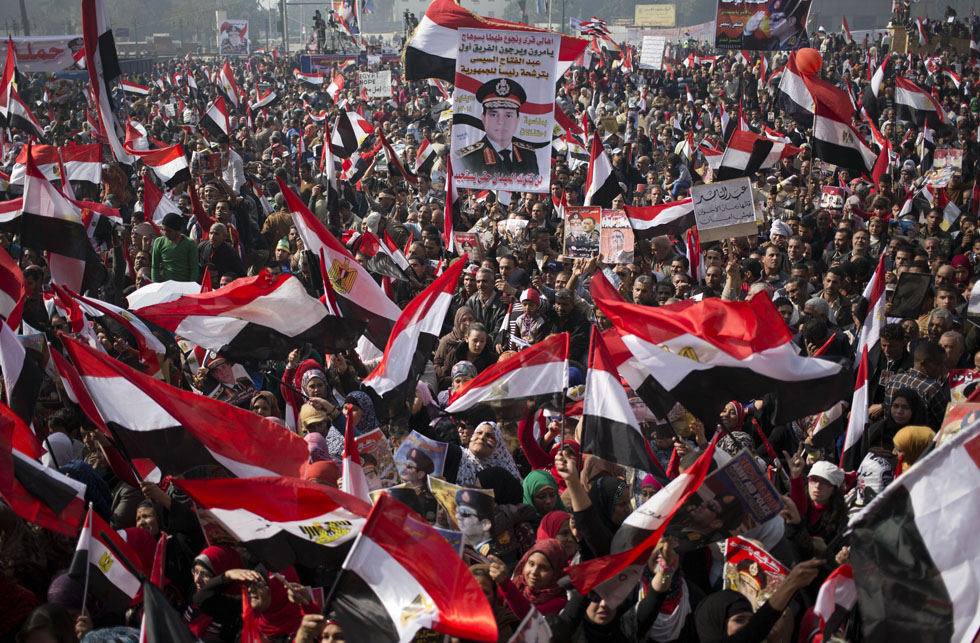
All segments of the Egyptian people realized that their paths had diverged from those of the terrorist organization, that the man in the Al-Ittihadiya Presidential Palace had to leave office, and that every day he remained in power meant greater losses for Egypt and the Arab world. Therefore, the Revolution of 30 June came, followed by the statement of 3 July at exactly nine o’clock in the evening, bringing to an end one of the most difficult years Egypt had experienced throughout its history. The rule of the Brotherhood came to an end, never to return.
Egypt was then followed by all the countries of the Arab world. Arab peoples rose up against the Brotherhood, and its project began to collapse throughout the Arab homeland. Its parliamentary representation declined in both Morocco and Tunisia, where it also lost ministerial positions and the office of prime minister. It likewise lost parliamentary seats in Algeria, Mauritania, and Libya. The organization fragmented in Somalia, Djibouti, and Algeria, while internal divisions intensified in Sudan. In the Arab East, its leaders were pursued in the United Arab Emirates, the Sultanate of Oman, Bahrain, Syria, and Jordan, while it came under even tighter restrictions in the Kingdom of Saudi Arabia. In many Arab countries, the Brotherhood was designated a terrorist organization, its assets were confiscated, and the institutions it had used to support its terrorist activities were closed.
Here, the most important question remains: Did the Revolution of 30 June put an end to the terrorist organization’s dream of ruling the Arab world and implementing its plans?
The answer is that the Revolution took many important steps, but it did not complete its mission in full. The road remains long before that mission is completed. Nor is this mission confined to work within Egypt alone; rather, it extends to all the countries of the Arab world and beyond. Solidarity and collective action remain the only way to put an end to the ambitions of the organization, ambitions that it will never abandon.


