


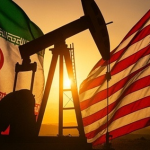


Academic and research centers have been concerned with China’s global expansion for many years and this has been seen by global political, diplomatic, and intelligence circles, particularly in the West, as a dire threat to their interests and the interests of their global partners and allies. The launch of the Belt and Road Initiative gave rise to similar concerns in the Middle East, with the project covering a large geographical area of the region. The long-term Sino-Iranian pact inked this week brings greater significance to this growing expansion and raises pressing questions on the future of the Middle East in view of the new and old geopolitical conflicts.
“A comprehensive roadmap that incorporates political and economic terms covering areas of commerce, economy, and transportation” – this is how Iranians described the yet unpublished agreement signed by the Iranian Minister of Foreign Affairs Mohammad Javad Zarif and his Chinese counterpart. However, a leaked draft of the agreement obtained by the New York Times revealed that the agreement extends beyond broad joint economic cooperation in oil, mining, manufacturing, port and railway construction, agriculture, tourism, banking, and investment to include military cooperation and intelligence sharing.
Iran’s negotiations with China started last summer but have been kept lid on and no single official document on negotiations have ever come to light. However, recent leaks reveal that the agreement, known as the “Comprehensive Strategic Partnership”, covers a $400 billion worth of Chinese investments across Iran over the next few years. In exchange for that, other resources disclosed, Iran will provide China with a steady supply of heavily discounted oil and will engage in the “Belt and Road Initiative” that connects China to Africa and Europe via the Middle East.
Essentially, the agreement, awaiting endorsement by the Iranian Parliament, will give the Islamic Republic the opportunity to ease the heavy burden of the sanctions imposed by the US after Trump’s administration launched its “maximum pressures” campaign following the US withdrawal from the Joint Comprehensive Plan of Action of 2015. This agreement will enable Iran to proceed its nuclear program and the enriching of uranium in case the 2015 agreement couldn’t be revived without additional terms form the US – which has been Iran’s long-standing position since the US withdrawal. Moreover, the agreement will offer Iran economic and military advantages enabling it to further its ambitious projects in the region.
The Path toward the agreement
Talks about the agreement started back in 2016 with the Chinese President, Xi Jinping, visiting Iran and proposing the project which President Hassan Rouhani approved and the idea wasn’t a hard sell to persuade the Iranian Supreme Leader, Ali Khamenei, of. For purely tactical reasons pertaining to the P5+1 agreement, Iran didn’t desire to publicly unveil the project until they reap the fruit of the agreement i.e. lifting the UN sanctions and restoration of trade and investment links with the West. Beyond the economic gains, Iran was aspiring that the nuclear agreement would beef up its political relations with these countries, particularly the US, which will positively affect its expansion projects in the region.
It has been five long years of negotiations before Iran got off the dime and conclusively signed the Agreement with China. Iran was pinning hopes on Biden winning the elections and Trump getting out of office, hoping that Biden will keep his campaign promises – lifting sanctions imposed by his predecessor and replacing the “maximum pressures” campaign. Iran was also hankering after continued complacency from Europe and more leniency from the Gulf, both will create a convivial atmosphere in the Middle East allowing it to freely exercise its regional influence.
Now, Iran’s publicly disclosing its long-term agreement with China and holding it as a major diplomatic achievement indicates that it plays down hopes on Biden’s unconditional return to the 2015 nuclear agreement. Also, Iran seems to see little window of opportunity for a radical change in the European position or the GCC countries retreating from their goal of thwarting Iran’s regional dominance. Thinking on its feet, Iran was quick to publicly announce its pact with China placing hopes on this strategic partnership with their “friend-in-need”, as Javad Zarif, Iranian Minister of Foreign Affairs put it.
What will China gain?
Looking at the projects China will be implementing in Iran, we find they are consistent with China’s ambitions of completing the Sothern-Western part of the “Belt and Road Initiative”, otherwise known as the “New Silk Road”, a project that China has been working on for years with the aim of further expanding to Africa and Europe through a land-maritime network. Jask ports, located along Iran’s Arabian Sea coastline and which China will be developing, are one of China’s main expansion hubs for their strategic location just outside of the Strait of Hormuz, one of the most important oil trading passageways in the World. And if we took into consideration the ports China had constructed on the maritime line between China and Africa including the Hambanthota Harbour in Sri Lanka and the Gwadar Port in Pakistan on the Indian Ocean, then it seems like the Jask ports will be the hotspot that links ports china built in Somalia, Djibouti and the Suez Canal, which are supposed to be China’s stepping stones to expansion in Africa.
Moreover, the telecommunications and transportation projects included in the agreement, including airports, high-speed railways, a 5G telecommunications network, a global positioning system (Beidou), and a satellite telecommunications network – which China will be constructing or expanding across Iran as part of what is called “China’s Great Firewall” – will be a stepping stone to link the “Belt and Road Initiative” with Southern Europe via Turkey and the Mediterranean. Although the details of the Sino-Iranian agreement haven’t yet been disclosed, the agreement seems to be along the lines of the memorandum of understanding signed between Beijing and Baghdad in 2019 during the reign of former Iraqi Prime Minister Adel Abdul-Mahdi, by virtue of which China was expected to undertake a series of complementary projects that share a common goal with those agreed upon with Iran, particularly the railway network, land route, and oil and gas pipelines on the Syrian coasts.
As regards petroleum, according to Refinitiv, a global provider of financial market data, China’s oil imports last year reached a record high of 17.8 million tons within 14 months, at a rate of 306.000 barrels a day, most of which have been smuggled due to the imposed US sanctions. The agreement will offer China a steady supply of discounted oil enabling it to expand its petroleum reverse and meet its immediate needs without being affected by the international market price fluctuations, a major advantage to the second largest global economy in the face of other major economies.
Looking at the military, security, and armament aspects, the leaked draft of the agreement reveals China’s intention to expand its military collaboration with Iran. According to Western intelligence information, the Chinese People’s Liberation Army fleet has visited Iran for at least three times since 2014, and it has conducted joint drills with the Iranian Navy in the Persian Gulf and the Arabian Sea, the most recent of which was the visit of the missile-carrying destroyer Shen Neng, which was engaged in Iranian-Russian naval drills in the Gulf of Oman. As far as the leaked version revealed, China will increase its arms exports and supplies to Iran and will support Iran’s various military industries, a direction that China has long moved in to following Iran Shah’s fall in 1079 and during the Iran-Iraq war between 1980 and 1988.
Security cooperation goes beyond that. Iran and China had started collaboration in intelligence sharing, particularly with regard to activities of the US Navy and air bases in the Gulf region. According to leaks, the agreement would give China the permission to dispatch up to 5,000 troops in Iran on the pretext of protecting its interests in Iran. Giving the military aspects of the agreement a once-over, it can be found out that China’s goal is to establish military and security bases to secure the petroleum supply lines that provide it with about 70% of its oil imports from the Gulf as well as its trade routes with Africa and the world.
What should we expect?
On the Iranian side, the agreement will remain pending subject to Iran’s Parliament approval after being questioned and debated within the constitutional framework or through the decision-making institutions. Despite the several advantages the agreement will seemingly present to Iran, it will undergo a strict assessment by members concerned with the Iran’s expansion in the region. The agreement however brings about one critical issue that is left unanswered, namely the extent to which Iran is ready to offer China advantages without that causing Iran to have less wiggle room to maneuver other sides whose relationship with Iran might be affected by the Sino-Iranian rapprochement. While the Iranians don’t usually put all eggs in one basket, Iran tries to give off the impression that the agreement represents a “geopolitical shift” in its interests at the expense of its opponents in the region and worldwide.
On the Chinese side, no hopes are pinned on China revealing details of the agreement given its customary secrecy policy let alone its willingness to avoid escalation with the US and some European countries that resist the Chinese expansion. Moreover, China has no desire to raise concerns of other countries involving in the Belt and Road Initiative who would fear that China’s agreement with Iran will come at their expense. China doesn’t want to go out on a limb given the fact that the Iranian oil only covers 3% of China’s daily consumption of oil with the rest coming from Saudi Arabia, Russia, Iraq, and Brazil. It should be noted that oil accounts for 20 percent of China’s total energy consumption, importing about 10.85 million barrels of oil per day.
The US response to the Sino-Iranian agreement came from the head of the State with President Joe Biden expressing worries over the agreement in a time his administration is trying to persuade Iran to give up what it has achieved in its nuclear program following the US withdrawal from the 2015 agreement in an effort to revive it. In fact, containment of the Chinese expansion is a top priority of the US foreign policy. As such, the Sino-Iranian agreement being a multi-dimensional challenge for the US administration is beyond question. While the military and the security aspects of the agreement represent a direct threat to the US interests in the Middle East, the Persian Gulf, the Indian Ocean, and the Eastern coasts of Africa, it will more critically weaken the bases of US strategy in one of its most important areas of influence in the world.
In the Arab world, no official response has been made as regards to the agreement. However, the media coverage revealed the deep concern of some regional countries particularly Gulf countries that believe such level of long-term Sino-Iran partnership would enhance Iran’s regional influence which happens to coincide/ with Iran’s efforts to develop its defensive weapons system and expand its relations with its agents in the region. More than that, the Arab countries fear that this increased Sino-Iranian collaboration may ultimately bring about structural changes in the entire regional security system, exposing the Arab world to more challenges and dangers.
A cause for concern?
Just is the case with any geopolitical shift, such broad cooperation between external actors is likely to have serious effects on the entire Arab region, particularly if Arab countries are standing by watching without appropriately addressing the challenge in alignment with changes in the global balance of power and the regional environment. The impacts of this Sino-Iranian agreement are expected to extend to affect oil economies as well as the geopolitical situation in the region, both require conducting a full-scale review of the visions and strategies of the Arab countries.
With regard to oil, which is the backbone of the Sino-Iranian agreement, the Arab countries need to carefully consider the anticipated radical changes in the global oil market conditions, the future of oil as a commodity, and strategies pursued by major importers such as China and India to deal with possible price increases, all of which will profoundly affect not only the financial resources of “oil producers” but the “oil-dependent” economies as well. Theoretically, oil prices are expected to go down for years, if not decades, with China getting a steady supply of discounted oil from Iran, a variable that would require Gulf countries to reconsider all their development plans.
As for the security impacts on the directly-concerned Arab countries and the region in general, Iran’s possible restoration of its economic and military power and its alliance with a potential superpower pose an enormous challenge to the Arab countries and place considerable pressures on them, the consequences of which wouldn’t be faced up to without a radical change in visions and strategies.
Given that, the Arab countries need, first and foremost, to reconsider their dialogue approach with China to bring gains commensurate with the 18 agreements signed by Arab countries with China within the Belt and Road Initiative so that Iran don’t get the lion’s share of gains at the expense of Arab countries and to help create a unified Arab position that sends a powerful message regarding the future of the Chinese project in Europe and Africa, which utilize the Arab region as a bridge and transit stations.
Second, there is a need for active and effective inter-Arab cooperation that goes beyond the typical joint Arab action to develop creative visions, plans, and strategies that give birth to a new regional system in conformity with the current developments and expected future challenges, arising from the agreement or the international conflicts it will provoke. Achieving this will be no cakewalk, though. It requires an extraordinary effort to create a new formula for the region in which all of its countries become active partners in making arrangements that go beyond those that have been boxed in for decades. The arrangements sought should take the Arab world to a wider context where the unified Arab interests go beyond the Chinese Belt and Road Initiative before the region becomes an albatross around its countries’ necks.