


By using ECSS site, you agree to the Privacy Policy and Terms of Use.
Accept
ECSS - Egyptian Center for Strategic StudiesECSS - Egyptian Center for Strategic Studies
  • Home
  • International Relations
    International Relations
    Show More
    Top News
    Another obstacle on the Grand Ethiopian Renaissance Dam?
    June 5, 2020
    Varied paths of reform in Africa
    March 22, 2019
    G20 Membership Justified: Africa and the Road to the G20
    June 14, 2020
    Latest News
    2025 Yearender: Flood fallout
    January 20, 2026
    A Strategic reorientation: A critical reading of the 2025 US National Security Strategy
    January 18, 2026
    A diplomatic maneuver: Israel’s recognition of Somaliland
    January 17, 2026
    2025 Yearender: China’s multipolar world
    January 15, 2026
  • Defense & Security
    Defense & Security
    Show More
    Top News
    A Multi-dimensional Affair: Women and Terrorism in Africa
    June 14, 2020
    On deradicalisation: Marc Sageman and the psychology of jihadists
    June 22, 2020
    Assessing Deterrent Measures and the Prospects of War: US Military Movement in the Gulf to Confront Iran
    June 22, 2020
    Latest News
    Israel-Iran War: Does Israel Stand Alone?
    June 18, 2025
    Navigating Security and Diplomacy: What Russia’s Delisting of the Taliban Means for Bilateral Ties
    May 17, 2025
    Lakurawa: Armed Bandit Violence in Nigeria
    May 12, 2025
    Europe amid US–Iran Escalation: Can It Play the Diplomat or Become Entangled in the Crisis?
    April 13, 2025
  • Public Policy
    Public Policy
    Show More
    Top News
    Sinai: A Strategy for Development amid Fighting Terrorism
    June 17, 2020
    Egypt’s Comprehensive Vision for Human Rights
    June 22, 2020
    The Right to Health in Egypt
    June 22, 2020
    Latest News
    Weaponization of Resources: The Role of Rare Earth Metals in the US-China Trade War
    May 25, 2025
    The Carbon Border Adjustment Mechanism: A Catalyst or a Challenge for Egypt’s Export Ambitions?
    May 15, 2025
    The Suez Canal amidst Global Competition (3): National Strides Outpacing Time
    April 29, 2025
    Gaza’s Changing Demographics: The Toll of War and Blockade
    March 9, 2025
  • Analysis
    • Opinion
    • Analysis
    • Situation Assessment
    • Readings
  • Activities
    • Conferences
    • ECSS Agenda
    • Panel Discussion
    • Seminar
    • Workshops
  • ECSS Shop
  • العربية
  • Defense & Security
  • International Relations
  • Public Policy
All Rights Reserved to ECSS © 2022,
Reading: Boosting Egypt’s Foreign Exchange through Tourism
Share
Notification Show More
Latest News
Book Review | The struggle for economic sovereignty: Who owns the instruments of power?
Readings
Displacement from Gaza: Deconstructing the idea, doctrine, and plan
Readings
The Egyptian Center for Strategic Studies participates in the 57th Cairo International Book Fair for the sixth year
Readings
2025 Yearender: Flood fallout
Iranian Studies Palestinian & Israeli Studies
A Strategic reorientation: A critical reading of the 2025 US National Security Strategy
Palestinian & Israeli Studies
Aa
ECSS - Egyptian Center for Strategic StudiesECSS - Egyptian Center for Strategic Studies
Aa
  • اللغة العربية
  • International Relations
  • Defense & Security
  • Special Edition
  • Public Policy
  • Analysis
  • Activities & Events
  • Home
  • اللغة العربية
  • Categories
    • International Relations
    • Defense & Security
    • Public Policy
    • Analysis
    • Special Edition
    • Activities & Events
    • Opinions Articles
  • Bookmarks
Follow US
  • Advertise
All Rights Reserved to ECSS © 2022, Powered by EgyptYo Business Services.
Economic & Energy Studies

Boosting Egypt’s Foreign Exchange through Tourism

Sally Ashour
Last updated: 2023/08/03 at 2:16 PM
Sally Ashour
Share
8 Min Read
SHARE

Contents
I. Egypt’s Tourism RevenueII- Outstanding International Experiences to Boost Tourism Revenues

Egypt is one of the most alluring tourist destinations in the world due to its illustrious past, distinctive culture, and breathtaking natural beauty. However, boosting tourism in Egypt is not a simple task, especially given the global impact of Covid-19 lockdowns on the tourism industry. 

Fitch Solutions, a leading provider of insights, data, and analytics, predicted that Egypt’s tourism industry would maintain its recent upswing. According to a Fitch report, the number of annual tourist arrivals increased by 117.5 percent in 2021, from 3.7 million in 2020 to 8 million in 2021. By exploiting the pent-up demand for travel following the Covid closures and the end of the peak of the Russian-Ukrainian crisis’ effects, the flow of tourist delegations continued to higher levels in 2023 than it was before the Covid-19 pandemic in 2019.

With 13.1 million visitors expected in 2023, compared to 11.7 million in 2022, Fitch projected an annual increase in the number of tourists visiting Egypt by 11.6 percent. This will be reflected in tourism revenues, which are projected to increase from $13 billion to approximately $14.4 billion over the same period.

Fitch’s future outlook also indicates that tourist arrivals to Egypt will continue to rise over the next five years, from 2023 to 2027, to reach 15.2 million, with an average annual growth rate of 5.4 percent during the forecast period. In line with the growth in arrivals, international tourism revenues will rise from $14.4 billion in 2023 to $17.4 billion in 2027, supported by higher consumer spending. The local currency’s low exchange rate helped to make hotels, restaurants, historical sites, and transportation more affordable for visitors from abroad, increasing the country’s appeal as a popular travel destination.

This article presents the most significant international experiences that can be used in Egypt to promote tourism while also providing an analysis of the incoming tourism movement to Egypt over the coming years.

I. Egypt’s Tourism Revenue

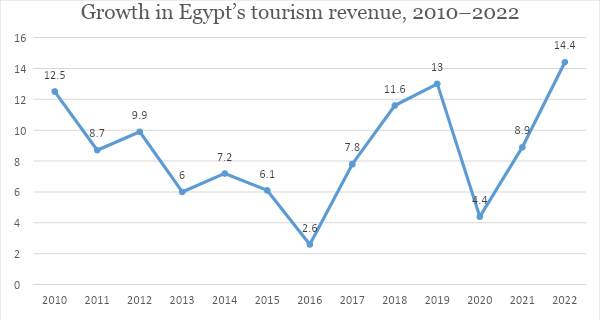
Tourism is one of the most significant sources of hard currency in Egypt, which also significantly boosts the country’s GDP, creates job opportunities, and provides the government with a significant portion of its annual foreign exchange earnings. According to official reports, Egypt’s tourism revenues surpassed $14.4 billion in 2022, reaching their highest level since 2010. Figure 1 depicts the growth of tourism revenues between 2010 and 2022.

Figure 1: Growth in Egypt’s tourism revenue, 2010–2022
Source: Central Bank of Egypt

The majority of visitors to Egypt come from Europe, specifically Russia, followed by Germany, the United Kingdom, France, and Italy. Egypt’s tourist attractions are spread across a number of areas, including Cairo, Luxor, Aswan, Giza, the Red Sea, Sinai, Fayoum, the New Valley, and Beheira.

According to Prime Minister Mostafa Madbouly’s statements, Egypt plans to increase annual tourism sector revenues from the current average of $14.4 billion to $30 billion over the next three years.

To that end, the Egyptian government is working to put a plan into action to revive tourism in the country and supports policies and programs to upgrade the country’s tourism-related infrastructure and promote it more effectively abroad. With the gradual easing of travel restrictions around the world, it is anticipated that Egypt’s tourism sector will resume growth.

II- Outstanding International Experiences to Boost Tourism Revenues

1. Digital Marketing: To attract more international tourists, countries tend to place emphasis on digital promotion, where international tourists can obtain the necessary information about the country and its tourist attractions, as well as book and plan their travels online. These websites must be user-friendly and contain accurate, trustworthy content.

2. Investing in the Training and Development of Tourism Staff: Employees in the tourism industry need to be trained on how to interact positively with foreign visitors and deliver excellent service. This can be accomplished by offering employees training programs in a variety of tourism-related skills, including foreign languages, effective communication, and hospitality.

3. Building up the Tourism Infrastructure: Investments should be allocated to modernize hotels, restaurants, transportation options, and tourist attractions in order to improve Egypt’s tourism infrastructure. To ensure that visitors have a pleasant stay, essentials like water, electricity, communications, and transportation must be made available.

4. Promoting Sustainable Tourism: Sustainable tourism in Egypt requires the preservation of the country’s natural and cultural attractions. This can be accomplished by putting into practice sustainable tourism practices, such as cutting back on the use of harmful materials for the environment, conserving wildlife, practicing sustainable agriculture, and improving waste management.

5. Creating Unique Tourist Itineraries: Egypt needs to develop its tourism industry by providing tourists with memorable experiences that set the country apart, such as riding on vintage trains, taking balloon rides, scuba diving in the Red Sea, and other activities. This can be accomplished by collaborating with local and international tourism partners to develop trip options for tourists.

6. Providing Investors with Financial Facilities: To encourage investors to invest in Egypt’s tourism industry, the necessary financial facilities, including guarantees, loans, and tax breaks, must be made available. In addition, financial incentives, such as discounts at hotels, restaurants, and attractions, can be offered to international tourists to encourage them to visit Egypt.

In conclusion, utilizing these global experiences will boost Egypt’s tourism industry and bring in more foreign visitors, strengthening the country’s economy. It is critical to emphasize that collaboration between the public sector, the private sector, and the local, national, and international communities is necessary to achieve these goals. If these measures are implemented effectively, Egypt will be among the countries with the quickest tourism industry recovery following the Covid-19 pandemic.

Related Posts

Weaponization of Resources: The Role of Rare Earth Metals in the US-China Trade War

The Carbon Border Adjustment Mechanism: A Catalyst or a Challenge for Egypt’s Export Ambitions?

The Political Fallout of Climate Change: The Case of Greenland

The Power behind the Shift: How Critical Minerals Fuel the Global Energy Transition

Sally Ashour August 3, 2023
Share this Article
Facebook Twitter Whatsapp Whatsapp LinkedIn Telegram Email Copy Link Print

Stay Connected

Facebook Like
Twitter Follow
Instagram Follow
Youtube Subscribe

Latest Articles

Prigozhin’s Death: What’s Next?
European Studies September 5, 2023
The Two-State Solution: Any New Game Changer?
Opinions Articles October 8, 2022
Significant Regression: Ennahda’s Trajectory in Tunisia after Ghannouchi’s Arrest
Arab & Regional Studies May 17, 2023
Playing the Pressure Card: The Ramifications of Boosting US-Taiwan Economic Relations for China
Economic & Energy Studies September 17, 2023

Latest Tweets

//

The Egyptian Center for Strategic Studies is an independent non-profit think tank providing decision-makers by Policy alternatives, the center was established in 2018 and comprises a group of experts and researchers from different generations and scientific disciplines.

International Relations

  • African Studies
  • American Studies
  • Arab & Regional Studies
  • Asian Studies
  • European Studies
  • Palestinian & Israeli Studies

Defence & Security

  • Armament
  • Cyber Security
  • Extremism
  • Terrorism & Armed Conflict

Public Policies

  • Development & Society
  • Economic & Energy Studies
  • Egypt & World Stats
  • Media Studies
  • Public Opinion
  • Women & Family Studies

Who we are

The Egyptian Center for Strategic Studies (ECSS) is an independent Egyptian think tank established in 2018. The Center adopts a national, scientific perspective in examining strategic issues and challenges at the local, regional, and international levels, particularly those related to Egypt’s national security and core national interests.

The Center’s output is geared toward addressing national priorities, offering anticipatory visions for policy and decision alternatives, and enhancing awareness of various transformations through diverse forms of scientific production and research activities.

All Rights Reserved to Egyptian Center for Strategic Studies - ECSS © 2023

Removed from reading list

Undo
Welcome Back!

Sign in to your account

Lost your password?