








Europe is hit by a dire crisis in energy supplies that is likely to get worse as winter looms. Gas prices and electricity bills keep soaring, threatening the recovery European economies are pursuing following the recession caused by the pandemic.
The crisis isn’t new. It dates back to the years when the continent relied primarily on imports to secure its energy needs in tandem with shifting briskly towards renewable energy sources without giving a second thought about energy storage sources nor hiking natural gas prices.
Europe’s Energy Sources
Energy generated from local sources accounts for only 39 percent of the gross energy available while imported energy accounts for 61 percent of the available energy. This makes the continent largely dependent on imported energy to secure its needs.
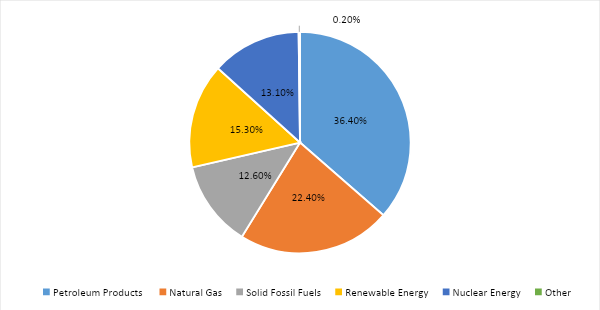
In 2019, petroleum products constituted the highest share of Europe’s energy sources with 36.4 percent, followed by natural gas with 22.4 percent, renewable energy with 15.3 percent, nuclear energy with about 13.1 percent, and solid fossil fuels (coal) with about 12.6 percent. Figure 1 shows the percentage of each energy source in Europe.
Figure 1: Energy sources in Europe, 2019
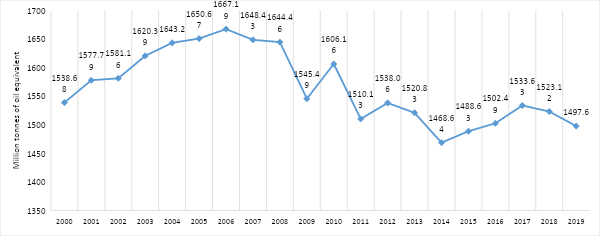
The diversity of energy sources available for the European Union (EU) countries reveals that the total energy available decreased in 2019 by about 1.7 percent on a year-on-year basis as is shown in figure 2.
Figure 2: Gross energy in Europe
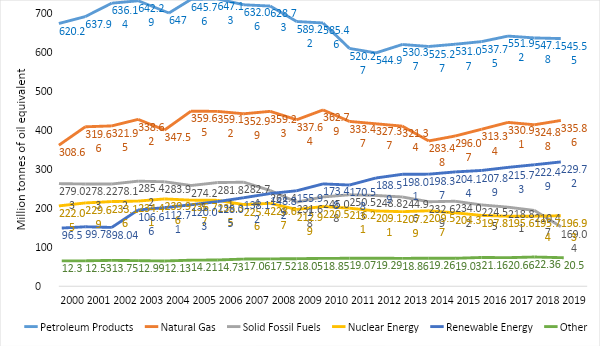
Crude oil and petroleum products ranked highest among the available energy sources in the EU despite the long-term downward trend. Likewise, natural gas remained the second largest source of energy in the EU countries whereas the share of renewable energy increased compared to nuclear energy and solid fossil fuels (coal) shares.
Figure 3: Gross energy in Europe by source
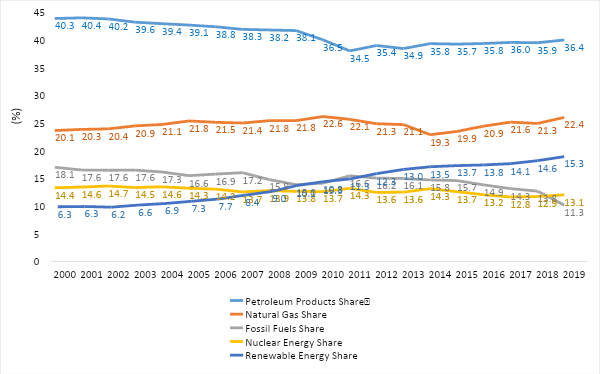
While petroleum products retained the first place among other energy resources, their share of the gross available energy decreased by 3.9 percent in the period from 2000 to 2019. Similarly, the share of energy generated from solid fossil fuels decreased by 6.8 percent while renewable energy share increased noticeably from 6.3 percent to 15.3 percent, an increase of about 9 percent during the review period, as is illustrated in figure 4.
Figure 4: Change in energy sources in the EU
Causes of Europe’s Energy Crisis
The energy crisis Europe is currently experiencing can be attributed to many internal and external factors, which can be summarized as follows:
1. Plummeting Gas Supplies
In the first quarter of 2021, Europe’s production and imports of natural gas suffered a considerable decline where production fell by 11 percent, i.e. 1.7 billion cubic meters, to reach 13.8 billion cubic meters, the second lowest quarterly production in a decade. Similarly, the EU net gas imports dropped by 3 percent, i.e. 2.5 billion cubic meters, reaching 78.5 billion cubic meters relative to 81 billion cubic meters for the same period of the previous year.
Germany topped the list of the EU largest importers of natural gas (22 billion cubic meters) in the first quarter of 2021, followed by Italy (17 billion cubic meters), France (10 billion cubic meters), Spain (8 billion cubic meters), and Belgium (6 billion cubic meters).
This drop in production and imports caused the continent’s natural gas reserves to go down by about 75 percent relative to the same period the previous year, to become the fastest decline since 2013.
2. Growing Demand for Natural Gas
As economies started to recover from repercussions of the pandemic and with businesses’ activities starting to return to normalcy, global demand for natural gas soared with the need for more gas supplies to boost production. According to statistics, global gas demand is expected to rise by 3.6 percent in 2021, up to 7 percent by 2024 against pre-Covid-19 levels (2019).
In the first quarter of 2021, the EU gas consumption grew by 7.6 percent on a year-to-year basis reaching 141.8 billion cubic meters compared to 131.7 billion cubic meters in Q1 2020 and 120.6 billion cubic meters in Q4 2020. Demand for gas for electricity generation increased by 3.4 percent on a year-to-year basis (an increase of 4.9 TWh).
3. Increasing Dependence on Russia
In the first quarter of 2021, Russian gas supplies accounted for about 45 percent of the EU net natural gas imports, up from 41 percent for the same period in 2020, followed by Norway and Algeria whose supplies accounted respectively for 23 and 12 percent of the EU exports.
Figure 5: Largest natural gas exporters to the EU
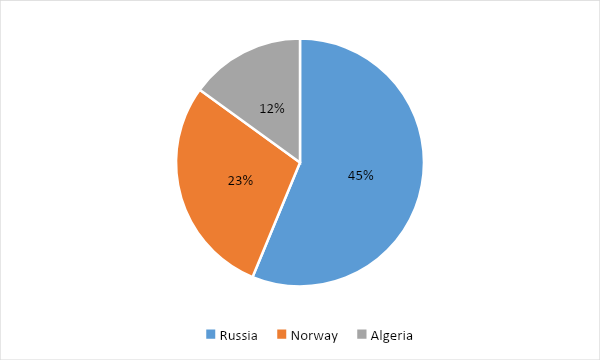
As indicated in Figure 5, only three countries fulfil 80 percent of Europe’s natural gas needs, which poses a considerable risk to the EU.
4. Low Wind Speed
Renewable energy generation in Europe hinges on wind energy. Currently, Europe has the largest floating wind power capacity in the world accounting for about 70 percent of the total capacity. Thus, wind energy accounts for a large share of Europe’s energy sources. When windmills stopped due to lack of strong wind, the entire electricity network was negatively affected. Added to that, a string of outages at power stations and a fire in the cable connecting the Britain’s and France’s power systems brought about a surge in power prices.
The Crisis Fallout
The repercussions of Europe’s energy crisis varied considerably from bringing about a surge in gas prices to carrying implications for fertilizer and food industries, as detailed below.
1. A Surge in Natural Gas Prices
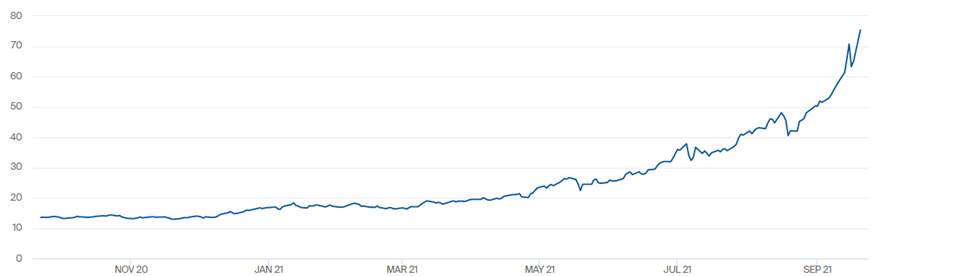
Given the growing demand for natural gas and the limited supply, gas prices have jumped by 250 percent since the beginning of 2021 and by about 70 percent since last August. Standard natural gas futures were traded at €71.5/megawatt hour at the Dutch TTF hub —a European benchmark for natural gas, as figure 6 demonstrates.
Figure 6: Natural gas (Euro per megawatt hour)
2. Rising Electricity Prices
Since the beginning of September, electricity prices have risen in Germany and France by about 36 and 48 percent respectively, to cost as near as €160 per megawatt-hour. In Britain, prices have reached £385 per megawatt-hour, up from £147 last month.
Energy spending represents about 10 percent of consumer spending in Europe. So, any rise in energy prices will have an impact on inflation rates, harming consumers and threatening the post-Covid economic recovery in Europe. Figure 7 shows the consumer price index for energy in the EU since the start of 2021.
Figure 7: Energy Consumer Price Index (points)
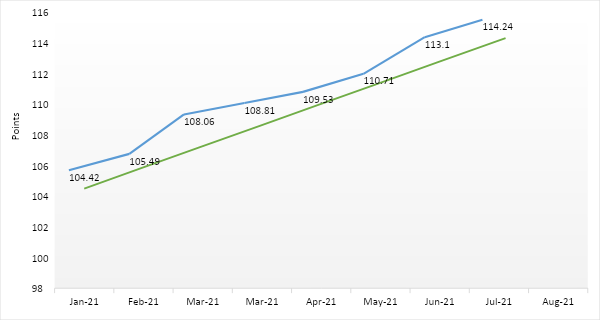
As figure 7 indicates, there has been an increase in the consumer price index for energy by 9.4 percent since the beginning 2021 until last August, with projections for continued increases until the end of 2021.
3. Disruption to the Food Industry
The energy crisis in Europe places intense pressures on the European food industry – particularly in the United Kingdom – due to the threats imposed on the fertilizer industry. The crisis forced many corporations to reduce production or close their factories including, for example, CF Industries Holdings. Given the negative repercussions of the crisis on the fertilizer industry, the production of carbon dioxide, which is a by-product of the ammonia production and is used in packaging to extend the shelf life, in dry ice production to preserve frozen products, and in chicken slaughtering, is likely to be negatively affected, meaning the crisis may directly affect European food security.
4. Interruption of Climate Change Mitigation Plans
Natural gas is the fundamental basis for mitigating climate change and making the shift to green energy. A study by IHS Markit Ltd shows that investment in gas infrastructure will be a catalyst in supporting the long-term decarbonization of the energy system. The study also revealed that using natural gas in old and less efficient power plants would reduce emissions by 50 percent per power unit
Given the growing role of natural gas in climate change mitigation plans, this surge in prices could thwart objectives of the EU’s Green Deal initiative aimed at achieving climate neutrality by 2050.
Overall, the repercussions of the natural gas crisis will not only impact Europe. It could further extend to Asia which rushed to purchase gas for fear of a surge in prices on a larger scale.