






In light of Israel’s evident stubbornness in facilitating the entry of aid to Palestinians, the completion date for the construction of the temporary pier off the Gazan coast—which was announced earlier this month by US President Joe Biden—is quickly approaching, which will allow humanitarian aid to be delivered to the residents of Gaza, who are currently suffering from famine. This raises questions regarding the true motivations of Biden in his decision to construct that pier.
What Is the US Floating Pier Project?
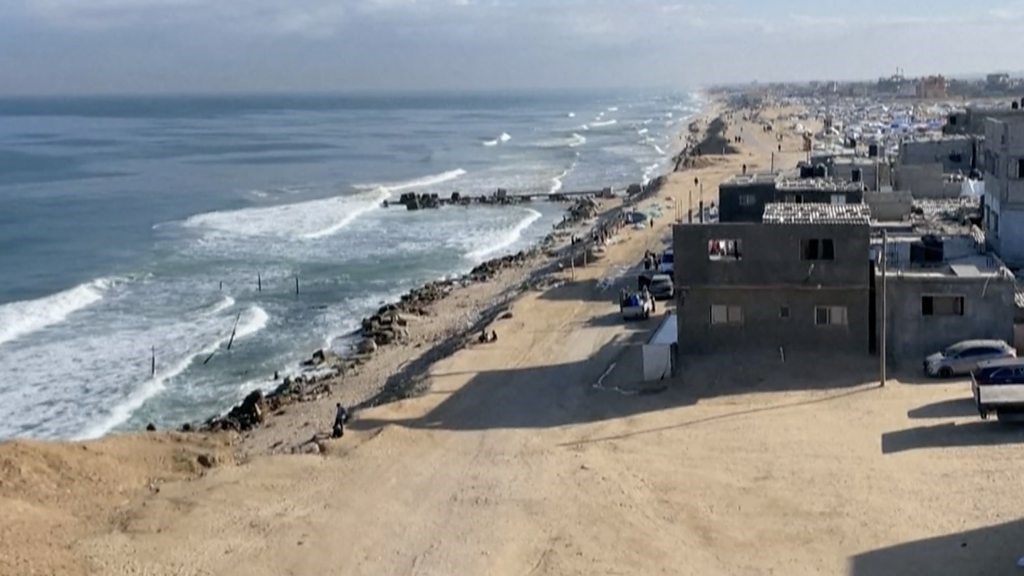
Amidst Israeli delays and hindrances in providing humanitarian aid to the Gaza Strip via land routes, the US President declared on March 8, during his State of the Union address, that he had directed the military to construct a temporary pier along the coast of Gaza to receive shipments of food, water, and medicine. The aid is expected to reach Cyprus first, where it will be examined and prepared for shipment. From there, commercial ships will presumably take it to a floating pier off the Gazan coast, and finally, smaller ships will take it to the sea corridor.
Furthermore, the United States has declared the deployment of approximately 1,000 soldiers and military officers in this area to ensure the security of the pier during its commencement of operations. Nevertheless, US officials made it clear that this endeavor does not encompass “the positioning of military personnel on ground.” The initial operational capacity of the pier will be 90 daily truckloads per day, which will subsequently increase to 150 truckloads.
Notably, British Foreign Secretary David Cameron declared that the United Kingdom and the United States would construct a maritime corridor to facilitate the delivery of humanitarian supplies to the Gaza Strip. Further, European Commission President Ursula von der Leyen has announced Europe’s intention to provide financial support for the Palestinians by establishing a maritime route connecting Cyprus, the United States, and the United Arab Emirates.
US Motives
The United States’ decision to construct Gaza’s floating pier is motivated by multiple goals, which can be outlined as follows:
I. Washington is perhaps seeking to accomplish a number of political objectives through the sea corridor, including bolstering its influence in the Mediterranean against Russian attempts at expansion in Syria and Libya and countering the growing influence of China in the region, given Washington’s growing apprehensions about China’s ambition to establish a foothold in ports overlooking the Mediterranean.
It is highly probable that Washington also seeks to secure a significant forthcoming trade corridor, which was unveiled at the G20 summit in India in September 2023. During this summit, representatives from the United States, Saudi Arabia, India, the Emirates, France, Germany, Italy, and the European Union all agreed to sign a memorandum of understanding concerning the establishment of a new economic corridor connecting India, the Middle East, and Europe. This initiative is meant to compete with the Chinese Belt and Road project.
II. The United States could potentially exploit humanitarian aid as a justification for deploying military forces in the region with the intention of encircling and containing Iranian influence. This is particularly evident given the United States’ acknowledgment of deploying soldiers to safeguard the pier. Furthermore, there are several reports suggesting the possibility of deploying British military personnel in the Gaza Strip.
British Foreign Minister David Cameron stated that the United Kingdom will collaborate with the United States to establish a maritime route for delivering aid directly to Gaza. This demonstrates the alignment of British interests with US moves in the region. This also underscores that the embedding of Specialist British military planning teams with the US operational HQ in Tampa—as well as in Cyprus—for several weeks would enhance Britain’s influence in Cyprus through its ownership of a military base in the region.
Notably, London has utilized the Akrotiri base to conduct various US and British military operations in the Middle East, targeting areas in Libya, Syria, and Iraq, as well as recent airstrikes against the Houthis. These actions have incited strong discontent among the Cypriot people, who object to the use of Nicosia as a staging area for such attacks, causing the Cyprus government to face widespread protests earlier this year.
III. This step holds strategic significance beyond its humanitarian implications, as it extends to provide opportunity for preparation for a combat operation that could potentially be decisive in the event of armed hostilities erupting in the Taiwan Strait. With this mission, the US fleet showcases its capacity to create sea bridges that overcome logistical barriers and improve the efficiency of American forces in confronting military challenges. This corridor is particularly significant as it is part of the Joint Logistics Over-the-Shore (JLOTS) system, which facilitates the unloading of humanitarian aid from ships. It is also regarded as a strategic choice that improves the Pentagon’s abilities and grants it increased adaptability in managing emergencies.
IV. Washington aims to actively participate in the interactions taking place in the Eastern Mediterranean region in order to safeguard the interests of its energy sector companies and its strategic allies in the region. Additionally, establishing a presence in the Mediterranean would assist the United States in managing potential conflicts that may arise between Turkey, Greece, and Cyprus. President Biden is keen on maintaining the current pace of pacification between these countries, particularly in light of the impending US elections.
Notably, some reports also suggested that the Yasser Arafat Airport would be operational and an artificial island would be constructed subsequent to the pier’s completion, in an effort to bypass the Houthi militias who are actively launching attacks in the Red Sea.
V. one of the primary motivations behind Washington’s establishment of this sea corridor is the pursuit of economic objectives, particularly the exploitation of natural gas reserves and the facilitation of international trade routes in the region. Additionally, some sources suggest that Washington is inclined to relax the siege on strategically significant Israeli ports, including Ashdod, Ashkelon, and the commercial port of Eilat, which have all been targeted by invasions and closures.
Multiple Implications
The Gaza floating pier project encompasses various connotations, including:
US Manipulation: Amidst Washington’s efforts to create a maritime route to enhance the amount of humanitarian assistance reaching the Gaza Strip, the US Congress approved a $26.4 billion aid package for Israel on April 20. Furthermore, on April 19, the United States exercised its veto power to oppose the Algerian proposal to grant full UN membership to Palestine. This action clearly showcases the United States’ backing of Tel Aviv in its conflict with the Gaza Strip. It also suggests that the United States’ stated reasons for establishing the sea corridor are merely a facade aimed at deceiving the international community and improving its reputation both globally and domestically, with the US interior being increasingly dissatisfied with Biden’s handling of the Gaza crisis, as evidenced by recent protests occurring in American universities. These protests explain Biden’s efforts to appease his dwindling local electoral base.
Direct US Involvement: The United States consistently safeguards the security and stability of Israel, as evidenced by its reaction to the recent Iranian assault on Tel Aviv. However, the presence of US Army personnel would perhaps bring Washington into direct conflict if Hamas targeted army forces, particularly if an attack occurred near the sea corridor.
Israeli Obstruction: Tel Aviv failed to adequately safeguard aid transfers. In February of last year, over 100 Palestinians were fatally injured, either by gunfire from Israeli forces who were protecting the aid convoy, as reported by Palestinian witnesses, or by being crushed in the midst of the crowd, as stated by the Israeli army. In addition, Israeli forces destroyed roads, bombed trucks and warehouses, and stopped sending police officers in the Strip to guard aid convoys after they were previously targeted by Israeli occupation forces. Hence, Tel Aviv is likely to obstruct the delivery of aid through the sea corridor, particularly in light of its announcement that aid will be delivered subject to security checks that adhere to Israeli standards. This implies that Tel Aviv will ultimately decide whether or not to allow any aid to enter.
Eliminating the Palestinian Cause: It is not inconceivable that Tel Aviv welcomed constructing the Gaza pier because it fits in with Israeli plans to forcibly relocate Palestinians and eliminate UNRWA, the organization tasked with providing aid, particularly after the independent committee tasked with investigating Israel’s allegations against UNRWA, acquitted the agency on April 22.
In short, Washington has undisclosed ulterior motives for creating the Gaza floating pier. If its true objective was to effectively tackle the humanitarian crisis in Gaza, it could have accomplished this by applying pressure on Israel to open land crossings, thereby eliminating the need for establishing a sea corridor, which will take a significant amount of funding and time to accomplish its stated goal, especially given that the estimated cost of the project to the United States is now $320 million.


