







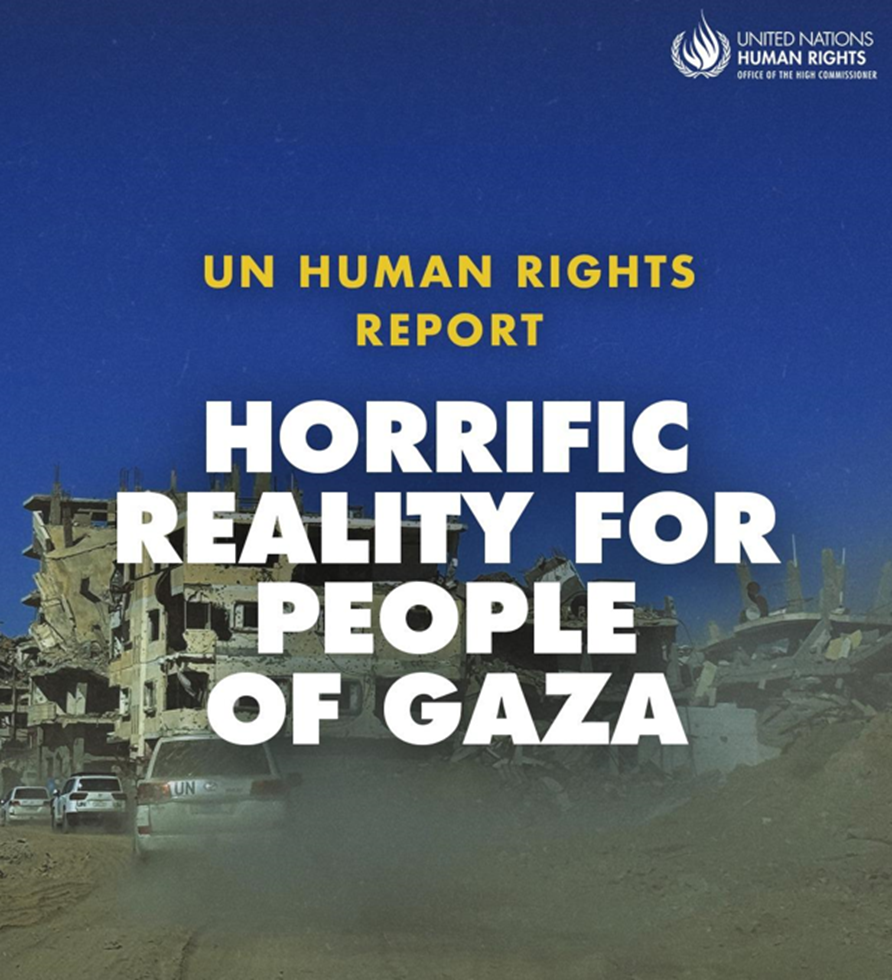
On November 8, the Office of the United Nations High Commissioner for Human Rights released its updated semi-annual report on the developments in Gaza since October 2023. The report underscored the urgency of achieving justice for grave violations of international law committed in the Gaza Strip. It highlighted that these crimes formed part of a widespread or systematic assault on civilians, qualifying as crimes against humanity, and included acts intended to destroy a national group in whole or in part, amounting to genocide.
The report called on Israel to fully and promptly fulfill its responsibilities under the International Court of Justice, considering its operations in northern Gaza, Tel Aviv’s legislation impacting UNRWA’s activities, the enduring human rights repercussions of Israel’s 57-year occupation of Palestinian territories, including the West Bank and East Jerusalem, and the 17-year-long suffocating blockade of the Gaza Strip.
Despite the findings highlighted in the report, Israeli forces persist in their bombardment under unconvincing pretexts, even as the majority of Gaza lies in ruins, rendered uninhabitable and dysfunctional.
The Israeli incursion into Gaza since October 7, 2023, stands as one of the most brutal and devastating wars, flagrantly violating international humanitarian law, showcasing the chilling application of human ingenuity in advancing tools of destruction, suffering, and devastation.
The report outlined the range of violations taking place in Gaza, both past and ongoing. Below are some of the crimes highlighted in the report:
- Killing of Civilians: As of September 2024, the OHCHR confirmed 8,119 deaths, including 2,036 women and 3,588 children. Children accounted for 40% of the fatalities, women 26%, and men 30%, with the majority being killed in residential areas, highlighting the absence of safe zones in Gaza.
- Unlawful Killings: The Israeli forces in Gaza carried out summary executions of civilians and targeted and killed healthcare workers within hospitals.
- Assaults on Humanitarian Personnel: The report cited data from the United Nations Office for the Coordination of Humanitarian Affairs (OCHA), revealing that at least 196 aid workers were killed in Gaza, along with civilian police officers, acts classified as war crimes.
- Use of White Phosphorus: The Israeli forces used white phosphorus in Gaza, notably in the Jabalia refugee camp, the largest in the region. White Phosphorus is an incendiary substance that inflicts severe injuries and immense suffering, often resulting in a slow and agonizing death, with lasting impacts on the affected Palestinian communities.
- Limitations on Humanitarian Aid Leading to Starvation: The Israeli-imposed restrictions on the entry of essential humanitarian aid have placed Gaza’s civilian population at risk of starvation due to the total blockade, including cutting off water supplies to northern Gaza. Additionally, Israeli attacks on the United Nations Relief and Works Agency (UNRWA), ranging from direct assaults on its personnel and infrastructure to legislative efforts to curtail its operations in Gaza and baseless accusations, further exacerbate the crisis.
- Attacks on Hospitals and Killing of Medical Personnel: The Israeli forces launched deliberate attacks on hospitals throughout Gaza, effectively dismantling its healthcare infrastructure and causing significant loss of life among medical staff, under the pretext that Hamas fighters were operating within certain hospitals.
- Communication Blackouts: The blockade on Gaza, coupled with frequent power outages and Israeli attacks on communication facilities, constitutes a violation of international humanitarian law, specifically regarding the targeting of civilian infrastructure. These disruptions severely impede the ability to document and report serious violations of international law promptly.
- Mass Displacement: The events in Gaza mark the largest mass displacement in its history, as the occupation forces demanded the evacuation of southern Gaza, compelling 1.7 million people—approximately 75% of the Strip’s population—to seek refuge in Rafah.
- Attacks on Cultural and Educational Sites: The Israeli forces have destroyed a significant number of educational facilities, including 412 schools and universities as of April 2024. These attacks were accompanied by widespread damage to infrastructure and the demolition of mosques across Gaza.
- Incitement to Commit Human Rights Violations and Abuses, and Atrocity Crimes: Israeli officials have propagated incitement and retaliatory rhetoric, justifying civilian casualties in Gaza as collateral damage and asserting that the end of the conflict is contingent upon Gaza’s entire destruction and the exodus of the Palestinian people.
- In January 2024, the International Court of Justice, in the South Africa v. Israel case, emphasized Israel’s obligation to implement precautionary measures to prevent and punish direct incitement to genocide against individuals in the Gaza Strip. The OHCHR expressed grave concern over Israel’s failure to meet these obligations.
- The report noted that Palestinian armed groups fired indiscriminate projectiles into Israel, causing civilian casualties, an act prohibited under international humanitarian law. It also highlighted the ongoing detention of 133 Israeli hostages in Gaza, a breach of the Geneva Conventions, and urged their immediate release.
The report concluded that not all reported violations were covered, highlighting the scale of the crisis. It condemned the deliberate disregard for international humanitarian law by both the Israeli occupation forces and Palestinian armed groups, actions that have driven the current unprecedented levels of human suffering. Furthermore, it emphasized that many documented cases constitute war crimes, crimes against humanity, and acts of genocide.
Key Recommendations from the OHCHR Report on Gaza’s Humanitarian Crisis
1. Recommendations for Parties to the Conflict
- Implementing an immediate ceasefire.
- Repressing and punishing all violations of international law, including international humanitarian law.
- Israel should prioritize the realization of the human rights of Palestinians, including their rights to self-determination, equality and non-discrimination
- Hamas should immediately and unconditionally release all hostages in a safe and secure way and ensure that hostages and all persons deprived of their liberty are treated with humanity.
2. Recommendations for UN Members
- Abiding by international law and assessing arms sales or transfers and provision of military, logistical or financial support to a party to the conflict
- Supporting the work of the International Criminal Court in relation to the Occupied Palestinian Territory to achieve fair trials.
- Supporting the protection of Palestinians wherever they are, securing an immediate ceasefire, and enabling provision of humanitarian assistance
In light of the findings outlined in the report, it is evident that the OHCHR’s report serves as undeniable evidence of Israeli aggression against the Gaza Strip and the blatant violation of international laws, particularly international humanitarian law. The report meticulously documents the violations committed during the reporting period from October 2023 to April 2024, although the atrocities perpetrated by the Israeli forces after this period are even more severe, aggressive, and inhumane. These violations could also be presented as compelling evidence before the International Court of Justice, aligning with the report of the Prosecutor of the International Criminal Court submitted to the First Chamber of the Permanent International Criminal Court.
The OHCHR report emphasized two key principles that must be upheld, namely the principle of distinction and the principle of proportionality. The principle of distinction is a fundamental element of international humanitarian law, designed to protect civilians from the consequences of armed conflict. This principle requires a clear differentiation between civilians and combatants, as well as between civilian objects and military targets, as outlined in Article 48 of Additional Protocol I. A crucial aspect of this principle is the prohibition on direct attacks against civilians, along with indiscriminate attacks that affect both military objectives and civilians or civilian infrastructure without distinction.
The principle of proportionality dictates that an attack should not be launched if it is expected to result in excessive civilian casualties or harm. In this context, every action taken by Israel is inherently prohibited. Proportionality becomes relevant only when attacks are directed at legitimate military targets, which, in the case of Israeli forces, has not been observed in any of their attacks.
Regarding the use of white phosphorus in attacks by the Israeli forces, the International Court of Justice has affirmed that the prohibition of weapons causing unnecessary suffering and severe harm is a fundamental principle of international humanitarian law. This principle was blatantly violated in the Israeli actions in the Gaza Strip. Israel stands as a prime example of flagrant disregard for international laws and conventions. What is happening in Gaza constitutes a direct violation of international legitimacy, under the general principles of international law, the specific provisions of international humanitarian law, and international human rights law— all of which have been violated by Israel.
The report also casts a critical light on the United States, Israel’s foremost ally, placing it in a precarious position before global public opinion due to its role in the Gaza war and its comprehensive support for Israel. This stance is expected to have profound implications for the Middle East peace process, potentially obstructing any constructive efforts in this direction.
In conclusion, the OHCHR’s primary focus remains on safeguarding human rights by thoroughly investigating Israeli violations of international humanitarian and human rights laws. Humanitarian considerations always outweigh military necessity. Human rights law is applicable at all times, whether in times of peace or during conflict, ensuring that an individual’s rights remain unaffected by the fluctuating realities of war and peace. The ultimate purpose of these laws is to safeguard every individual, everywhere, and at all times, regardless of their circumstances.


