



With the rise in population in Egypt – currently one of the most populated countries in North Africa and the Arab world – and in line with Egypt’s Vision 2030, launched in 2016, the government has changed policy design, implementation, and scope of national social security and food provision programs with the ultimate objective of eliminating hunger.
While government efforts panned out as has been evidenced by the improvement in the real gross domestic product (GDP) and the moderately good economic growth rates, Egypt still has a number of long-term development challenges to overcome including poverty, food security, malnutrition, socio-spatial inequalities, as well as climate shocks. According to the Global Hunger Index (GHI) of 2020, Egypt has a level of hunger that is moderate with a number of challenges lying ahead, most notable of which is the ability to afford food costs and ensure food quality and security where half of Egypt’s basic food supplies coming from global markets.
First: Critical dimensions of food security in Egypt
The agricultural sector in Egypt is affected by several challenges to which agrarian reform policies are propelled to achieve the desired development. These challenges include:
Supply: Food production is dependent on several different factors, including availability of quality and safe raw materials, intermediate goods (packaging and labelling supplies), modern (local or imported) machinery, and ease of access to these items. As a fact, food manufacturing in Egypt is highly dependent on imported intermediate goods. According to the Egyptian Chamber of Food Industries (ECFI), food imports accounted for 24 percent ($16.8 billion) of Egypt’s imports totaling $71.3 billion.
The lack of local intermediate goods is the reason why Egypt relies on imported ones. Although Egypt has recently made some progress producing quality intermediate goods, agricultural development is still hampered by the poor agricultural practices, low quality and limited availability of intermediate goods, lack of adequate agricultural guidance, poor harvesting practices, absence of quality assurance and control systems, limited skills, and inadequate infrastructure facilities.
Demand: There is a permanent demand from consumers and businesses; however, there is also a need to ease exports of agricultural and manufactured food products. In 2020, Egypt’s food products accounted for 14 percent ($1.8 billion) of total export value, taking the third place among Egypt’s non-petroleum exports.
According to the data for the first quarter of 2020, Egypt’s exports of fresh agricultural crops dropped slightly by 8-10 percent in the first quarter of 2020, relative to the same period in 2019. Similarly, Egypt’s exports of processed food products has dropped by five percent over the first five months of 2020. However, it have seen a positive growth of 2.2 percent by the end of the first half of 2020.
Despite the recent efforts made by the competent authorities with the aim of improving food safety and increasing Egypt’s agricultural exports, there are still some bottlenecks related to quality and safety considerations that poses a challenge standing in the way of increasing Egypt’s agricultural and food exports to some markets. However, these efforts paid off with Gulf countries lifting the imposed restrictions on the Egyptian exports.
Employment: The lack of adequately skilled workforce is a major challenge facing agricultural producers and manufacturers which is negatively impacting productivity and competitiveness of the entire food chain.
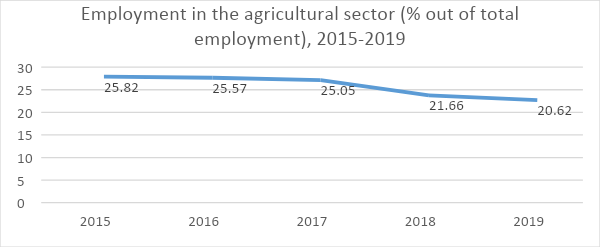
The following figure shows the change in employment in the agricultural sector relative to total employment.
Figure 1: Employment in the agricultural sector (% out of total employment), 2015-2019
Source: The World Bank
The previous figure reveals a decline in employment in the agricultural sector relative to total employment during the same period, dropping from 25.82 percent in 2015 to 20.62 percent in 2019, evidently affecting the efficiency and productivity of the agriculture sector, which in turn will negatively affect the economic return.
Low investment in the agricultural sector
Despite the realized increase in the share of investments in the agricultural sector relative to total investments, this share is still minimal compared to total investments in Egypt which makes low investment one of major problems facing agricultural development in Egypt.
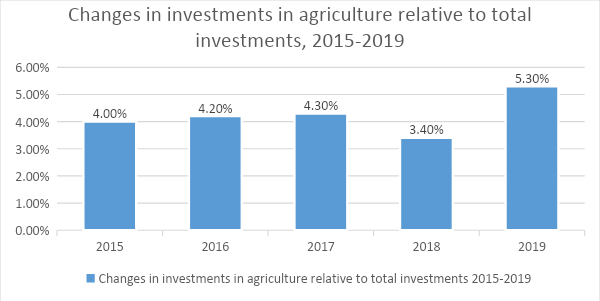
The figure below illustrates changes in investments in agriculture against total investments:
Figure 2: Changes in investments in agriculture relative to total investments, 2015-2019
Source: The Central Bank of Egypt (CBE)
According to CBE data, investments in the agricultural sector increased to $2797 million in 2019, compared to $1391 million in 2018. Moreover, the share on investments in the agricultural sector of overall investments increased from 3.4 percent in 2018 reaching 5.3 percent in 2019, which is still a relatively low percentage of overall investments, nonetheless.
Water resources
Development in the agricultural sector isn’t possible without sufficient water resources. Thus, water resource limitations and using rudimentary irrigation systems would hamper agricultural development, which is why the Egyptian Ministry of Water Resources and Irrigation is saving no effort to meet the water needs of the agricultural sector.
Second: Cultivated areas and food production
A high level of food security can be achieved with more local agricultural production and less dependence on imported agricultural inputs. The scale of agricultural production is dependent on the total cultivated area. The below tables show the total cultivated area and the agricultural production in Egypt in 2015-2018.
Table 1: Total cultivated lands in Egypt, 2015-2018

Source: Central Agency for Public Mobilization and Statistics (CAPMAS)
According to the 2020 statistical yearbook issued by the CAPMAS, Egypt’s area of cultivated land decreased from 9.09 million acres in 2015 to 8.68 million acres in 2018.
Table 2: Total agricultural production, 2015-2018

Source: CAPMAS
The previous table shows there has been a decline in the production of summer products falling to 43,137 tons in 2018 compared to 45,507 tons in 2015 whereas the production of winter products has seen an increase to 78,163 tons in 2018 compared to 77,351 tons in 2015.
Third: The food gap and self-sufficiency
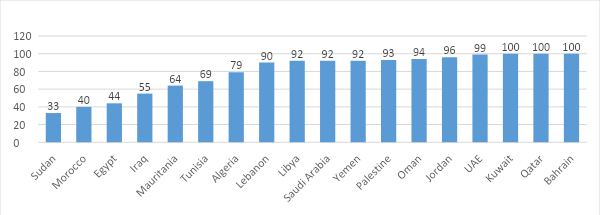
The food gap is defined as the difference between the local production of food commodities and consumption. To fill such a gap, countries resort to importing food commodities to meet consumer demand. Egypt is a big importer of grains; however, looking at the Arab region, we find Egypt’s dependence on imported grains is not heavy compared to other Arab countries with 44 percent of grain needs imported. The below figure illustrates Grain import dependency in some of the Arab countries in 2017
Figure 3: Grain import dependency in selected Arab countries in 2017
Source: UN Food and Agriculture Organization
During COVID-19 pandemic, Egypt managed to support domestic markets by providing food supplies that meet consumer needs particularly of wheat. In the same context, the CBE has been engaged in a EGP 100 billion initiative aimed at revitalizing fishing, poultry and livestock industries contributing to supporting domestic food market.
Regarding Egypt’s self-sufficiency of basic crops such as wheat, rice, maize, fresh fruits and vegetables, citrus, and potatoes, the following table illustrates self-sufficiency rates for selected commodities over the period from 2015 to 2018.
Table No. (3): Self-sufficiency in selected basic crops, 2015-2018

Source: CAPMAS
The previous table reveals there has been a drop in Egypt’s self-sufficiency rates of some basic crops and a rise in others. For instance, Egypt achieved full self-sufficiency in fruits, vegetables, citrus, and potatoes in the period 2015-2018, while its self-sufficiency in wheat, rice, and maize decreased during the same period.
Egypt, realizing the importance of food security in boosting its ability to implement socio-economic development plans, has endeavored to take all the necessary measures to increase food stock and achieve food security, particularly given the growing increase in population and the exacerbation of food insecurity. Despite these efforts, a number of challenges are still to be faced requiring additional efforts to upgrade the agricultural sector. These challenges include providing skilled labor, stimulating investment in the sector, and training farmers on modern irrigation methods to prevent the waste of water, among others.


