




Abstract:
United Nations documents and official correspondence between Egypt and the United States highlighted the effective role played by Egyptian policy and diplomacy in establishing the Egyptian vision for the recovery of Egyptian, and indeed Arab, territories from Israel. Egyptian policy was not detached from military operations; rather, the tripartite coordination among the political leadership, the President’s National Security Adviser, and the Egyptian Foreign Ministry constituted a triangle of success in achieving Egypt’s objectives in the October 6, 1973 War and transforming military victories on the ground into political gains linked to territorial sovereignty. From the first day of the war, Egypt relied on international coordination and mobilization that contributed to isolating Israel both Arab and African levels, while also securing UN resolutions that served as an international reference point for the Arab-Israeli conflict. This was evident even before the October War, as follows:
- Refuting the Israeli narrative and returning to the pre-June 5, 1967 borders: Egyptian diplomatic efforts, in cooperation with the Arab group before and after June 1967, succeeded in securing UN Resolutions 233, 234, and 235 calling for a ceasefire, followed by Resolution 237, which explicitly recognized Israel as an “occupying power” and required it to protect civilians in accordance with the Geneva Conventions.
- Establishing Resolution 242 as an international reference for peace to this day: The session was convened following a communication addressed by Egypt, and established the principle that “the inadmissibility of the acquisition of territory by war” must be upheld, alongside Israeli withdrawal and the termination of the state of war. The resolution subsequently became the principal reference for a political settlement.
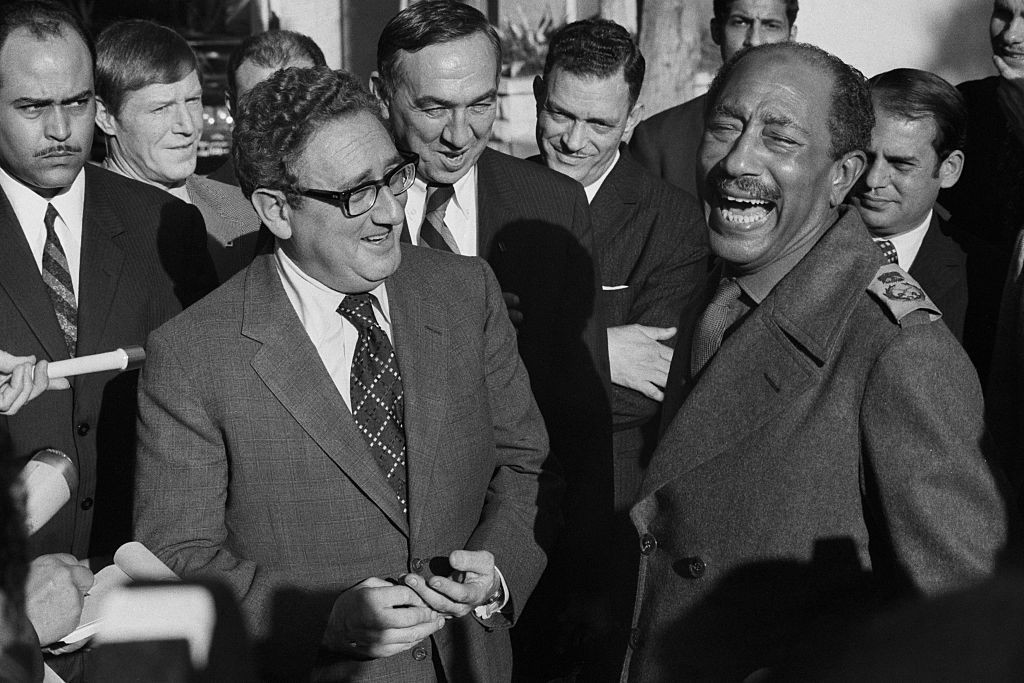
- Diplomatic moves as part of the strategic deception plan and the concealment of zero hour: This included the preliminary acceptance of the Rogers Plan, to project an image of readiness for peace, while capitalizing on the knowledge of the differences between Nixon and Rogers, which Nixon prevented from being completed. This was complemented by the meeting between Egyptian Foreign Minister Ismail Fahmy and his US counterpart Henry Kissinger one day before zero hour, and the coordination to hold another meeting in November, which reinforced the conviction of US and Israeli intelligence services that there was no imminent intention to resort to a military option.
- The diplomatic fronts of the October War:
- The first Egyptian step following the outbreak of the October War was to establish contact between President Sadat and the United States to clarify the objectives of the war, expose Israeli provocations, and declare Egypt’s readiness for “peace.”
- Isolating Israel internationally: This was reflected in several African countries severing relations with Tel Aviv, issuing condemnations of attacks against civilians, and supporting Egypt’s positions regarding the terms of the ceasefire and the deployment of international emergency forces.
- Playing an active role in securing the adoption of Resolution 338 calling for the cessation of military operations, a return to the October 22 lines, and the convening of peace negotiations for a just and comprehensive peace in accordance with Resolution 242.
- Egyptian demands to address Israeli violations and Israel’s targeting of the cities of Suez resulted in the adoption of Resolutions 339, 340, and 341, which led to the establishment of the United Nations Emergency Force (UNEF), with Egypt firmly emphasizing that the presence of these forces would be within the framework of its full territorial sovereignty and exclusively on its national territory.
- Consolidating the situation on the ground and ensuring the delivery of supplies: This was a condition for agreeing to hold the Kilometer 101 talks. The Six-Point Initiative was subsequently formulated and signed on November 11, followed by the adoption of Resolution 344 in December 1973, which paved the way for a positive engagement with the Geneva Peace Conference and transformed the conflict from a state of “crisis management” into a “comprehensive settlement process.”
- Preventing a return to a state of “no peace, no war”: Under the First Disengagement Agreement, signed on January 18, 1974, Israel withdrew from the western bank of the canal and retreated eastward, while buffer security zones were established under UN supervision. Before the signing of the Second Disengagement Agreement, Egypt maneuvered at the Security Council by withholding its approval for the renewal of the international forces’ mandate in order to prevent Israel from exploiting the existing situation. In response to the guarantees conveyed by the Security Council to President Sadat, Egypt agreed, paving the way for the signing of the Second Disengagement Agreement (September 1975).
- The efforts of the political leadership, together with its diplomatic and military wings, continued toward the frameworks of the 1978 Camp David Accords and then the 1979 peace treaty, which achieved the Egyptian state’s strategic objective of Israel’s complete withdrawal to the internationally recognized borders and the restoration of Egypt’s full sovereignty over Sinai.
Introduction:
Egyptian diplomacy played a pivotal role, no less important than military operations, during the October 1973 War. Through complementary roles and joint plans under the leadership of President Anwar Sadat, it succeeded in mobilizing international support, politically isolating Israel, and securing a legitimate cover for the offensive aimed at recovering the occupied territories. This was evident in the UN initiatives undertaken in the period leading up to the outbreak of the war and in coordination with neighboring countries, extending through the disengagement process, in an effort to prevent Israel’s ambitions of expanding into Arab territories. How was this achieved?
Diplomacy and the War of Attrition:
Before the Israeli attack on Arab territories on June 5, 1967, diplomatic efforts were underway in the halls of the United Nations to underscore Israeli intentions and expose the Israeli narrative, amid Israel’s expansionist objectives and continued clashes, whether inside Palestine or through expansion into neighboring territories and the use of a policy of creating faits accomplis. This was accompanied by acts of violence and claims of seeking a peaceful solution, in an effort to portray the June attack as an act of self-defense, exploiting the assertion that “the Arabs would throw Israel into the sea,” while the Zionist lobby promoted this narrative, as well as the claim that the attack on Bahr El-Baqar School was justified on the grounds that the school had been a weapons depot. Egyptian diplomacy was therefore actively engaged in refuting these narratives, securing UN resolutions, and changing the Western perception of the conflict, as follows:
- On May 29, 1967: Before the Israeli aggression against Arab territories, Egypt submitted a complaint to the Security Council, warning of Israel’s aggressive policy, which threatened peace and security in the Middle East and endangered international peace and security. This was followed by a letter dated May 29, 1967, from the Permanent Representative of the United Kingdom to the President of the Security Council, followed by several meetings and an invitation to representatives of the Arab states to participate, without voting rights, until Israel launched its aggression on June 5 of the same year to expand the occupied territories.
- On June 6, 1967: Egyptian diplomatic efforts to expose the Israeli narrative contributed to the adoption of Resolution 233 (1967), following an oral briefing to the Security Council. The Council expressed its concern over the outbreak of fighting and the dangerous situation in the Middle East and called upon the governments concerned to take immediate initial steps toward a ceasefire and the cessation of all military activities in the region, while keeping the Council informed of developments. This was followed by Resolution 234 (1967) of June 7, 1967, which noted the continuation of hostilities despite the Security Council’s resolution and called for a ceasefire at 8:00 p.m. on June 7, while keeping the Council informed of the situation. The governments of Israel and Syria accepted the ceasefire pursuant to Resolution 235 (1967), dated June 9, 1967, and the Security Council called for the immediate cessation of hostilities.
- These efforts resulted in the recognition of Israel as an “occupying power” under Resolution 237, adopted on June 14, 1967, which emphasized the need to protect civilians and ensure the return of displaced persons to their cities, while referring to the Geneva Convention and the obligation of governments to protect prisoners of war.
- On November 22, 1967: Resolution 242 (1967) was adopted, becoming the resolution relied upon to this day in diplomatic efforts and international political solutions. Egypt played a major role in its adoption, as it was issued following a communication from the “United Arab Republic.” Egypt, Israel, and Jordan were invited to participate, without voting rights, in the discussion of the agenda item entitled “The Situation in the Middle East,” pursuant to the communication submitted by Egypt on November 7. The resolution addressed “the inadmissibility of the acquisition of territory by war, and the need to work for a just and lasting peace under which every State in the area can live in security, while reaffirming that all Member States, by accepting the Charter of the United Nations, have undertaken to act in accordance with Article 2 of the Charter and fulfill its principles, which require the establishment of a just and lasting peace in the Middle East,” which should include the application of the following two principles:
(1) “Withdrawal of Israeli armed forces from territories occupied by Israel in the recent conflict;
(2) Termination of all claims or states of belligerency, and respect for and acknowledgment of the sovereignty, territorial integrity, and political independence of every State in the area and their right to live in peace within secure and recognized boundaries, free from threats or acts of force;
(3) Guaranteeing freedom of navigation through international waterways in the area, and achieving a just settlement of the refugee problem, while guaranteeing the inviolability of the territory and political independence of every State in the area through measures including the establishment of demilitarized zones.
In November 1967, and pursuant to this resolution, the Secretary-General requested the appointment of a Special Representative to travel to the Middle East to establish and maintain contacts with the States concerned, in order to promote agreement and assist efforts to achieve a peaceful and accepted settlement in accordance with the provisions and principles of this resolution.
The Strategic Deception Plan and Exposing Israeli Intentions:
Egyptian diplomacy was one of the tools used to shape the external image as part of the strategic deception plan for the October War, whether by exposing Israel’s intentions and lack of desire for peace internationally or by concealing the zero hour and creating the impression that Egypt was not yet prepared for war. This was evident in the following:
- On June 29, 1973: The Egyptian government continued to exert pressure in the halls of the United Nations, undertaking diplomatic and political efforts before the war and refuting all Israeli claims regarding the reasons for going to war. These efforts coincided with an initiative by US Secretary of State William Rogers to lead secret talks between Egypt and Tel Aviv, provided that Israel’s prior agreement was obtained to discuss peace without returning to the 1967 borders. Egypt’s agreement to the initiative came in light of its prior knowledge of the disputes and rivalry between Rogers — who refused to leave his post until August of the same year — and President Nixon and Kissinger. Consequently, the initiative was unlikely to produce any progress, given Nixon’s desire not to grant his Secretary of State Rogers any advantages and his decision to await the talks that had begun with Russia concerning the Middle East. Thus, the preliminary Egyptian approval was intended to create the impression that the process was moving toward peace rather than war.
- In August 1973: There were Israeli aerial skirmishes in the surrounding territories amid the state of no peace and no war prevailing in the region, including Lebanon. Several resolutions were adopted during that year condemning Israeli actions in the Middle East, including Resolution 337 (1973), which was adopted in August of the same year following a request by the Lebanese government for Israel to cease its hostile actions. Israel was condemned for violating Lebanon’s sovereignty and territorial integrity after its air force forcibly diverted and seized a Lebanese passenger aircraft chartered by Iraqi Airways from Lebanese airspace. The incident was deemed an act of aggression violating the 1949 Armistice Agreement between the two countries — as well as the armistice agreements concluded with Egypt, Jordan, Lebanon, and Syria — and the 1967 ceasefire resolution.
- From August 13 to September 30, 1973: Egypt engaged with the United States in “step-by-step” negotiations toward a peaceful settlement, despite Egypt’s awareness of the lack of seriousness on the part of the West in reaching an actual solution, as was stated during Kissinger’s meeting with Israeli Ambassador Simcha Dinitz, The United States also took advantage of the proximity between its ambassador to Iran, Ardeshir Zahedi, and then Presidential National Security Adviser Hafez Ismail, to lead mediation efforts aimed at reaching a “peaceful settlement,” while Egypt remained fully convinced that Israel was pursuing a policy of procrastination with US support. Egypt’s participation therefore sought to prevent the United States from achieving its hidden objective of isolating President Sadat, as well as to portray the Arab side as adopting an intransigent position amid the domestic pressure faced by the United States from oil companies, such as Mobil and Standard Oil.
- On October 5, 1973: Egyptian Foreign Minister Mohamed Zayyat and his US counterpart, Henry Kissinger, met on the sidelines of the US Secretary of State’s meetings during his participation in the UN General Assembly. According to an account published by The New York Times, the meeting addressed the situation in the Middle East, and an agreement was reached to hold another meeting the following November, which would also bring Kissinger together with his Israeli counterpart at the time, Abba Eban. The meeting also reaffirmed that there was no intention of presenting a specific peace plan for the region, with the United States preferring to use its influence to initiate dialogue between the Arabs and Israel.
This was the meeting that contributed to what Kissinger later stated during his meeting with State Department staff: that the United States had not prevented Israel from launching preemptive strikes, amid the US and Israeli intelligence services’ conviction that it was impossible for the Arabs to wage war against Israel until the morning of October 6, 1973,
This was despite President Sadat’s statement in May of the same year, during an interview with journalist Arnaud de Borchgrave of Newsweek, that “the time has come for the shock.” At the same time, President Sadat’s diplomatic moves and his statements concerning Soviet pressure toward peace led the Americans to believe that Egypt’s military movements and the movement of its aircraft were merely part of routine training exercises. Sadat reinforced this impression in his speech on Labor Day, stating that there was Soviet pressure to reach a “peaceful solution,” thereby suggesting that the US and Soviet positions were aligned in seeking peace amid the lack of progress at the UN. The speech led them to believe that President Sadat was awaiting a UN decision at the end of May of the same year in order to reach an outcome that would facilitate discussion of peace.
Diplomacy from the War to the Disengagement of Forces
The first step was Egyptian, through Egypt’s wartime actions and diplomatic moves. President Sadat capitalized on the initial moves by establishing contact with the US side to clarify the Egyptian vision and conditions in an initial letter to Kissinger. Just as Egypt was managing the battle militarily, an equally critical battle was being waged on the political and diplomatic fronts amid international efforts to halt Israel’s actions and ambitions in the region. Egyptian diplomatic moves compelled the international powers to become directly involved in finding fundamental solutions to the conflict rather than pursuing a policy of crisis management, as follows:
- From October 6 to 9, 1973: (The First Step) While the war was underway, President Sadat opened a diplomatic and political channel with the United States, explaining the reasons for the clashes and stating that they had come after the Israeli air attack on Syria on September 13, prior to the outbreak of the war. He explained that the war had been launched as a preemptive step against surprise Israeli strikes and in response to Israel’s continued provocations, emphasizing that Egypt had no intention of pursuing expansion. This was intended to establish an Egyptian political vision alongside the military victories being achieved on the ground, while clarifying Egypt’s conditions, which centered on withdrawal from the occupied territories in exchange for participation in a peace conference.
As the Egyptian army made advances on the battlefield, alongside the gains achieved on the Golan at the beginning of the war, Egyptian diplomacy was able to impose its conditions for achieving peace. This was reflected in a letter from US Secretary of State Henry Kissinger to his Egyptian counterpart, Mohamed Zayyat, and National Security Adviser Hafez Ismail, in which he inquired about Egypt’s conditions for accepting a peace agreement and whether Israeli withdrawal to the pre-June 5, 1967 borders was a condition for participating in peace talks, particularly following President Sadat’s remarks to the Iranian ambassador in Cairo that Egypt still wanted “peace.” Kissinger sought to present the United States as a mediator for peace in the region, amid the heavy losses Israel had suffered on the third day of the war. Through Kissinger, the United States agreed to provide covert support to Israel by delivering weapons aboard aircraft disguised so as not to bear the Israeli “El Al” insignia, following its acknowledgment of the heavy losses Israel had sustained, thereby ensuring the United States could maintain its claim of being “neutral.”
- From October 8 to 12, 1973: The Security Council did not adopt any resolutions during this period; proceedings were limited to briefings before the Council. Three Security Council meetings were held, during which the Egyptian and Syrian sides focused on Israeli attacks against civilians in separate raids, while Israel focused on asserting that it had not initiated the attack. This came against the backdrop of prior coordination with the United States not to take the first step in the war, despite the skirmishes and provocations employed by Israel, and amid what Israeli leaders referred to as “brainwashing the Americans by Israel” concerning the superiority of Israeli weapons over those of the Arabs. This was reflected in communications between the US State Department and Israeli leaders from October 6 to 10 concerning efforts to “delay the Security Council decision” on a ceasefire in order to enable Israel to regain control of the territories that Egypt had recovered during the October 6 war, as well as to take advantage of the situation to reduce Soviet influence in the region, despite the joint coordination between Russia and the United States on the need to end the war. Russia believed that the Arabs would inevitably be defeated, while the US Secretary of State sought to maintain the status quo in order to protect US and Israeli interests by weakening the image of the Soviet Union, conveying that those who relied on it would inevitably lose, and restoring the prewar borders as initial gains that had been secured for Israel.
- Despite the US-Israeli biases, Egyptian diplomatic moves at the Arab and African levels, as well as coordination with the United States, led the latter to declare its neutrality, in light of its objective of avoiding the loss of Arab countries and reducing Russian influence in the region. These efforts contributed to imposing a state of isolation on Israel. The meetings witnessed Arab and African condemnations of Israel, and a number of countries severed diplomatic relations with Israel. The African Union also reaffirmed its condemnation of Israel through the representative of Nigeria, who stated that this was the situation he had previously warned against as a result of the policy of procrastination and the attack adopted by the major powers, which had prevented the achievement of peace following the Israeli attack of June 5, 1967.
- On October 21, 1973: The Security Council convened at the invitation of the Soviet Union and the United States to adopt a ceasefire resolution and undertake joint efforts to reach an agreement. During the session, Britain emphasized that the 17-day war had demonstrated the impossibility of reaching a solution in the Middle East through military means, as continued military operations had failed to produce a definitive outcome. Accordingly, the UN Security Council adopted Resolution 338 (1973), which became a reference for subsequent resolutions concerning the conflict alongside Resolution 242 (1976), as the two resolutions were adopted following two wars with the Israeli entity. Resolution 338 was issued on October 22, 1973, and halted all military operations 12 hours after its adoption, while calling for negotiations aimed at establishing a just and comprehensive peace in the Middle East. The resolution was issued at the request of the United States.
- On October 24, 1973: Egyptian Foreign Minister Mohamed Zayyat requested that the Security Council convene an emergency session to expose Israeli violations and confirm that Israel had exploited the ceasefire by using laser-guided missiles and American Phantom aircraft against areas east and west of the Canal, storming Adabia Port, launching an intensive attack on the city of Suez, and preventing UN observers from reaching the October 22 lines. Israeli Defense Minister Moshe Dayan asked them to wait until the Israeli battle had been resolved and new lines had been demarcated. He also confirmed that President Sadat had been in contact with his American and Russian counterparts to urge them to fulfill their role, given that they were the sponsors of the agreement, while reaffirming the Egyptian people’s position that they would rather die than accept betrayal and aggression. Political coordination contributed to Arab countries, including Sudan, accusing Israel and the Security Council of supporting Zionism and violating international charters.
- From October 23 to 26, 1973: Several Security Council resolutions were adopted to halt military operations and establish a ceasefire, and to return the forces to the positions they had occupied when the ceasefire entered into effect. The Secretary-General called for the immediate dispatch of international observers to monitor compliance with the ceasefire between Egypt and Israel, using UN personnel already present in the region. The resolution was approved by 14 members, while China abstained. Resolution 340 was subsequently adopted as a result of continued violations and the failure to enable the observers to deploy on both sides of the ceasefire line. The resolution renewed the call for the return of the forces to their positions as of October 22, 1973, and provided for the establishment of a UN Emergency Force (UNEF) under the Security Council, composed of personnel from Member States other than the five permanent members of the Council. It was approved by all States except China, which abstained. Urgent measures were also adopted, with an appeal for cooperation with the International Committee of the Red Cross. Resolution 341 established an initial six-month mandate for the Emergency Force, subject to extension, and adopted a mechanism for implementing Resolution 340.
- From October 20 to 23, 1973: Exchanges of correspondence between President Sadat and his US counterpart, Nixon, as well as between the two countries’ foreign ministers, resulted in the formulation of Egyptian conditions for accepting a ceasefire, together with a proposal to convene a peace conference for a comprehensive settlement and the provision of guarantees by the United States and the Soviet Union to ensure the ceasefire, as a condition for Egypt’s acceptance. This came amid US assurances that it was coordinating with Russia to submit a joint draft resolution to the Security Council. President Sadat also warned Nixon against any violations of the ceasefire, stating that such violations would affect its continuation and that Washington would bear full responsibility for any Israeli violations. This prompted Nixon to instruct Kissinger to immediately demand that the Israeli government fully comply with Security Council Resolution 338.
- October 27, 1973: The Egyptian political and diplomatic position emerged during this session in comments on Resolution 340 (1973), through coordination with the members of the Security Council. The Security Council convened at Egypt’s request following Israel’s exploitation of the October 22 ceasefire agreement to achieve regional gains, using the ceasefire resolution to shell Suez and reinforce its forces, while continuing its attacks and exploiting the situation to isolate the Third Field Army by preventing the delivery of supplies and launching attacks on civilians in Suez, who confronted the Israeli forces with the support of the army. This prompted the Soviets to hold the United States responsible for implementing the agreement in coordination with Prime Minister Golda Meir. Delegations, including those of Yugoslavia, Sudan, and India, also cited written and official statements issued by Egypt’s representative, Ambassador Ahmed Esmat Abdel Meguid, referring to “Egypt’s acceptance of the international forces within the framework of its full territorial sovereignty and solely on its national territory, without interference in its sovereignty.”
- Over October 27–28, 1973 (Kilometer 101 Talks): Egypt hosted US- and UN-sponsored talks at Kilometer 101 on the Cairo-Suez road, led by Field Marshal Abdel-Ghani El-Gamasy. President Sadat agreed to hold the talks on the condition that Israel provide supplies to the Third Army under the supervision of the United Nations and the International Red Cross. Kissinger presented the Egyptian condition, which the Israeli side accepted. The talks were subsequently held as a prelude to reaching the First Disengagement Agreement. They were attended by Ensio Siilasvuo, Commander of the UN Emergency Force operating in Sinai, alongside coordination between the Egyptian and US foreign ministers regarding Kissinger’s planned visit to Cairo at the time.
- Field Marshal El-Gamasy explained in his memoirs that the objective of the meeting was to consolidate the ceasefire by establishing a buffer zone for the deployment of international emergency forces, implementing Security Council Resolutions 338 and 339, and returning to the October 22, 1973 lines. Discussions continued until the US Secretary of State arrived in Cairo on November 6 and the Six-Point Agreement was reached at the initiative of the United States. The agreement included provisions for returning to the October 22 lines, exchanging prisoners and facilitating the delivery of supplies between the parties, and placing checkpoints on the Suez road under UN supervision. It was signed on November 11. In parallel, the Geneva Peace Conference was convened, culminating in the signing of the Disengagement Agreement on January 18, 1974, with the exchange of implementation documents taking place on January 24, 1974.
- From October 27 to November 2, 1973: The Security Council convened to discuss the situation in the Middle East and the presence of international emergency forces, and called for withdrawal to the lines preceding October 22, 1973, the date of the ceasefire agreement. The United States and the Soviet Union agreed on the draft resolution. Kenya severed diplomatic relations with Israel in protest against Israeli aggression against Arab territories, while China maintained that the presence of international emergency forces would legitimize international intervention in the region. This reflected Chinese sympathy for the Arab cause, as expressed in a conversation between the US Secretary of State and the Chinese ambassador in Washington following the outbreak of the war.
- The commander of the international emergency forces delivered a statement on coordination with the Israeli army to return to the stipulated lines and coordinate with the emergency forces, with no response from the Israeli government by the time the session was convened. The session also witnessed Israeli claims and accusations against the Security Council for failing to adopt an immediate resolution, asserting that the Council’s first meeting had been held on October 8 without adopting a resolution condemning the Egyptian and Syrian forces that had launched attacks against Israel. This had been the result of US-Israeli coordination, as previously noted.
- Egyptian diplomacy, alongside political coordination, succeeded in imposing international isolation on Israel. During the session, Egypt’s representative to the United Nations, Ambassador Ahmed Esmat Abdel Meguid, responded not only by refuting these allegations, but also by reminding Israel of the international isolation it had come to face as numerous African countries severed diplomatic relations with it. He also referred to the violations committed by Israel against civilians and the destruction of several Egyptian villages, including Fayed, Kibrit, and Serapeum, the detention of 600 civilians, and the continued cutting off of water supplies to the city of Suez. He affirmed that the leadership of the international emergency force had been informed of these violations. This was also confirmed by the Saudi representative at the meeting, who referred to the international bias in favor of Israel and the violations committed by Israel, including those against Palestinian prisoners.
- On December 15, 1973: Resolution 344 was adopted, calling on the parties to adopt a positive attitude at the peace conference being held in Geneva in order to reach an agreement under US sponsorship. The permanent members abstained from voting, namely France, the United States, and Russia, while China rejected the agreement and declined to participate, accusing the United States and the Soviet Union of seeking to extinguish the flame of struggle in the Arab world and return to a state of no peace and no war. The draft resolution was submitted by the ten non-permanent members, who rejected the bilateral understandings of the major powers. Britain maintained that it would wait until an agreement was reached between the Soviets and the Americans.
- On January 18, 1974, the First Disengagement Agreement was signed: It was signed by Field Marshal Mohamed Abdel-Ghani El-Gamasy, Chief of Staff of the Egyptian Armed Forces; David Elazar, Chief of Staff of the Israeli Armed Forces; and UN representative and commander of the United Nations Emergency Force, Ensio Siilasvuo. Through cooperation with the United Nations, Egypt succeeded in signing an agreement with Israel on the disengagement of forces within the framework of the Geneva Peace Conference. The agreement was also known as the Sinai Disengagement of Forces Agreement, later referred to as Sinai I. It resulted in the establishment of a separation zone between the forces. Under its provisions, Israel withdrew its forces from the areas west of the Suez Canal that it had controlled since the October 1973 ceasefire, and also withdrew several kilometers along the Sinai front east of the Canal. Three approximately parallel security zones were established, each about six miles wide, serving as Egyptian, UN, and Israeli buffer zones. The Second United Nations Emergency Force (UNEF II), established pursuant to UN Security Council Resolution 340, assumed responsibility for the international presence.
- On April 8, 1974: Security Council Resolution 346 (1974) was adopted at the Council’s 1765th meeting to extend the presence of the international emergency forces for another six months, until October 24, 1974. The mandate was subsequently extended again at the Council’s 1799th meeting pursuant to Resolutions 362 and 363 (1974). The resolution was adopted on the grounds that the situation in the Middle East would remain unstable and that the “disengagement of forces” agreement between the Egyptian and Israeli forces was merely a first step toward resolving the problem. The presence of the forces was considered necessary to maintain calm and support efforts to achieve a just and lasting peace. The resolution was approved by the members, with China abstaining.
- On July 21, 1975: The Security Council held its 1832nd meeting to urge President Sadat to accept an extension of the emergency forces’ mandate. Egypt rejected the proposal and submitted a letter from Foreign Minister Ismail Fahmy expressing its reservations about the request for an extension, as Israel was using the presence of these forces as a pretext to prolong its presence on Egyptian territory. The Council therefore sent a letter to President Sadat urging him to accept the extension, while providing guarantees and preventing any deadlock in the peace talks. This letter paved the way for President Sadat’s acceptance. The members approved the resolution, with Iraq and China abstaining, on the grounds that the presence of these forces would pave the way for a return to a state of no peace and no war.
- On September 4, 1975: This letter contributed to reaching the Second Disengagement Agreement, which defined a buffer zone in accordance with the map attached to the agreement, with the aim of preventing threats or the use of military force between the two parties, as a step toward the signing of a peace agreement at the Geneva Conference rather than as a final agreement. It established an annual renewal period for the presence of the international emergency forces, introduced UN aerial surveillance and early-warning functions, and addressed the movement of civilian personnel and non-military trucks between the two parties and through the Suez Canal. It also assigned American civilian personnel to resolve technical problems.
- On October 23, 1975: The UN understandings, the letter addressed to President Sadat, and the Second Disengagement Agreement contributed to Egypt submitting a letter accepting the extension of the emergency forces at the Security Council’s 1851st meeting, extending their mandate for a full year instead of the previous short-term periods. This was accompanied by an emphasis on Egypt’s sovereign rights and the need to pursue comprehensive peace and reconvene the Geneva Peace Conference with the participation of all parties, while renewing the forces’ mandate in accordance with the Second Disengagement Agreement, following the provision of UN guarantees to monitor and prevent any Israeli violations.
- Egyptian political efforts continued in coordination with the United States to emphasize complete withdrawal from Egyptian and Arab territories. On September 17, 1978 (the Camp David Accords were reached): The accords addressed the withdrawal of Israeli forces from their positions in the West Bank and Gaza, as well as arrangements for a five-year transitional period with Jordanian participation, with peace with Jordan to be established three years after implementation of the agreement. They also provided for the restoration of economic relations, specified the presence of UN forces in the area, and defined the deployment of forces on both sides of the border. Regarding the temporary withdrawal, “between three months and nine months after the signing of the peace treaty, all Israeli forces shall withdraw east of the line extending from a point east of El Arish to Ras Mohammed, with the exact location of this line to be determined by mutual agreement.”
- In March 1979, the Peace Treaty between Egypt and Israel was signed: It ended Israel’s full presence and established the borders in accordance with those delineated before the Mandate, with Israeli forces returning to the borders of Mandatory Palestine. It also established a framework for determining freedom of movement in Sinai, while affirming that the maps and the Camp David Accords constituted an integral part of the peace process.
Conclusion: UN and international documents demonstrated that Egyptian diplomacy was not merely a tool for following events, but rather a strategic driver capable of managing the conflict effectively — from deception before the war, through the skillful use of the balance between the two superpowers during the fighting, to the use of UN mechanisms to safeguard national sovereignty and fully recover the territory.
References:
Resolution No. 233 (1967) / [adopted by the Security Council at its 1348th meeting], of 6 June 1967 UN. Security Council (22nd year: 1967), Digital Library Un, Available at: https://digitallibrary.un.org/record/90711?ln=ar&v=pdf
Resolution No. 233, Resolution 233 (1967) / [adopted by the Security Council at its 1350th meeting], on 7 June 1967. UN. Security Council (22nd year: 1967), United Nations Digital Library, Available at: https://digitallibrary.un.org/record/90712?ln=ar&v=pdf
Resolution 237 (1967) / [adopted by the Security Council at its 1361st meeting], of 14 June 1967, United Nations Digital Library, Available at: https://digitallibrary.un.org/record/90715?ln=ar&v=pdf
Resolution 242 (1967) / [adopted by the Security Council at its 1382nd meeting], of 22 November 1967, United Nations Digital Library, Available at: https://digitallibrary.un.org/record/90717?ln=ar&v=pdf
Representatives, Mediators, Teams, Coordinators, and Good Offices, United Nations Digital Library, Available At: https://main.un.org/securitycouncil/ar/content/repertoire/representatives-mediators-coordinators-and-good-offices
Chapter V. Subsidiary organs established by or in pursuance of Security Council resolutions, UN Doc., Available at: https://main.un.org/securitycouncil/sites/default/files/ar/sc/repertoire/66-68/66-68_05.pdf#page=4
Next Steps on the Middle East, US National Security Agency Documents, Document No. 4, available at: https://nsarchive2.gwu.edu/NSAEBB/NSAEBB98/octwar-04.pdf – https://nsarchive2.gwu.edu/NSAEBB/NSAEBB98/#II
Resolution 337 (1973) / [adopted by the Security Council at its [1740th meeting], of 15 August 1973, United Nations Library, available at: https://digitallibrary.un.org/record/93465?ln=en&v=pdf
Document No. 5, Israeli-American Talks on the Middle East, National Security Agency Documents, available at: https://nsarchive2.gwu.edu/NSAEBB/NSAEBB98/octwar-05.pdf
Document No. 6, Talks with Zahedi, National Security Agency Documents, available at: https://nsarchive2.gwu.edu/NSAEBB/NSAEBB98/octwar-06.pdf Kissinger Calls on Latin American Leaders to Join in ‘New Dialogue’, New York Times, October 6, 1973, accessed August 21, 2026, available at: https://www.nytimes.com/1973/10/06/archives/kissinger-calls-on-latins-to-join-in-new-dialogue.html
Document No. 63 of the U.S. State Department Meetings, The October War and U.S. Policy, U.S. National Security Archive, published October 7, 2003, available at: https://nsarchive2.gwu.edu/NSAEBB/NSAEBB98/octwar-63.pdf
https://nsarchive2.gwu.edu/NSAEBB/NSAEBB98/#VI
Indications of Arab Inclination to Sign Attacks, U.S. National Security Documents, available at: https://nsarchive2.gwu.edu/NSAEBB/NSAEBB98/octwar-01.pdf
Al-Gamasy’s Memoirs: The October War 1973, p. 346, archived copy available at: https://archive.org/details/mozakrat_algmasi/page/n349/mode/2up
Document No. 20: A letter from Kissinger to Egyptian Foreign Minister Al-Zayyat, dated October 8, 1973, enclosed with a letter to Mr. Hafez Ismail from Dr. Kissinger,” dated October 8, 1973, US National Security Agency documents, available at: https://nsarchive2.gwu.edu/NSAEBB/NSAEBB98/octwar-20.pdf
Document 21, Kissinger’s Conversations with the Israeli Ambassador in Washington, US National Security Documents, available at: https://nsarchive2.gwu.edu/NSAEBB/NSAEBB98/octwar-21b.pdf
Documents Nos. (13, 15, 16), US National Security Agency Documents, available at: https://nsarchive2.gwu.edu/NSAEBB/NSAEBB98/#II
Document No. 18: Dinitz-Kissinger Memorandum, US National Security Agency Documents, available at: https://nsarchive2.gwu.edu/NSAEBB/NSAEBB98/#II
https://nsarchive2.gwu.edu/NSAEBB/NSAEBB98/octwar-18.pdf
Security Council Sessions (1743-1746), United Nations Archives, available at: https://docs.un.org/en/S/PV.1744(OR) – https://docs.un.org/en/S/PV.1743(OR)
https://docs.un.org/en/S/PV.1745(OR) – https://docs.un.org/en/S/PV.1746(OR)
Security Council Meeting No. 1747, United Nations Archives, available at: https://docs.un.org/en/S/PV.1747(OR)
Resolution 338 (1973) / [adopted by the Security Council at its 1747th meeting], of 22 October 1973 opcit.
Security Council Resolutions 1749, United Nations Archives, available at: https://docs.un.org/en/S/PV.1749(OR)
Security Council Resolutions 239, 340, and 341, United Nations Library, available at: https://docs.un.org/en/S/RES/341(1973)
Security Council Resolutions 399, 340, and 341, United Nations Library. Resolution 339 (1973) / [adopted by the Security Council at its 1748th meeting], of 23 October 1973, United Nations Library, available at: https://digitallibrary.un.org/record/93467?ln=en&v=pdf
https://docs.un.org/en/S/RES/341(1973)
Official correspondence between the Ministries of Foreign Affairs of the two countries and Presidents Sadat and Nixon SECRET/SENSITIVE (XGDS), US National Security Agency Archives, available at: https://nsarchive2.gwu.edu/NSAEBB/NSAEBB98/octwar-44.pdf
Security Council Meeting 1751, requested by Egypt, UN Archives, available at: https://docs.un.org/en/S/PV.1751(OR)
Security Council Meeting 1752, 27 October, UN Archives, available at: https://docs.un.org/en/S/PV.1752(OR)
Document 85, Foreign Ministry Cable No. 212588 to all diplomatic missions, “The Egyptian-Israeli Ceasefire Situation,” and Document No. 86, Egyptian National Security Agency Documents, available at: https://nsarchive2.gwu.edu/NSAEBB/NSAEBB98/octwar-85.pdf
https://nsarchive2.gwu.edu/NSAEBB/NSAEBB98/#II
Memoirs of Field Marshal Gamasy on the October War of 1973, pp. 457–473, available at: https://archive.org/details/mozakrat_algmasi/page/n459/mode/2up
1754th Meeting of the United Nations Security Council, held in New York on 2 November 1973, United Nations Library, available at:
Document 17: Memorandum between Kissinger and Ambassador Huang Chen, Liaison Office of the People’s Republic of China, 6 October 1973, U.S. National Security Agency, available at: https://nsarchive2.gwu.edu/NSAEBB/NSAEBB98/octwar-17.pdf
Security Council Resolution 344 (1973) on the Geneva Peace Conference, United Nations Library, Resolution 344 (1973) / [adopted by the Security Council at its 1760th meeting], of 15 December 1973, UN Library, available at: https://digitallibrary.un.org/record/93495?ln=en&v=pdf
https://docs.un.org/en/S/RES/344(1973)
1760th Closed Session of the Security Council, held on 15 December 1973, Dag Hammarskjöld Library (United Nations), available at: https://docs.un.org/en/S/PV.1760(OR)
First Disengagement Agreement, signed on 18 January 1975, United Nations Peacekeeping Forces, available at: https://peacemaker.un.org/sites/default/files/document/files/2024/05/eg20il740118agreementondisengagementofforces.pdf
Security Council Resolution 346, United Nations Archives, available at: https://docs.un.org/en/S/RES/346(1974)
Security Council Meeting 1765, held on 8 April 1974, United Nations Archives, available at: https://docs.un.org/en/S/PV.1765(OR)
Security Council Meeting 1799, held on 23 October 1974, United Nations Archives, available at: https://docs.un.org/en/S/PV.1799(OR)
Security Council Resolutions 362 and 363 of 1974, United Nations Archives, available at: https://docs.un.org/en/S/RES/362(1974)
Security Council Meeting 1832, United Nations Archives, held on 21 July 1975, available at: https://docs.un.org/en/S/PV.1832(OR)
Interim Agreement between Egypt Israel (Second Disengagement Agreement), 4 September 1975, United Nations Peacekeeping Forces Library, available at: https://peacemaker.un.org/sites/default/files/document/files/2024/05/eg20il750904interim20agreement20between20israel20and20egypt.pdf
Security Council Meeting No. 1851, 23 October 1975, United Nations Archives, available at: https://docs.un.org/en/S/PV.1851(OR)
Camp David Accords; September 17, 1978, Avalon Project, Yale University, available at: https://avalon.law.yale.edu/20th_century/campdav.asp
Text of the Peace Treaty, Peace Treaty Between Israel and Egypt, March 26, 1979, Avalon Project, Yale University, available at: https://avalon.law.yale.edu/20th_century/isregypt.asp
Attachments:
Map of the buffer zone in the Second Disengagement Agreement – published on the United Nations Library website at: https://digitallibrary.un.org/record/1301585?ln=en&v=pdf
The meeting between the US Secretary of State and his Egyptian counterpart was part of a series of meetings on the sidelines of the United Nations General Assembly, according to what was published in The New York Times in 1973.
President Sadat’s letters to Nixon from October 20-23, 1973 – US National Security Agency documents:
Rogers’ Initiative in the Middle East
Security Council Resolution 344 of 1973
Security Council Resolution 338
Security Council Resolutions (399, 340, and 341)
The second United Nations Emergency Force, which monitors the withdrawal of forces along the Suez Canal. (DND/Sentinel 1974 No. 4/MEC 74-121, available at: https://www.cmpa-apmc.org/lb-unef-ii-military-police.html)