








Consecutive events in occupied Palestine in the recent period, as well as related events in the Syrian arena, have signalled the imminence of an escalation of unimaginable proportions, with the epicenter being the Gaza Strip. Operation Al-Aqsa Flood, ongoing at the time of writing, involved a number of tactical and field surprises, giving this round of combat between the Palestinian resistance factions and the Israeli army different qualitative dimensions at the military and strategic levels.
Unlike previous clashes between Gaza factions and the Israeli army, which had usually lasted hours or days, Al-Aqsa Flood, launched at 6 a.m. on 7 October by the Al-Qassam Brigades, the military arm of the Hamas movement, was more than just a missile engagement operation. Instead, it was “a joint and complex operation”, in which Al-Qassam Brigades-affiliated special units coordinated simultaneous attacks on the majority of the settlements near the Gaza Strip from the air, the sea, and land, aimed not only to suddenly “raid” the settlements and then return to the Gaza Strip but also to temporarily seize control of the area inside these settlements, destroy any military and security installations that can be destroyed, and target as many Israelis as possible, especially soldiers, either by engaging them in direct combat or by arresting them and escorting them into the Strip.
This attack’s element of surprise was unexpectedly high, given that the Gaza Strip’s border with the nearby Israeli settlements is subject to a stringent and extensive surveillance and security system, which includes continuous aerial surveillance, whether through surveillance balloons or regular flights of reconnaissance drones, as well as dozens of guard and security sites and hundreds of surveillance cameras. As a result, the attack’s methodology and what seemed to be a “stupefaction” that struck the Israeli guard units stationed on the Gaza Strip’s borders were two of the operation’s biggest surprises.
On the ground, special Al-Qassam Brigades elements attacked 21 points on the border fence and then crossed into seven Israeli settlements, all of which are south of the Gaza Strip. These settlements include Bat Hefer, Sderot, and Netivot, in addition to the military base and border crossing at Kerem Abu Salem, east of Rafah. All of these settlements were accessible to the attacking forces with apparent ease, and they even conducted raids and made arrests of any Israelis they came across—who were undoubtedly completely unprepared for the presence of Palestinian fighters deep inside the settlements.
This surprise extended beyond settlement residents and included Israeli soldiers stationed inside the military guard post along the border fence as well as those inside the Kerem Abu Salem crossing. The majority of these soldiers did not exhibit much resistance, and it appeared that most of them were taken aback to the point where several Israeli Merkava-4 tanks, the newest in the Israeli arsenal, which were assigned to be stationed at various points along the border fence, were destroyed by fire and damage, with the crews doing nothing to react.
It was evident that these security personnel were not given any information regarding the Palestinian attack. They found themselves lifted out of the tanks in which they were stationed and moved swiftly into the Gaza Strip, much like the as-yet-unidentified number of Israeli soldiers and civilians who were transported into the Strip in a coordinated manner. This indicates that capturing as many Israeli captives as possible was the main objective of this attack. General Nimrod Aloni, who was formerly in charge of the Gaza Division and is now in charge of the Israeli army’s Depth Corps, is most likely one of those held captive.
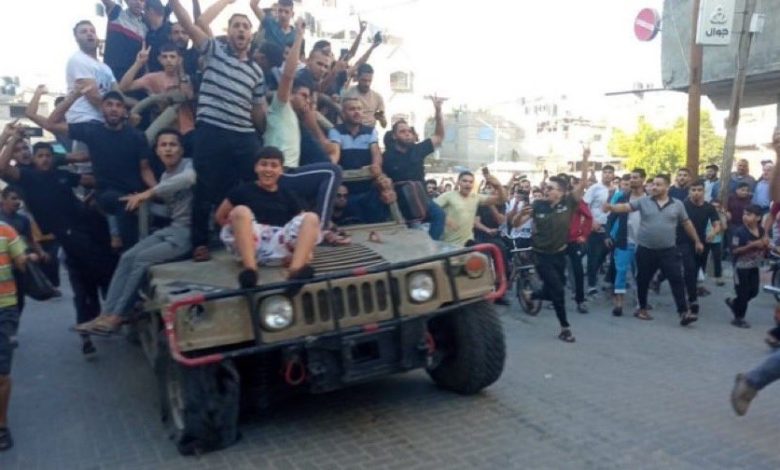
Palestinian resistance fighters also had control over some Israeli light military vehicles, which they drove into the Gaza Strip. Video footage showed the deaths of a number of Israeli soldiers and settlers, including the chairman of the Regional Council for the Sha’ar Hanegev settlement. Residents of the attacked settlements experienced a shocking shock as a result of this because no previous Israeli estimates had considered the possibility of conducting such impromptu ground operations against the settlements surrounding the Gaza Strip or the dependence of those estimates on the intensity of Israeli security measures along the border fence enclosing the Gaza Strip.

It should be noted that the Palestinian ground assault was supported by air and naval movements, as evidenced by the movement of the Saqr unit, a paratrooper unit connected to the Al-Qassam Brigades that relies on paragliding, which hastened the fighters’ arrival at the Netivot settlement and also had a significant psychological effect because the use of this technique, in addition to the movement of light boats owned by Palestinian factions along the northern coast of the Gaza Strip, represented a repetition of earlier scenes from one of the most successful Palestinian guerrilla operations, namely the Qibya operation in 1987, which the group that carried out it utilised a small boat to reach the Tel Aviv beach.
Notably, the Palestinian air campaigns also involved the use of drones. One of these drones was used to destroy a Merkava-4 tank by releasing a PG-7VR anti-tank launcher with a tandeam HEAT warhead. Other drones were also used to direct hand grenades at Israeli soldiers gathered near the Gaza Strip settlements.

The Palestinian movements went beyond this. In addition to their assault on the settlements, Palestinian factions simultaneously fired roughly 2,500 missiles in a short period of time at northern Gaza, from Ashkelon in the south to Tel Aviv in the north and the surrounding areas of Jerusalem. This led to direct casualties in a number of cities, including Ashkelon, where Palestinian missiles severely damaged the Rutenberg Power Station, Israel’s second-largest electrical power generation station. This, coupled with ground operations, prompted the Israeli military command to declare a state of emergency, summon reserve forces, declare an emergency within 80 kilometres of the Gaza Strip border, and launch air and ground operations under the codename Iron Swords, with the intention of attacking positions of the Palestinian factions in the Gaza Strip and securing the settlements that were infiltrated.
In conclusion, the Israeli warning and surveillance system is currently suffering from a complex failure that can be fairly compared to its failure in the days leading up to the October 1973 War. This failure demonstrates the incompetence of the Israeli field crews, particularly the Armored Corps. As the number of “Israeli captives” rises into the dozens, Israel finds itself in a perilous situation both on the battlefield right now and when it comes to managing this file. Tel Aviv may be forced to make significant concessions as a result, which will undoubtedly fan the flames of growing discontent within Israel on both the political and social fronts. This will eventually be accompanied by an internal uprising over Israel’s poor military performance in this conflict, which will not only perpetuate the “October Complex” but also worsen the “state of rebellion” that has been permeating the Israeli military establishment for months.


