





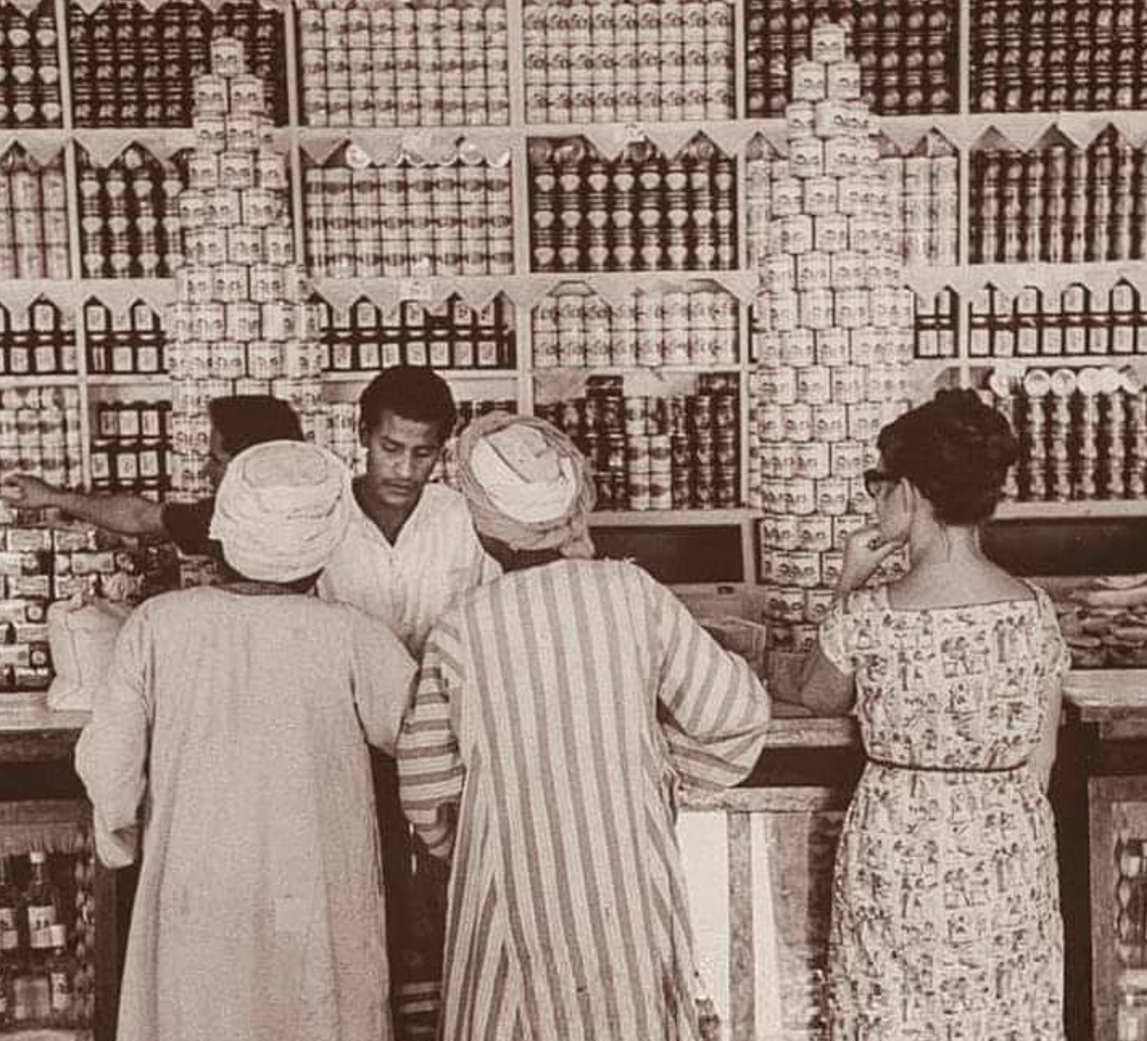
Anyone examining Egypt’s history during the 1960s and 1970s will note that Egyptian society did not experience any acute shortages of food stocks or basic commodities throughout either the War of Attrition or the October War, despite the severe economic conditions that remain vivid in the memories of older generations. Nor were there any recorded instances during that period of exceptional famine or similar conditions in any of the country’s 22 governorates at the time, as a result of shortages in the logistical supplies that had to reach more than 35 million citizens every day.
The credit for this achievement, which may appear ordinary or go unnoticed by many, lies in the stability of the national logistics system. Its resilience was not the product of chance, but rather the result of sustained, cumulative efforts to strengthen its systems and supply chains, even before the outbreak of the wars. These efforts helped establish one of the pillars of home-front security during the period from 1967 to 1973. The efficiency of the logistics system played a decisive role in preparing the state for the battle to reclaim the occupied Sinai. There can be no domestic peace and stability in a society whose people are going hungry, nor can an army deployed along the front lines be expected to endure without a reliable supply of food.
The success described above calls for an examination of the components of the national logistics system that secured food supplies for the population and the armed forces over seven years and enabled the state to devote the bulk of its attention to developing the crossing plan and preparing for the battle. This, in turn, offers a new perspective on Egypt’s history during the October War.
The Agricultural Sector
Agricultural land was — and remains — the most important asset owned by the Egyptian state. It was the foundation upon which one of the greatest human civilizations arose, and its presence enabled the Egyptian people to withstand some of the harshest conditions brought about by drought and hardship throughout history. Just as it has long sustained the Egyptian people, during the War of Attrition and the October War it served as a strong shield, securing the population’s needs for most of the agricultural crops and grains essential to daily consumption. Statistics for 1973, the year of the war, show that the country had a total of 10.27 million feddans of agricultural land, with production encompassing dozens of major crops, as well as vegetables and fruits.
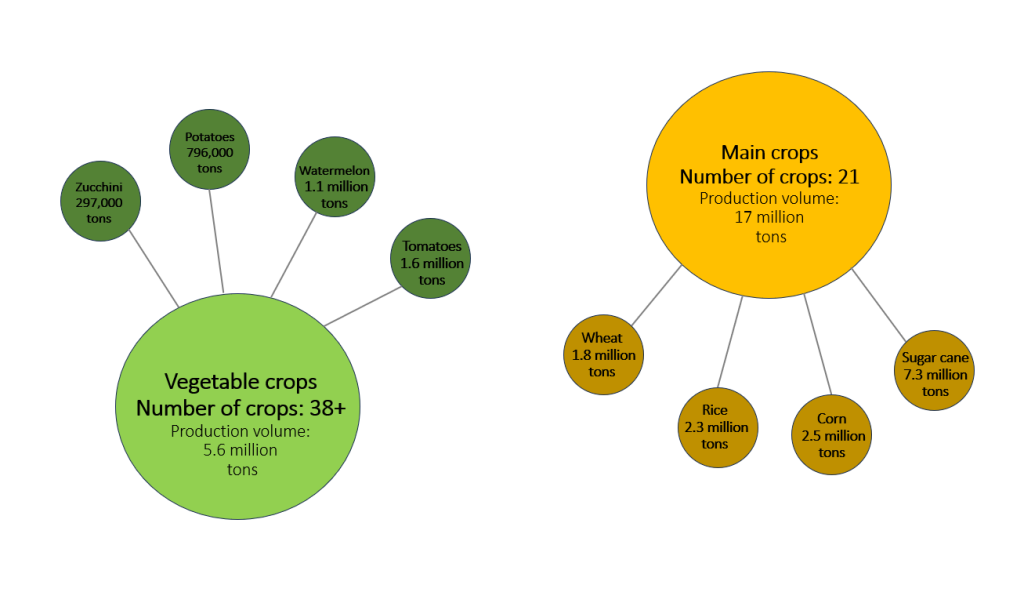
In 1973, 18 major food crops were cultivated, with total production reaching 17 million tons of storable strategic food commodities, including rice, wheat, and maize. Meanwhile, more than 38 varieties of fast-moving vegetables were cultivated, with total production amounting to 5.6 million tons. Tomatoes, watermelons, potatoes, and zucchini topped the list of fast-moving vegetables produced that year — see Figure 1 below. Fruits ranked third among agricultural crops, comprising 17 varieties, although their total production did not exceed 1.8 million tons.
Figure 1: Major agricultural crops and perishable vegetables produced in 1973, their total quantities, and the main varieties within each category, together with the quantities produced of those varieties.
Source: Annual Statistical Yearbook, 1974, Central Agency for Public Mobilization and Statistics, Cairo, October 1975
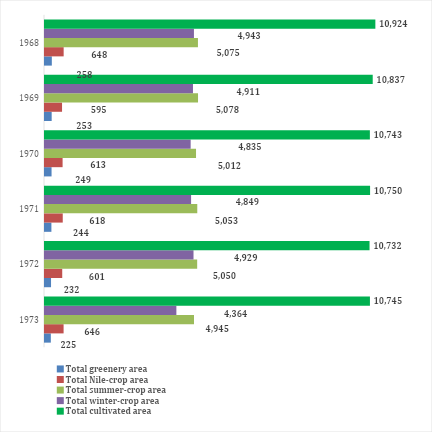
This diversity in agricultural production was facilitated by the distinctive characteristics of Egypt’s agricultural land, which allowed it to be cultivated across three agricultural cycles throughout the year: the summer, winter, and Nile cycles. Each cycle produced a distinct range of crops, the cultivation of which required suitable climatic conditions — see Figure 2 below. This was in addition to the areas devoted to fruit orchards, which typically contain fruit-bearing trees, each producing a single type of fruit throughout the year.
Figure 2: Distribution of Egypt’s cultivated crop area between 1968 and 1973 (thousand feddans)
Source: Annual Statistical Yearbook of the Arab Republic of Egypt, 1952–1973, Central Agency for Public Mobilization and Statistics, October 1974
Livestock Production
The availability of animal protein served as a complement to the supply of plant-based foods. The country’s substantial livestock population helped Egypt achieve near self-sufficiency in red and white meat products. In 1973, Egypt had 7.67 million head of livestock, including cattle, buffalo, sheep, goats, and camels — see Figure 3/1 below. It also had 37.5 million poultry birds, including chickens, ducks, turkeys, geese, and rabbits — see Figure 3/2.
It is worth noting that the numbers of these livestock and poultry steadily increased over the period from 1968 to 1973, despite the repercussions of the difficult economic conditions resulting from the war. This demonstrated the resilience of their production institutions in the face of the adverse effects of those conditions, much as the agricultural sector demonstrated its resilience amid the exceptional circumstances confronting the country.
Figure 3/1: Growth in the number of livestock between 1968 and 1973 (million head)
| Cows | Buffalo | Sheep | Goat | Camels | |
| 1968 | 2.06 | 1.94 | 1.94 | 1.1 | 0.13 |
| 1969 | 2.09 | 1.98 | 2 | 1.1 | 0.13 |
| 1970 | 2.16 | 2 | 2.1 | 1.2 | 0.13 |
| 1971 | 2.11 | 2.06 | 2 | 1.2 | 0.1 |
| 1972 | 2.13 | 2.1 | 2 | 1.2 | 0.12 |
| 1973 | 2.13 | 2.14 | 1.99 | 1.3 | 0.11 |
Figure 3/2: Growth in the number of poultry between 1968 and 1973 (million head)
| Chicken | Turkey | Duck | Geese | Pigeon | Rabbits | |
| 1968 | 23.93 | 0.634 | 2.9 | 2.45 | 4.44 | 2.11 |
| 1969 | 24.24 | 0.643 | 2.95 | 2.47 | 4.24 | 2.1 |
| 1970 | 24.54 | 0.652 | 3 | 2.5 | 4.1 | 2.1 |
| 1971 | 24.85 | 0.661 | 3.05 | 2.5 | 3.9 | 2.1 |
| 1972 | 25.15 | 0.67 | 3.1 | 2.5 | 3.7 | 2.1 |
| 1973 | 25.46 | 0.678 | 3.15 | 2.6 | 3.5 | 2.1 |
Source: Annual Statistical Yearbook of the Arab Republic of Egypt, 1952–1973, Central Agency for Public Mobilization and Statistics, October 1974
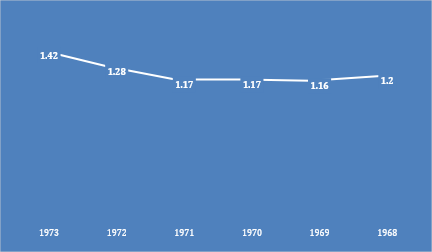
However, the most significant economic impact on the livestock production sector was reflected in the decline in Egyptian consumption of relatively expensive red meat. The number of slaughtered animals declined throughout the years of the War of Attrition and the October War, reaching 1.2 million head in 1973, down from more than 1.4 million head in 1968 — see Figure 4 below. White meat and eggs, however, served as a consistent alternative under such circumstances.
It is difficult to estimate the number of poultry slaughtered during that period, as it was customary for households in both cities and villages to raise poultry on rooftops and in their courtyards and slaughter them themselves to meet their families’ needs, or to purchase poultry from local butcher shops that slaughtered and cleaned the birds on site, without the need for a slaughterhouse to record the number of poultry slaughtered. Statistics on table eggs circulating in the markets, however, provide an indication of the extent to which this inexpensive source of protein was consumed. The supply of eggs increased from 1.32 billion in 1968 to 1.46 billion in 1973.
Figure 4: Decline in the number of animals slaughtered for red meat production between 1968 and 1973 (million head)
Source: Annual Statistical Yearbook of the Arab Republic of Egypt, 1952–1973, Central Agency for Public Mobilization and Statistics, October 1974
Note: The slight increase in the number of slaughtered livestock in 1973, estimated at 40,000 head, may be attributed to the government’s release of thousands of head of live livestock at reduced prices per kilogram of live weight, as part of a plan to increase citizens’ reserve stocks of food commodities and animal protein in the period immediately preceding the outbreak of the war.
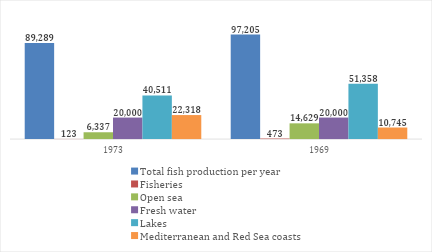
Fishing also helped provide consumers with additional quantities of protein, despite the damage sustained by Egyptian fishing activities as a result of the closure of the ports of Suez and Port Said, as well as a number of smaller harbors designated for fishermen, and restrictions on the movement of fishing boats due to military operations. Statistics show that total fish production amounted to 89,000 tons in 1969, but had risen to 97,000 tons by 1973 — see Figure 5 below. This increase was attributed to intensified fishing operations in Egypt’s lakes, particularly Lakes Nasser and Mariout, as well as the doubling of the activity of the deep-sea fishing fleet, which at the time was operated by the Egyptian Deep-Sea Fisheries Company.
Figure 5: Trends in fish production between 1969 and 1973 by fishing location (tons)
Source: Fish Production Statistics Bulletin in the Arab Republic of Egypt, 1969/1970, Central Agency for Public Mobilization and Statistics, March 1973; and Fish Production Statistics Bulletin in the Arab Republic of Egypt, 1973, Central Agency for Public Mobilization and Statistics, August 1975
Food Processing and Distribution
Dozens of Egyptian institutions operating in the food processing sector supplied the bulk of the country’s needs for processed and packaged food products. These products were essential to urban residents and some rural residents, depending on their daily lifestyles and consumption patterns, as well as to military forces stationed along the front lines, where delivering foodstuffs to these forces in their raw form was difficult, while preparing and cooking them for consumption was even more challenging. Examples of food-processing institutions, some of which remain in operation to this day, include Qaha and Edvina Canning Companies, Tanta Company for Oils and Soap, the Egyptian Sugar and Integrated Industries Company, and Alexandria Mills and Bakeries Company, among others.
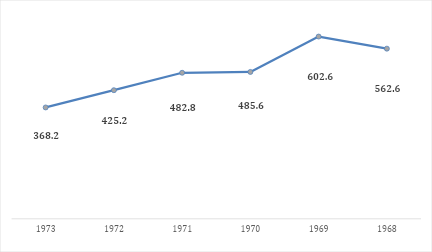
Throughout the War of Attrition and the October War, these companies succeeded in supplying 31 categories of processed food products, including dried vegetables, raw sugar, tomato sauces, full-fat and processed cheeses, frozen and canned fish, pasteurized dairy products, cooking oils, vinegar, and others. As a result, the food-processing sector witnessed a notable revival during the wartime period. This may have been due to the nature of military conditions and their logistical requirements, or to changes in consumer preferences in response to the faster pace of daily life. Overall, this contributed to the value of manufactured food products reaching more than EGP 562 million in 1973, an increase of 153 percent over the value of such food products manufactured in 1968, when their value did not exceed EGP 368 million — see Figure 6 below.
Figure 6: Growth in the value of locally manufactured food products between 1968 and 1973 (EGP million)
Source: Annual Statistical Yearbook of the Arab Republic of Egypt, 1952–1973, Central Agency for Public Mobilization and Statistics, October 1974
The history of national food-processing institutions cannot be discussed without highlighting the role they, along with other entities, played in manufacturing products that were no less important to daily life than food, including soap and industrial detergents, which were essential for maintaining personal and public hygiene. The production of these cleaning products reached nearly 200,000 tons in 1973. National pharmaceutical companies also developed their capabilities, successfully localizing and advancing the pharmaceutical industry in an effort to achieve a degree of self-sufficiency. This increased the economic size of the pharmaceutical industry by 186 percent between 1969 and 1973, with its value reaching EGP 45 million in the latter year.
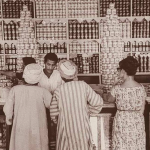
To complete the Egyptian food supply system and ensure the smoothest possible delivery of consumer goods to the final consumer, the Egyptian government relied on its affiliated entity, known as the Egyptian General Organization for Foodstuffs, established in February 1967, to establish and expand a number of affiliated companies operating in wholesale and retail trade. These included, for example, the Egyptian Company for Wholesale Trade, the Nile Company for Consumer Complexes, and the Alexandria Company for Consumer Complexes. These companies were not limited to trading locally produced goods; they also distributed foreign goods imported by the government to address any logistical shortages emerging in the market. In addition, the branches of these companies played a hidden mobilization role, as they were converted, shortly before the outbreak of the 1973 War, into small strategic warehouses stocked with whatever rationed goods were available, with each branch assigned a role in serving the district or administrative center within its geographical jurisdiction during emergencies.
Imports
Alongside domestic production, there was a constant need to import additional quantities of various food commodities, including processed foods, livestock and livestock products, vegetable oils, and major agricultural crops — see Table 7 below. With regard to the latter category, which ranked highest in monetary value among Egypt’s food imports, one of its direct causes was the inability of Egypt’s total agricultural land, given its size and natural conditions at the time, to produce all of the annual quantities of major crops required by the population. Similar circumstances also contributed to the weakness of domestic production of vegetable oilseeds and fats.
The overall economic hardship also hindered the development of national food-processing institutions, making it difficult to produce certain types of processed food products and forcing the relevant authorities to import them to meet domestic demand. Finally, because of the high costs of feed, medicines, and other inputs for local livestock breeders, and their consequent need to sell their products at prices beyond the means of the average citizen, there was a tendency to import quantities of red and white meat products from abroad. These imported meats were relatively inexpensive, but were also characterized by lower quality compared with locally produced meat.
Table 7: Changes in the total value of all Egyptian imports, with the value of food commodity imports shown separately, between 1968 and 1973 (EGP million)
| Total imports | Plant-based products | Greases and oils | Food products | Live animals and their products | |
| 1968 | 289.6 | 74.52 | 12.74 | 9.77 | 1.84 |
| 1969 | 277.3 | 48.45 | 12.37 | 10.38 | 2.46 |
| 1970 | 341 | 48.59 | 16.92 | 10.21 | 4.28 |
| 1971 | 399.9 | 80.93 | 23.21 | 10.45 | 4.45 |
| 1972 | 390.8 | 63.52 | 31.04 | 12.37 | 5.62 |
| 1973 | 361.1 | 77.39 | 16.76 | 13.37 | 7.67 |
Source: Annual Statistical Yearbook of the Arab Republic of Egypt, 1952–1973, Central Agency for Public Mobilization and Statistics, October 1974
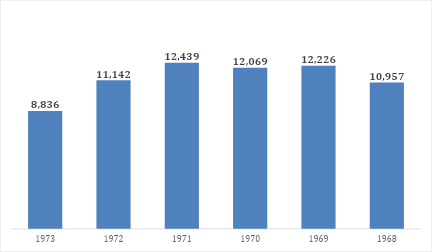
To ensure the arrival of these imported food supplies, the supply chain had to be completed by establishing maritime gateways connecting Egypt to the outside world. This posed a genuine challenge for the state, which, before 1967, had only three ports: Alexandria, Port Said, and Suez. Due to geographical and military circumstances, the latter two were rendered almost entirely inoperative, leaving the Port of Alexandria as the country’s only open gateway to the rest of the world. This prompted the Egyptian government to place the port at the top of the list of vital facilities requiring enhanced protection, alongside oil refineries and storage facilities, dams and barrages, and electricity generation and distribution stations. Measures were also taken to develop the transportation network serving the port, including railways and road freight, to prevent any congestion within the port and ensure that its operations continued with the highest possible degree of efficiency. These measures helped increase the port’s activity in handling imported goods by 23 percent between 1968 and 1973 — see Figure 8 below.
Figure 8: Growth in the volume of goods arriving at the Port of Alexandria between 1968 and 1973 (thousand tons)
In conclusion
The historical experience of the October War, as well as the years preceding it during which preparations were made for the October Crossing Battle, demonstrates that sectoral development in agriculture and industry, together with the strengthening and reinforcement of logistical supply and storage chains, is the most effective support for the Egyptian people in times of national crises and emergencies, whether domestic or imposed by regional and global circumstances. This applies whether such crises arise from natural causes, such as earthquakes and epidemics, or are human-made, such as wars between states or cross-border conflicts and conflicts surrounding maritime chokepoints.
There is no shortage of potential strategic crises in our region today, driven by the succession of conflicts among multiple powers and by the effects of global climate change. Egypt must therefore rapidly complete all ongoing projects aimed at expanding its agricultural land, such as the New Delta and the 1.5 Million Feddan projects, as well as all projects already launched to develop livestock and fishery resources. It must also expand the food-processing sector by integrating the capabilities of public and private production institutions and deepening cooperation and coordination between them, so that Egypt can establish an integrated food security system that reduces, to the greatest extent possible, its dependence on imports in the event of major global challenges that may currently be unforeseen.