







The June 1967 defeat was not merely a military setback for Egypt; it was a comprehensive shock that simultaneously affected the country’s productive, financial, and external capacities, necessitating a fundamental reordering of economic policy priorities. The war came after a period of relatively high economic growth, with the economy averaging approximately 6.5 percent annual growth between 1961 and 1965, before slowing to around 3.3 percent during 1966–1970. The World Bank attributes this slowdown to the balance-of-payments crisis that preceded the war and to the June 1967 War, as well as the stabilization measures and resource reallocation that followed.
At the same time, the Egyptian economy lost a significant portion of its capacity to generate foreign exchange. The Suez Canal was closed, cities in the Canal Zone sustained extensive damage, and industrial facilities, including oil refineries, were damaged. The Suez Canal, tourism, and cotton had been key pillars of Egypt’s external resources; consequently, the loss of the canal brought about a major shift in the external accounts, with the economy becoming increasingly dependent on commodity exports, Arab aid, long-term assistance from Eastern Bloc countries, and suppliers’ credits from Organization for Economic Cooperation and Development countries.
The economic shock, however, coincided with a sharp rise in defense requirements. From 1967 onward, military objectives and the recovery of the occupied territories became the government’s foremost priority, and the share of national resources allocated to defense rose substantially. A 1970 World Bank document indicates that defense appropriations increased from approximately $480 million, equivalent to 8 percent of GDP in 1967, to $1.16 billion in 1970, or 18 percent of GDP, while the proposed 1971 budget allocated $1.265 billion to defense, equivalent to approximately 19 percent of GDP.
This gave rise to what may be termed the Egyptian war economy: an economy whose objective was not to maximize short-term growth, but to preserve the state’s economic capacity, mobilize available resources, and direct as large a share of them as possible toward rebuilding the armed forces and preparing for the battle of liberation, while seeking to keep the civilian economy functioning, ensure the availability of essential goods, and maintain a minimum level of social stability.
The experience of the Egyptian economy between defeat and victory therefore raises a number of central questions: How did the state reorder its fiscal priorities in the context of a prolonged war? How was it able to mobilize domestic resources despite the decline in foreign-exchange earnings? What was the cost of directing resources toward defense in terms of investment and civilian development? How did Arab support help bridge financing gaps? And, most importantly, how did the Egyptian economy move after the October victory from the logic of a “war economy” to that of reconstruction and economic opening?
This article seeks to address these questions by examining the 1967–1973 period as an integrated experience in managing a war economy, rather than merely as a historical phase in the Arab-Israeli conflict. Its aim is to understand how the Egyptian state managed its limited resources and balanced the financing of the war effort with the need to sustain production and social stability, ultimately reaching the point at which the October victory made it possible to redefine economic priorities and pave the way for a shift toward the open-door policy and the restructuring of the Egyptian economy.
First: the Egyptian economy after the 1967 defeat
The June 1967 War dealt a severe structural shock to the Egyptian economy, bringing to an end a decade of rapid and sustained growth that the country had experienced during the period of the First Five-Year Plan (1960–1965), when GDP growth averaged approximately 6.5 percent annually. Estimates published in World Bank reports indicate that economic performance deteriorated sharply following the outbreak of the war. The most significant repercussions were as follows:
Slower growth and a shift in the state’s priorities; average economic growth declined from 6.5 percent during 1961–1965 to approximately 3.3 percent in 1966–1970, alongside declining domestic savings and investment. The World Bank notes that this slowdown was not attributable to the war alone, but resulted from the interaction between the 1966 balance-of-payments crisis and the June 1967 War, prompting stabilization measures and a reallocation of resources.
The loss of the Suez Canal and foreign-exchange sources; the closure of the Suez Canal following the June 1967 War was one of the most consequential economic shocks to Egypt. Before the war, Egypt’s principal sources of foreign exchange were largely cotton exports, Suez Canal revenues, and tourism receipts. The closure of the canal therefore brought about a fundamental change in the structure of Egypt’s external accounts.
World Bank data illustrate the scale of this transformation. During the period 1959–1966, the services account recorded a cumulative surplus of approximately $865 million, averaging $108 million annually. The Suez Canal alone accounted for approximately $1.314 billion over the period, or an average of $164 million annually. After the war, however, during 1967–1972, the services account shifted to a cumulative deficit of $243 million, with an average annual deficit of approximately $40 million.
More importantly, Suez Canal revenues recorded under the services account fell to only about $108 million over the entire six-year period, averaging no more than $15 million annually, compared with an annual average of $164 million during the preceding period.
The loss of the canal, however, was not the only problem; tourism revenues also declined in the aftermath of the war. Before 1967, tourism and travel generated approximately $140 million annually in foreign exchange for Egypt, accounting for more than 13 percent of total current receipts, while the number of tourist nights in 1969 fell to only around 40 percent of its pre-war level.
Faced with this loss, the state was forced to increase its reliance on commodity exports, particularly cotton. Commodity exports totaled approximately $4.475 billion during 1967–1972, averaging $745 million annually, of which cotton, yarn, and textiles accounted for approximately $2.786 billion, or an average of nearly $464 million annually. Cotton thus became increasingly the “traditional source of foreign exchange,” offsetting part of the sharp decline in services revenues. However, the capacity of commodity exports to compensate remained limited. Although commodity exports increased on average, imports amounted to approximately $6.48 billion over the same period, averaging $1.08 billion annually.
The result was a widening external gap. The cumulative deficit in trade in goods and services reached approximately $2.25 billion during 1967–1972, averaging $375 million annually, compared with a deficit of only $1.61 billion during 1959–1966. When medium- and long-term debt repayments are included, the foreign-exchange deficit rose to approximately $3.746 billion during 1967–1972, equivalent to an average of $624 million annually.
This is where the Suez Canal’s importance to the war economy becomes particularly evident. Its closure did not simply mean the loss of an annual source of revenue; it created a persistent gap in Egypt’s capacity to finance imports. Egypt simultaneously needed to import food, raw materials, machinery, and equipment, while its foreign-exchange resources were declining. It was therefore impossible to finance the country’s economic and military requirements through exports alone. World Bank documents indicate that, during 1967–1972, Egypt was able to meet its needs for goods and services through a combination of Arab assistance, medium- and long-term aid from Eastern Bloc countries, and suppliers’ credits from Organization for Economic Cooperation and Development countries.
Second: Egyptian military expenditure data for 1962–2025
Egypt’s military expenditure data for the period 1962–2025 reveal a clear relationship between the intensity of military conflict and the reallocation of economic resources in Egypt. Military expenditure as a share of GDP rose from 6.68 percent in 1962 to 8.91 percent in 1967, before increasing sharply during the War of Attrition to 15.99 percent in 1970 and 17.19 percent in 1971. It subsequently peaked at 17.27 percent in 1974, in the aftermath of the October War.
This trajectory indicates that the economic cost of war is not confined to the year in which hostilities erupt, but extends into subsequent years as a result of rebuilding military capabilities, replacing losses, and maintaining defense investment. Conversely, as the security environment stabilized, military expenditure as a share of GDP entered a prolonged downward trend, declining to 3.47 percent in 1990, then to 1.95 percent in 2010, and eventually to 0.61 percent in 2025.
Source: The SIPRI Military Expenditure Database
Third: Mechanisms for managing the war economy and mobilizing domestic financial resources
The geopolitical and military transformations that followed 1967 led to a fundamental restructuring of Egypt’s public financial management system, as the country shifted from a model of “comprehensive development plans” to “annual strategic budgets,” or what became known as the implementation of a “war economy” under the leadership of the Ministry of the Treasury. The primary objective of this approach was to mobilize the maximum possible amount of domestic resources to meet the military’s requirements and rebuild the armed forces, without causing the collapse of essential services in the civilian sector.
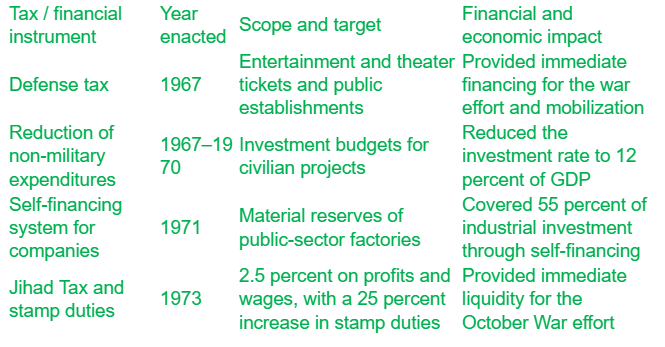
Military allocations rose to unprecedented levels in the history of the Egyptian budget, with defense appropriations increasing from $480 million, equivalent to 8 percent of GDP, in 1967 to $1.16 billion, or 18 percent of GDP, in 1970, reaching $1.265 billion, or 19 percent of GDP, in the proposed 1971 budget. To cover this substantial financial gap amid slowing economic growth, the government resorted to tightening its tax policy instruments.
The tax policy adopted to manage the wartime crisis included the introduction of exceptional legislative measures, most notably the imposition of a “defense tax” immediately following the defeat, covering entertainment tickets and public establishments. This was followed by the enactment of legislation on the “Jihad Tax” in 1973, which imposed a 2.5 percent levy on income from movable capital, commercial and industrial profits, and employment income, in addition to a 25 percent increase in stamp duties to meet the requirements of the battle for liberation.
On the public investment front, military requirements placed pressure on the investment budget of civilian sectors, resulting in a decline in the public investment rate from 16 percent of GDP in 1967 to 12 percent in 1970. To prevent the existing industrial base from grinding to a halt, the state introduced a “self-financing” system for public-sector factories, requiring each project or enterprise to draw on its own reserves to finance expansions, maintenance operations, and the replacement of spare parts. As a result of this strategy, self-financing covered approximately 55 percent of total investment implemented in the industrial sector during fiscal year 1971/1972, enabling the industrial sector to achieve positive growth rates of 7 percent in 1968 and 10.7 percent in 1971. The operation of offshore wells in the Morgan Field in the Gulf of Suez also helped compensate for a significant portion of the oil lost from the Sinai fields, with production from the field rising to 16.4 million tons in 1970.
Fourth: External financing and regional support: From the Khartoum Summit to the 1973 War
Domestic financial mobilization measures alone were insufficient to close the structural gap in the current account and balance of payments, making external financial support a critical pillar in sustaining Egypt’s war economy amid declining exports and rising requirements for food and military imports.
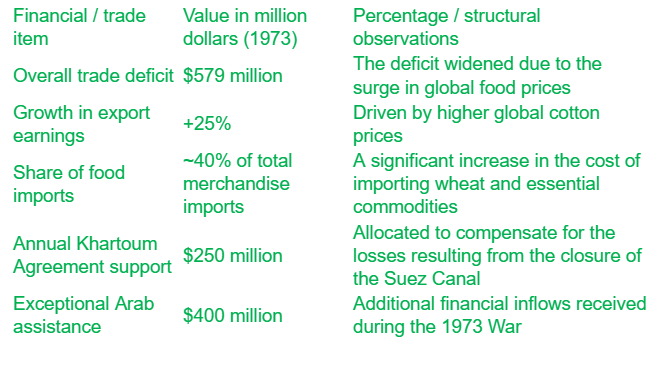
The Khartoum Summit, held in August 1967, provided an important source of financial support by establishing a financial safety net for Egypt. The conference approved regular financial assistance from the Arab countries accounting for the largest share of oil production — Saudi Arabia, Kuwait, and Libya — amounting to $250 million annually under the “Khartoum Agreement commitments,” to compensate Egypt for the revenues lost as a result of the closure of the Suez Canal to international navigation.
With the outbreak of the October 1973 War, an additional $400 million in exceptional financial assistance flowed from Arab countries. These financial inflows enabled the Egyptian economy to absorb the country’s substantial trade deficit in 1973, which amounted to approximately $579 million.
Although Egyptian export earnings increased by 25 percent in 1973, driven by improved international prices for raw cotton, this growth was offset by an even sharper increase in the prices of imported foodstuffs, particularly wheat, which accounted for approximately 40 percent of the country’s total import bill. The following table illustrates the movement of Egypt’s trade balance and external financial flows during the 1973 War, according to World Bank estimates.
Fifth: The social and demographic costs and management of the home front
The pressures of managing the war economy extended beyond the limits of the public budget to encompass enormous social and demographic challenges that threatened internal stability and required broad administrative and security responses from the state apparatus.
The most significant social costs of the defeat were manifested in the forced internal displacement of residents of the three Suez Canal cities — Suez, Ismailia, and Port Said — following their bombardment and destruction during the War of Attrition. Nearly one million people were evacuated and relocated from the Canal border zone to governorates across Egypt’s interior. This displacement placed financial burdens and additional pressure on public services, healthcare, education, and housing in the receiving governorates, while displaced families also received social benefits and assistance to cope with the resulting forced unemployment.
This crisis coincided with continued population growth of approximately 2.5 percent annually, while the population, which at the time exceeded 34 million, was concentrated within an area accounting for no more than 4 percent of Egypt’s total territory. The resulting waves of internal migration from rural areas to cities further increased population density in major urban centers such as Cairo and Alexandria.
Despite the establishment of the Supreme Council for Family Planning, World Bank reports indicate that population strategies at the time produced no tangible results, as most resources were redirected toward military purposes. The government also adopted a system of universal subsidies for rationed commodities and controls on the prices of basic foodstuffs, thereby maintaining a minimum level of social cohesion and sustaining the home front throughout the years of military resilience.
Sixth: Structural transformation after the October 1973 War and the launch of the open-door policy
The October 1973 victory brought about a fundamental shift in the direction of Egyptian economic policy, as the era of centralized planning and the contractionary war economy came to an end, paving the way for structural reforms aimed at opening the economy to global markets and reducing the state’s dominance over economic activity. This new direction was formally articulated in the “October Paper,” presented by President Anwar Sadat in April 1974, which set out a framework for the transition toward a more diversified and open economy.
The new model rested on four main pillars: restructuring and developing public-sector companies; encouraging and liberalizing the domestic private sector; attracting foreign capital and investment; and deepening economic and financial cooperation with Arab oil-producing countries. This was accompanied by the enactment of Law No. 43 of 1974 on the Investment of Arab and Foreign Capital and Free Zones, which granted broad privileges and tax exemptions to foreign investments.
World Bank reports issued during this period revealed that the tax system in place before 1974 constituted an obstacle to private-sector initiatives. Individual profits exceeding EGP 1,000 were subject to progressive tax rates ranging from 9 percent to 95 percent for incomes of EGP 10,000 or more, in addition to a 40 percent tax on commercial and industrial profits. The recommendations called for reducing these rates to encourage the reinvestment of profits and mobilize domestic savings.
In terms of financial and monetary transactions, a financing channel for the private sector was established through the Bank of Alexandria, which was tasked with distributing International Development Association (IDA) credits from the World Bank, amounting to $15 million in 1973 and $25 million in 1975, to cover the import requirements for capital goods. The authorities also introduced adjustments to the budget structure and exchange rate. Beginning January 1, 1973, the government’s fiscal year was standardized to coincide with the calendar year (January–December), replacing the previous system (July–June). As part of the 1973 currency revaluation, the official exchange rate of the Egyptian pound was adjusted to EGP 2.56 per US dollar (or 2.118 Special Drawing Rights, SDRs), while a “parallel market” was introduced at an exchange rate of $1.70 per pound to absorb remittances from Egyptians working abroad and support trade operations.
Conclusion
A review of World Bank documents and specialized economic studies covering the period from 1967 to 1973 shows that the Egyptian economic administration succeeded in achieving a critical overarching objective: sustaining the state’s financial capacity to finance the escalating war effort without defaulting on its international obligations or allowing the civilian rationing system to collapse. The findings of this analysis can be summarized as follows:
The flexibility of fiscal policy was reflected in the state’s ability to increase tax mobilization from an already substantial base and allocate approximately one-fifth of GDP annually to military expenditure. This overall success, however, came at the expense of long-term development, as lower public investment and the postponement of comprehensive development plans contributed to the aging of productive assets in the industrial and service sectors.
Regional financial flows and joint support, reinforced by the decisions of the 1967 Khartoum Summit and the assistance that followed during the 1973 War, played an important role in providing the necessary backing for importing strategic food requirements. This underscores the importance of the regional dimension in strengthening the resilience of national economies during crises.
The experience of “self-financing” by public-sector companies proved valuable in protecting the existing industrial base and securing spare parts and operational assets. However, foreign-exchange constraints limited their competitiveness and technological capacity, prompting an accelerated shift, immediately after the war, toward trade liberalization and economic opening policies aimed at attracting investment and modernizing production capabilities.
References:
World Bank. Egypt: Economic Report. Report No. 870a-EGT. Washington, D.C.: World Bank, January 5, 1976. https://documents1.worldbank.org/curated/en/593761468037491611/pdf/multi0page.pdf
World Bank. Arab Republic of Egypt: Economic Management in a Period of Transition. Vol. I: The Main Report. Report No. 1818-EGT. Washington, D.C.: World Bank, May 8, 1978. https://documents1.worldbank.org/curated/en/798001468234876265/pdf/multi-page.pdf
World Bank. Egypt: Economic Report. Report No. 1624-EGT. Washington, D.C.: World Bank, March 31, 1977. https://documents.worldbank.org/en/publication/documents-reports/documentdetail/260081468248085882
World Bank. United Arab Republic: Current Economic Position and Prospects. Washington, D.C.: World Bank, June 30, 1971. https://documents.worldbank.org/en/publication/documents-reports/documentdetail/167311468025735892
Al-Siyassa Al-Dawliya magazine. “The Economics of War and Resource Mobilization in Egypt (1967–1973).” Cairo: Al-Ahram Foundation.
https://www.siyassa.org.eg/News/19693.aspx
Stockholm International Peace Research Institute (SIPRI). SIPRI Military Expenditure Database. Stockholm: SIPRI. https://milex.sipri.org/.