








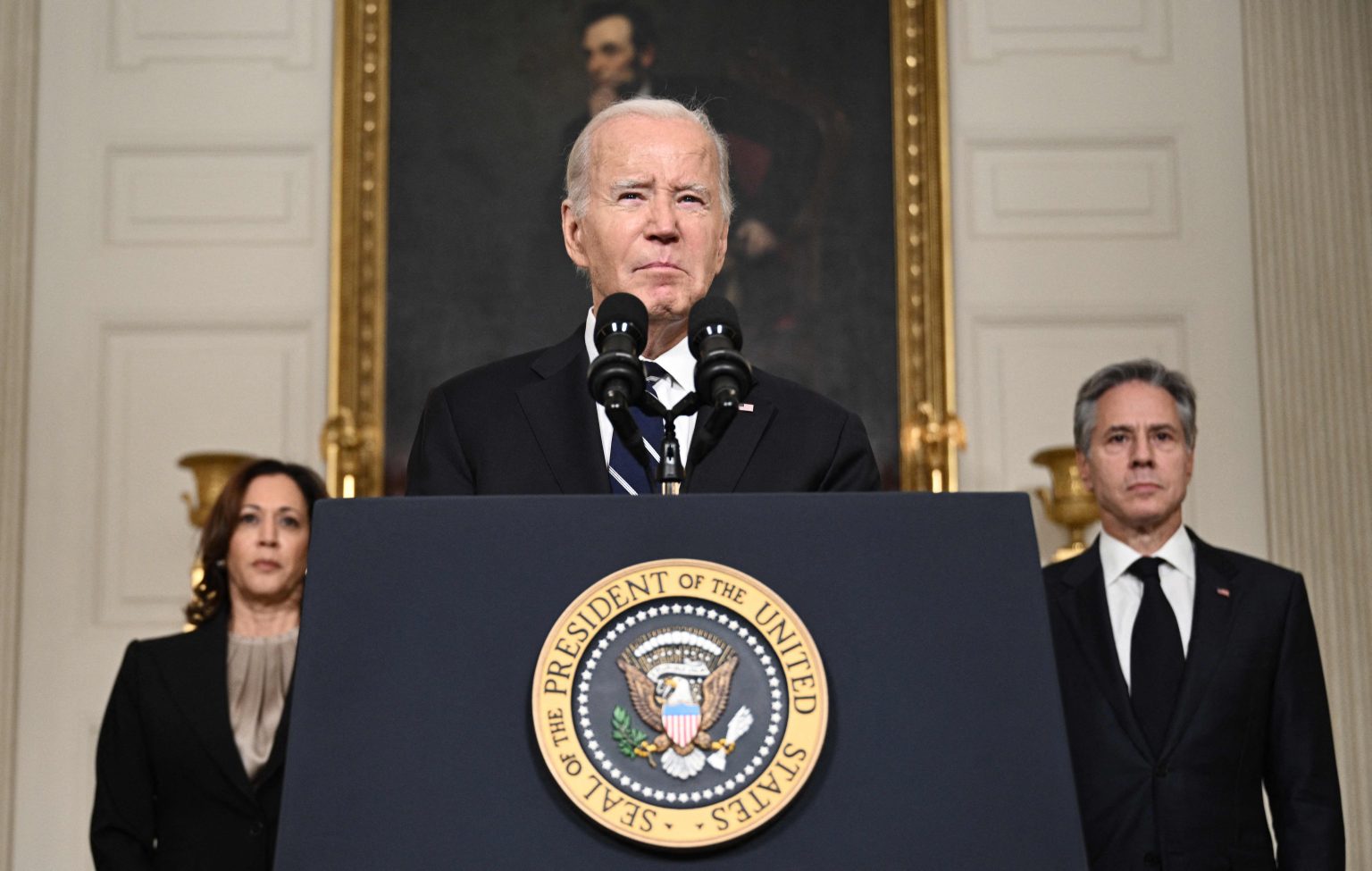
Current developments on the Israel-Palestine stage underscore the enduring US support for Israel, despite recent indications of disagreements between the two countries.
On 7 October, the Palestinian group Hamas captured dozens of Israelis during incursions into Israel, simultaneously igniting clashes in at least seven locations in settlements neighbouring the Gaza Strip and firing a barrage of rockets towards Israel.
In response, US President Joe Biden reaffirmed the US’ comprehensive support for Israel, emphasising its commitment to Israel’s security. He added that his administration was closely monitoring the situation and maintaining constant communication with Israeli Prime Minister Benjamin Netanyahu.
It was planning to provide military aid aimed at bolstering Israel’s capabilities in the face of Hamas, he said.
Biden’s statement indicates that the two countries are now putting their recent disagreements behind them, some of which include Biden’s call in March for Netanyahu to go back on changes to Israel’s judicial system and expressing concerns about the health of Israeli democracy.
Biden’s unequivocal “no” to questions regarding an invitation for Netanyahu to visit the White House indicated such strained relations.
There were earlier also calls for the cessation of US aid to Israel, not only from Democrats but also from Republicans, who viewed the possibility of leveraging military aid to Israel as a means to pressure it against closer ties with China.
But in his address to the media after last Saturday’s events, Biden said that “the US stands with Israel. We will not ever fail to have their back. We will make sure that they have the help their citizens need and they can continue to defend themselves.”
“I made clear to Prime Minister Netanyahu that we stand ready to offer all appropriate means of support to the government and people of Israel,” he said.
US Defence Secretary Lloyd Austin also spoke on the telephone with his Israeli counterpart, Yoav Gallant, reaffirming the US’ unwavering support for the Israeli Defence Forces and people.
US Secretary of State Antony Blinken talked with the Israeli president and foreign minister, condemning the attacks and expressing US solidarity with Israel. National Security Council Spokeswoman Adrienne Watson said that National Security Adviser Jake Sullivan was maintaining close contact with his Israeli counterpart.
Recent news reports have indicated an intention on the part of the Biden administration to announce additional military aid to bolster Israel’s defence capabilities, particularly in response to Netanyahu’s request for “emergency US support” for the country’s Iron Dome defence system.
Chairman of the US Senate Foreign Relations Committee Ben Cardin released a statement on efforts to draft new legislation aimed at equipping Israel with further military equipment to be used for self-defence.
He said that the proposed legislation would primarily focus on renewing the Iron Dome missile-defence system and allocate additional funding for defence systems more generally.
US State Department Spokesman Matthew Miller said that Blinken had discussed steps needed to enhance Israel’s security, emphasising US support for Israel’s right to defend itself.
Washington has long played a prominent role in the Arab-Israeli conflict as a mediator, but it has also consistently prioritised the protection of Israel and its security. Understanding the US stance regarding the current developments can be viewed with regard to several key factors.
The first is that protecting Israel has remained a fundamental objective for Washington across successive administrations, driven by the imperative of preserving Israel’s qualitative military superiority and enhancing its capacity to defend itself against any potential threat.
Washington considers this commitment to be one of its strategic imperatives and crucial to its own national security. The US will likely now offer Israel all the resources it needs to strengthen its defence capabilities and may even intervene to redirect the course of events.
The second factor is the internal political polarisation in the US itself. The present conflict in the Middle East takes place against a background of the conflict between the two major political camps in the US, including on the Palestine-Israel issue.
Several Republicans, including former president Donald Trump and Florida Governor Ron DeSantis, have been inclined to hold the Biden administration responsible for the attacks initiated by Hamas. They attribute them to the administration’s policies towards Iran and the recent signing of a hostage-release deal with Tehran in exchange for unfreezing some Iranian assets.
In response to these claims, the Treasury and State Departments have rejected Republican attempts to link the released funds to the Hamas attacks. This underscores the difficulty of disregarding the impact of the internal political polarisation in the US on Washington’s stance on the Middle East conflict, especially in the light of the approaching US presidential race.
The third factor is the intertwined situation in Palestine and Israel, which has revealed shortcomings in Israeli intelligence and a notable enhancement of the capacities of Hamas that has enabled it to capture or kill a large number of Israelis. The situation now demands greater adaptability in US policies and actions to work towards restoring calm.
Divisions in US public opinion make up the fourth factor. Until recently, it was widely assumed that US public sympathy for Israel was a fundamental constant of US politics. However, in recent years there have been notable shifts, particularly with some Americans connecting their stance on Israel to domestic struggles against racism.
On 20 March 2021, 12 members of the US House of Representatives sent a letter to Blinken urging the administration to adopt a foreign policy that “upholds the human rights and dignity of the Palestinian people.”
After the recent escalation in the violence, the leader of the US Goyim Defense League said that “Palestinians are killing the synagogue of Satan. God bless these brave men of Palestine.”
The US Jewish Voice for Peace said that “Israeli apartheid and occupation – and the United States complicity in that oppression – are the source of all this violence.” A group of demonstrators in New York City also marched with placards declaring that “resistance is justified.”
The fifth factor is the complex situation in the region. Given that the Palestine-Israel conflict is taking place in a volatile region, the US response is influenced by the necessity to consider the broader landscape.
This approach has been evident in the diplomatic initiatives undertaken by Blinken, who has engaged in talks with his counterparts from Jordan, Ayman Safadi, and Turkey, Hakat Fidan.
He has also held discussions with Qatar Prime Minister and Foreign Minister Sheikh Mohamed bin Abdel-Rahman Al-Thani. He has engaged with Egypt’s Foreign Minister Sameh Shoukri, in an effort to secure an immediate ceasefire, also conveying his appreciation of Egypt’s efforts to calm the situation.
The last factor is the interruption of the normalisation efforts between Israel and some Arab states due to the current conflict. This was initiated by the Trump administration and has been continued by the Biden administration with the aim of solidifying Israel’s position in the region.
The issue of possible normalisation between Saudi Arabia and Israel has gained considerable traction due to the diplomatic gains it could yield, possibly enhancing Biden’s prospects in the upcoming US presidential race.
This track is now likely to face disruption, given the challenge of Saudi Arabia’s maintaining its approach towards Israel while there is an ongoing loss of Palestinian lives. Blinken has held discussions with his Saudi counterpart, Prince Faisal bin Farhan, to address the developments in Israel, underscoring “Israel’s right to self-defence.”
Overall, the Biden administration faces a challenging road ahead, with Israel also confronting heightened military threats. It must simultaneously uphold Israel’s security, bolster Ukraine’s capacity in its confrontation with Russia, and navigate the internal political battle with the Republicans.
This article first appeared on Ahram Online on October 11 and a version of it appears in print in the October 12, 2023 edition of Al-Ahram Weekly.


