



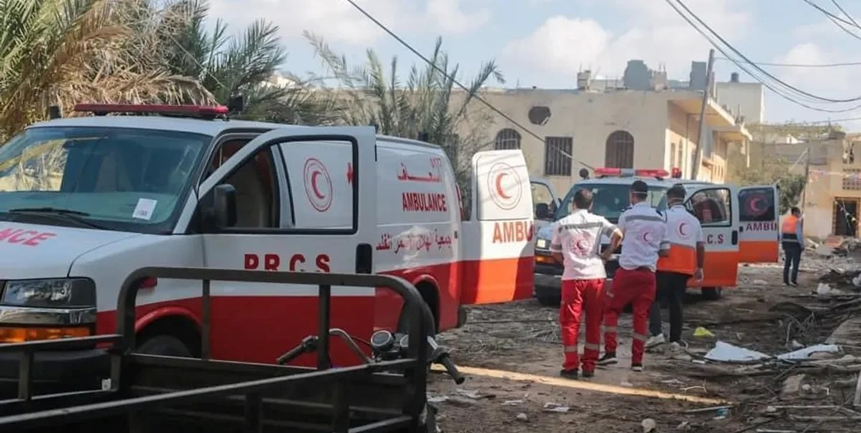
The systematic destruction of Gaza’s health sector following the events of October 7 has led to both direct and indirect consequences. The direct impacts were evident in the targeting of healthcare infrastructure and medical personnel, resulting in severe human and material losses. Indirect effects emerged in the form of increased strain on the healthcare sector due to acute shortages of medical supplies, equipment, and medications—compounded by the spread of disease driven by harsh living conditions, limited access to aid, and movement restrictions.
Against this backdrop, the article explores an emergency response scenario aimed at implementing immediate and effective solutions to revive the healthcare sector by identifying urgent priorities to ensure the continued delivery of essential health services. It also outlines the efforts required from donors and international organizations to support reconstruction efforts and ensure the sustainability of healthcare services in Gaza over the coming months. The emergency response plan is structured around three pillars: restoring the operation of essential health facilities, securing critical medical supplies, and providing psychosocial and mental health support.
Estimating the Cost of Reconstruction
In its latest report issued in February 2025, titled “Gaza and the West Bank: Interim Rapid Damage and Needs Assessment,” the World Bank (WB) estimated that damage to the health sector infrastructure and facilities in Gaza amounts to approximately $1.3 billion. In addition, material losses—including lost income, job losses, and displacement-related expenses—were estimated at approximately $6.3 billion.
Figure 1: Estimated Damage to Gaza’s Health Infrastructure (in Million USD)

The WB has further estimated that the recovery and reconstruction needs of the healthcare sector across Gaza exceed $7 billion, covering both reconstruction costs and service delivery requirements. Short-term needs alone amount to $4.3 billion, with a focus on humanitarian response efforts aimed at restoring and expanding essential services, rebuilding health infrastructure, and addressing immediate priorities such as mental health, rehabilitation, nutrition, and non-communicable diseases.
Medium- to long-term needs are estimated at $2.7 billion, with an emphasis on integrating preventive services such as emergency preparedness and response to address emerging public health challenges, as well as scaling up the health workforce to replace the large number of lost personnel. Service delivery during the recovery phase is particularly urgent, with a strong emphasis on addressing the spread of mental health disorders, malnutrition, and infectious diseases. Additionally, patient evacuation and the restoration of health information systems are essential to ensure continuity of care.
An Emergency Response Plan
This plan aims to resume urgent healthcare services and provide alternatives for destroyed facilities within a period of three to six months. The framework of the plan has been developed based on several factors, most notably the extent of damage and destruction to the healthcare sector, the priority of providing urgent services to displaced persons and local residents, and the needs of the healthcare system as well as the estimated cost of $4.3 billion, according to the WB. The plan is divided into several parts, with the key ones outlined below:
1. Reactivating Essential Healthcare Facilities: Restoring healthcare facilities in Gaza presents a major challenge due to the scale of destruction, the high number of casualties, and the growing humanitarian needs, which calls for a comprehensive approach that combines immediate repairs with long-term planning. A rapid assessment of damage to health infrastructure is a critical step in this process, along with evaluating the needs of the population based on population density and rates of internal displacement. This helps in identifying urgent medical priorities, ensuring the provision of the most critical equipment and medications, and redistributing resources more fairly and effectively. This part of the plan includes the following:
- Deployment of Prefabricated Containers
Known as Modular Primary Healthcare Facilities, these units support patient care in damaged hospitals and clinics, particularly during emergencies and in post-disaster or post-conflict reconstruction efforts. They have been central to WHO’s response and recovery strategies during the Russia-Ukraine war and were widely deployed in natural disasters like the 2010 Haiti earthquake and the 2023 Turkey-Syria earthquake.
These mobile units come equipped with a variety of medical equipment, including X-ray machines, mini operating rooms, ICU units, and laboratories, allowing them to provide full medical services in crisis environments. They are easy to transport and set up, with each unit taking just 10 days to two weeks to install. While temporary, they offer a flexible and sustainable solution to the shortage of healthcare infrastructure, capable of replacing damaged facilities for up to 10 years. With the number of ICU beds down to 81 and emergency beds at just 258, Gaza currently needs an estimated 80 to 100 containers.
 An example of modular primary healthcare facilities
- Scaling Up Mobile Field Hospital Construction
The World Health Organization reported that nearly 10 mobile field hospitals are currently operational in the Dier al-Balah, Khan Yunis, and Rafah governorates, with six functioning fully and four partially. These field hospitals provide a combined capacity of over 600 beds. This calls for further expansion of mobile hospitals in other affected areas in northern Gaza, as there is an urgent need for 10 additional hospitals to address the existing shortfall in beds, which has decreased from 2,536 to 1,847.
In this context, Al-Quds University has signed a cooperation agreement with the Jordan Hashemite Charity Organization (JHCO), the Kids Operating Room Foundation (KidsOR), the United Nations Development Programme (UNDP), and the Arab and International Organization to Construct in Palestine (AIOCP). The goal is to establish three modern mobile hospitals in the Gaza Strip to address the urgent healthcare needs of children, women, and injured patients. Notably, the KidsOR Foundation has extensive experience in setting up hospitals in conflict zones worldwide.
- Converting Non-Medical Buildings into Temporary Hospitals
In times of disasters and crises, available buildings are used to provide urgent medical care in affected areas, based on several factors. The most important of these are ensuring the structural safety of the building, availability of essential services such as water and electricity, and proximity to population centers and displacement areas. This can be achieved by developing an emergency plan that includes a list of undamaged buildings, along with securing international support to ensure the availability of necessary medical supplies and equipment.
Notably, during previous crises in Gaza, many non-medical buildings were converted into field hospitals, including mosques, schools, and even some event halls, to meet urgent medical needs and alleviate pressure on existing healthcare facilities. In this context, Gaza requires the conversion of approximately 15 to 20 buildings into hospitals to restore the pre-war number of beds and operational hospitals.
- Securing Critical and Urgent Medical Supplies
The World Bank reported that Israeli lockdowns and escalations over the past 16 years have severely impacted Gaza’s healthcare systems. As a result, more than 40% of essential medicines have run out, and critical delays in medical referrals have led to higher mortality rates, with some health conditions in Gaza becoming untreatable.
The emergency response plan thus relies on several key areas to ensure essential medicines and equipment reach hospitals and health centers in time, including the following:
- Identifying urgent needs, including essential medicines, medical equipment, and necessary surgical tools for handling emergency cases, in coordination between the Palestinian Ministry of Health and international organizations.
- Arranging urgent shipments for essential medicines, medical consumables, and lab materials.
- Cataloging non-communicable diseases to ensure patients receive the necessary treatments, especially those with dialysis needs, cardiovascular diseases, and cancer patients. These patients are at significant risk due to a lack of access to medications and proper healthcare, with approximately 827,100 affected.
- Ensuring the continuous entry of medical aid, bringing in specialized international medical teams, and ensuring their protection to reach the affected areas and provide medical services, along with redistributing medical staff within Gaza to optimize human resources.
- Strengthening the stockpile of essential medicines (such as antibiotics, chronic disease medications, and emergency drugs).
- Mental Health and Psychosocial Support
The residents of Gaza have been subjected to severe psychological trauma due to the war. A report by UNRWA, in partnership with UNICEF, states that one-third of the population requires psychological support, with widespread mental health disorders that need intervention, such as PTSD, depression, sleep disorders, and long-term psychological effects on children and teenagers. Consequently, mental health support requires an urgent plan that includes psychological treatment, social rehabilitation, and crisis management training, through the following measures:
- Establishing mental health support centers in field hospitals.
Creating digital platforms offering remote psychological consultations and supporting communication with international mental health professionals. - Providing specialized mental health staff.
- Rehabilitating survivors of both physical and psychological trauma.
- Offering psychological support programs for medical personnel and workers in the healthcare field.
- Providing psychological support programs for children and women.
In short, the emergency response and reconstruction plan for Gaza calls for immediate action from the international community. Sustainable funding is critical to implementing the proposed measures, with the following being the main donors and partners:
- The World Bank, which provides funding to the WHO to rehabilitate hospitals and expand health services in coordination with partners like UNRWA, UNICEF, UNDP, and KidsOR
- The World Health Organization, which delivers technical and operational support
- The European Union, which funds healthcare infrastructure and medical training programs
- Arab and Islamic countries, including Egypt, Qatar, Saudi Arabia, Kuwait, the UAE, and Turkey, which offer financial aid, deploy medical teams, and contribute to building field hospitals
- International humanitarian organizations, such as the Red Cross and Doctors Without Borders, which play a vital role in delivering urgent support through mobile hospitals and emergency medical supplies.