








Military operations in the Gaza Strip are in their second month. Violent clashes have spread from Israeli settlements in the Gaza Strip envelope to inside the Strip. Since their inception, battles have been largely characterized by irregularities, spanning from “immersive operations” to “street wars”, in their contemporary sense.
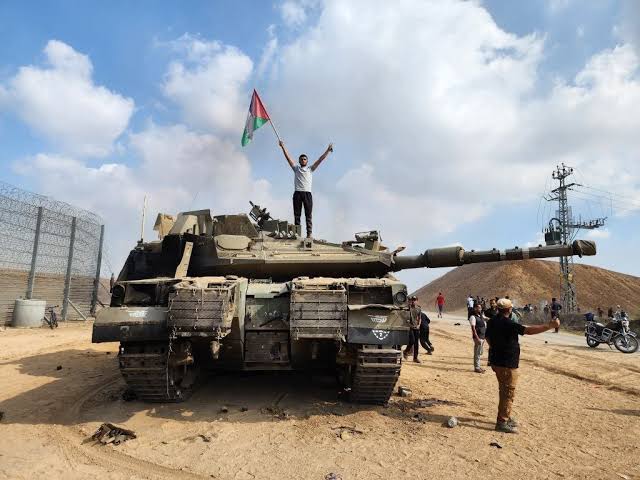
Despite having learned valuable lessons from previous engagements, the Israeli army’s defensive strategies proved ineffective in thwarting Hamas fighters’ initial attempt to breach the separation barrier. Furthermore, despite expanding its technological capabilities, training Israeli ground units in urban warfare did not contribute to a reduction in losses.
Military Tactics Used by Both Sides to Start the Battle
Al-Qassam Brigades, the military branch of the Hamas movement, implemented a specific strategy with the aim of disrupting the decision-making process and dispersing Israeli monitoring systems, which would ultimately led to the isolation and dispersion of Israeli ground units. In order to carry out its plan, a multifaceted attack was launched first using a variety of air, sea, and land forces. Following this, attacks were launched to obstruct Israeli support that was expected to arrive from behind the lines.
Sequence of Hamas’ Initial Attack
- A speedboat assault on the Zikim naval base in the northern region of the Gaza Strip.
- Electronic interference with Israeli satellite signals, communications, and radars
- A missile attack that aimed to confuse the Iron Dome system by utilizing three different types of long-range ground-surface missiles with varying shooting angles and ranges
- Aerial incursions by motorized paragliders, which typically fly at speeds of between 24 and 50 km/h between 3 and 5 km. These paragliders are harder for radars to detect because they fly at low altitudes, at speeds under 100 km/h, and with little thermal signature. Their objective was to attack positions of command and control and isolate the forces on the front lines by attacking them from behind.
- The main assault was carried out by individuals the size of a military division, organized into small, agile groups that could move quickly and make use of loaders, motorcycles, and small transport vehicles. In an interview with The New Statement magazine on 4 November, Eitan Shamir, the director of the Center for Strategic Studies at Bar-Ilan University, stated that the separation barrier is made to fend off multidirectional attacks involving up to fifty people. This was the planners’ highest estimate, yet the assault was launched by 1,500 individuals. The cameras of the reconnaissance balloons were undergoing maintenance that day; this was scheduled to be completed following the holiday. At least two-thirds of the troops were on leave, and the Air Force was virtually nonexistent, with only two operational Apache helicopters.
The Israeli troops stationed in defensive positions along the front line experienced significant distress as a result of the surprise assault. They abandoned their positions and arbitrarily withdrew. This serves as a compelling illustration of the Israeli military doctrine that victory in battle requires unavoidable technical, intelligence, and aerial superiority. However, in all cases, there is no substitute for actual soldier ground holding, even in the presence of all these factors.
The Israeli army, meanwhile, was unable to bomb its settlements with military aircraft, so it was forced to fight a close battle without any advance knowledge of the theater of operations. Its defense plan consisted of five tactical steps:
- Step 1: The swift advance of attack helicopters, intended to stop the influx of encroachers, particularly trucks. However, Hamas’ ground-based firing of shoulder-fired anti-aircraft missiles caught the Israeli occupation forces off guard. They thus made an effort to retreat, employ guided missiles for targeted sniping at safe distances, and secure landing zones for special forces.
- Step 2: The swift deployment of specialized forces units, including Yamam and Shaldag, via heavy transport helicopters was met with opposition owing to the attack helicopters’ inadequate security. Furthermore, and the landed forces were seized due to their small number.
- Step 3: This step involved the deployment of forces trained in counterterrorism operations who arrived in vehicles and whose vehicles the defenders precisely ambushed.
- Step 4: Drones and reconnaissance aircraft were used to locate Hamas’ operations rooms, field commanders, fighter groups, and missile stockpiles in the Gaza Strip. The fighters then proceeded to bomb these targets in an effort to hinder the offensive effort.
- Step 5: The army units arrived, first the infantry brigades (like the Nahal brigade) with their fast-moving armor and later the armored and tank brigades under attack from Hamas suicide and attack drones.
Military Strategies of the Conflict in the Gaza Strip
Urban battle experience in the past has shown that military operations against irregular forces necessitate a flexible and astute approach, along with equipment specially designed for the task.
More crucially, this necessitates the provision of specialized training for each combatant, which physically and psychologically prepares them to confront a lightly equipped adversary with exceptional maneuverability within a theater of operations. Furthermore, it entails the deployment of units of specialized forces dedicated to urban warfare, which are typically lightly armed and equipped with swift transportation, in order to clear the way for the army’s heavy forces to advance from the rear.
With regard to this conflict, the Israeli military campaign into the Gaza Strip commenced on 27 October. This operation was carried out with the explicit, stated strategic objective of besieging and suppressing the Hamas movement in order to eradicate it, subsequent to the call-up of the reserve forces. Preparations for this ground invasion included the following:
- A vigorous reconnaissance effort to get a comprehensive picture of the field situation, using all available Israeli resources as well as those of the allies, particularly the numerous US and British reconnaissance aircraft
- Conducting ground force incursions and withdrawing prior to the launch of the primary assault
- Preparation for firing with ground and naval artillery while continuing the process of locating Hamas operations rooms and field commanders and targeting them with intense bombardment that could reach 200-400 targets in one night
- Progress along three distinct axes emanating from the central, eastern, and northern regions of the Gaza Strip
- Complete disruption of communications due to termination of Internet services
- Locating anti-tank defensive positions and trying to destroy them to secure and create a path for the ground forces that will be accompanying them.

The armor and parachute brigades were the main force for the ground invasion mission, with assault aviation covering their rear lines and infantry brigades from the rear covering their front lines. In general, an Israeli armored brigade is composed of three divisions: an engineer battalion, three armored battalions, and a signal platoon. Within each battalion, there is a support company comprising leadership and services personnel, two tank companies, an armored support company, and a reserve tank company.
The assault was executed utilizing two distinct iterations of the Merkava tank system: the Merkava 5, also known as Barak, and the upgraded Merkava 4 designated as Roach. These are the most recent iterations featuring the Ofoq system, which facilitates communications with other air and ground systems, and the Trophy system, which provides a 360-degree sensing field around the protected vehicle.
For combat maneuvers, the Armored Corps employs two tactical formations: the first, a full company force, provides substantial support for the maneuver through directed firepower; and the second, an already-utilized semi-company force, significantly aids the maneuver.

The strategy employed by the Apache attack helicopter, which utilizes Hellfire and Spike missiles for long-range selective sniping, entails establishing a connection with the Eitan TB and Searcher reconnaissance drones stationed at the Hatzor base. These reconnaissance drones consistently relay targets to the reconnaissance aircraft. Targeting then commences, which closely resembles the approach taken by United States aviation attached-to-ground units.

Regarding the combat tactics employed by the Hamas movement during conflicts within the Gaza Strip, we find that it implemented guerrilla warfare, exclusively relying on tunnels to facilitate movement within the theater of operations characterized by strategically concealed apertures for assault and swift retreat, all with the aim of accomplishing critical objectives:
- Encircling and isolating the Israeli ground forces by surprising them from behind.
- Approaching the Israeli forces in close proximity to prevent the infusion of artillery or air support.
- Achieving optimal conditions to launch unguided missiles with a high rate of success, given that these armaments are difficult to detect and, consequently, do not provide assurance of a significant impact.
The Hamas movement capitalized on the Israeli forces’ inability to follow the logic of “combined arms maneuver”, which calls for integration between infantry and armored forces. This was demonstrated by the ease with which Hamas fighters were able to approach Israeli vehicles and equipment without being intercepted by Israeli infantry soldiers, allowing them to launch shells or even place explosive charges on the hulls of vehicles and easily retreat into tunnels. They were also able to fire large-caliber shells, such as Al-Yassin 105, which are locally manufactured designed to penetrate armor.
Tunnels were not Hamas’ only leverage; it also has the ability to conceal rocket and mortar artillery, as well as march through cracks and ground openings to provide fire support to combat elements engaged with Israeli forces, or even thwart Israeli support coming from the rear with rocket artillery, which has a high fire intensity. Its missiles and small mortar shells are fired one after the other and are difficult to intercept. Strategic maneuverability is an additional benefit offered by the diminutive Shehab and Zouari suicide drones, enabling them to target armored vehicles or command units via electronic warfare if their communications are intercepted and their whereabouts are ascertained. Finally, quadcopter drones were used to infiltrate undetected behind Israeli lines in order to attack soldiers’ gatherings with free-drop bombs.
In short, the engagements in the Gaza Strip revealed that the Israeli army exclusively employs ferocious offensive power, oblivious to the substantial casualties on both sides, in an attempt to attain field triumphs commensurate with the principal setback in the defensive operation. Moreover, the Israeli army further depletes its ground forces and ammunition while being heavily reliant on the assistance extended by the United States. Hamas’ success in the Gaza Strip conflicts is contingent on its ability to maintain support for armaments, gradually compensate for material and human losses, and withstand the increasing pressure from Israeli forces in the north and south.


