








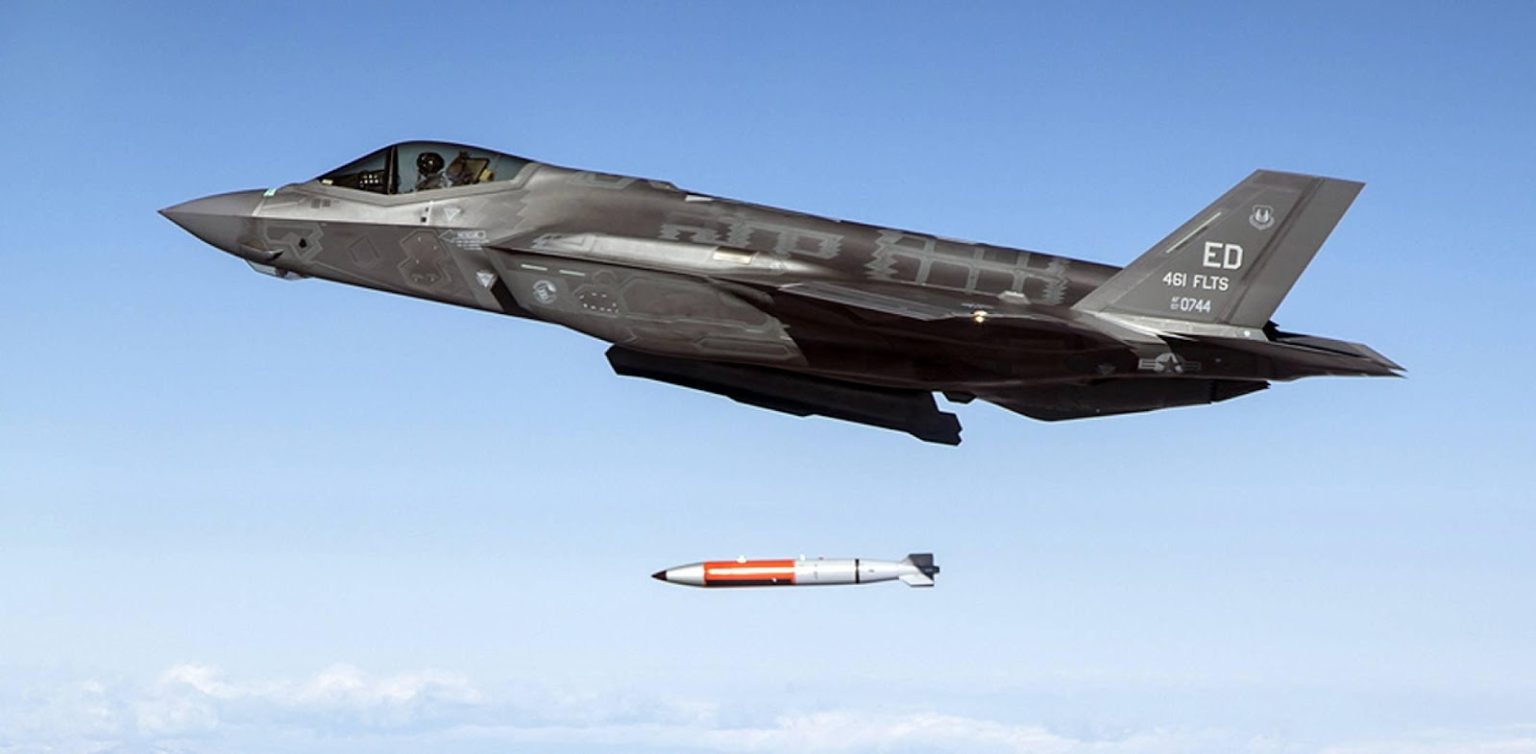
Nuclear weapons pose a threat to global security and stability, especially with the existence of nuclear arsenals in nine countries. Russia and the United States possess the largest share of nuclear warheads in the world, but this has not hindered the ongoing research and development efforts in their military laboratories to achieve smaller, more destructive, and more penetrating guided nuclear bombs. As this arms race continues, nuclear agreements between them occasionally crumble, and their provisions fall one by one amidst political entanglements over global issues that challenge the sovereignty and dominance of both countries. Given that nuclear armament is an important tool for imposing vision and dominance over international issues, neither country spares any effort to develop the capabilities of their nuclear triad—land, sea, and air—showcasing their abilities from time to time and improving the delivery systems for nuclear warheads to achieve better accuracy and greater range. In this context, on March 8, 2024, Ross Gomier, director of the F-35 program, announced that the American F-35 fighters were officially adopted to carry B61-12 nuclear bombs, becoming the first fifth-generation stealth aircraft to do so.
Nuclear-Armed States
There are nine countries in the world that possess nuclear weapons: Russia, the United States, the United Kingdom, France, China, India, Pakistan, North Korea, and Israel. There are 12,512 nuclear warheads in the world, according to the latest inventory count of the world’s nuclear warheads announced by the Stockholm International Peace Research Institute in its 2023 yearbook. Russia and the United States hold 88.98% of the global nuclear arsenal, with Russia possessing 5,889 warheads, outnumbering the United States, which has 5,244 warheads. Israel owns 90 nuclear warheads, although some reports indicate that it has a stockpile of nuclear materials sufficient to manufacture 200 warheads. Table 1 shows the estimates of nuclear warheads in the nine countries, along with the date of their first nuclear test.
Table 1: National Inventories of Nuclear Warheads
| Country | Date of First Nuclear Test | Total Stockpile of Nuclear Warheads |
| The United States | 1945 | 5244 |
| Russia | 1949 | 5889 |
| The United Kingdom | 1952 | 225 |
| France | 1960 | 290 |
| China | 1964 | 410 |
| India | 1974 | 164 |
| Pakistan | 1998 | 170 |
| North Korea | 2006 | 30 |
| Israel | Unknown | 90 |
Nuclear Developments
Despite the existence of agreements to reduce nuclear arsenals between Russia and the United States, the treaty that has remained in effect in this regard is the one that Russian President “Vladimir Putin” announced his country’s suspension of participation in, namely the “New START Treaty”, a treaty between the United States and Russia to reduce strategic weapons. This announcement came as a result of tensions surfaced due to the Russian-Ukrainian war. Information indicates that the development of nuclear weapons did not stop with the signing of the agreements between the two parties, but rather work continued in American nuclear facilities and laboratories to develop nuclear armament. Some of these laboratories played a pivotal role in developing the first nuclear bomb (15 kilotons TNT equivalent) and the second (21 kilotons TNT equivalent) that were dropped on the cities of Hiroshima and Nagasaki in World War II. Examples of these laboratories include Los Alamos National Laboratory in New Mexico, Sandia National Laboratories in New Mexico, Lawrence Livermore National Laboratory in California, Oak Ridge National Laboratory in Tennessee, and Mound Laboratory in Ohio.
American Nuclear Weapons and Development Plans
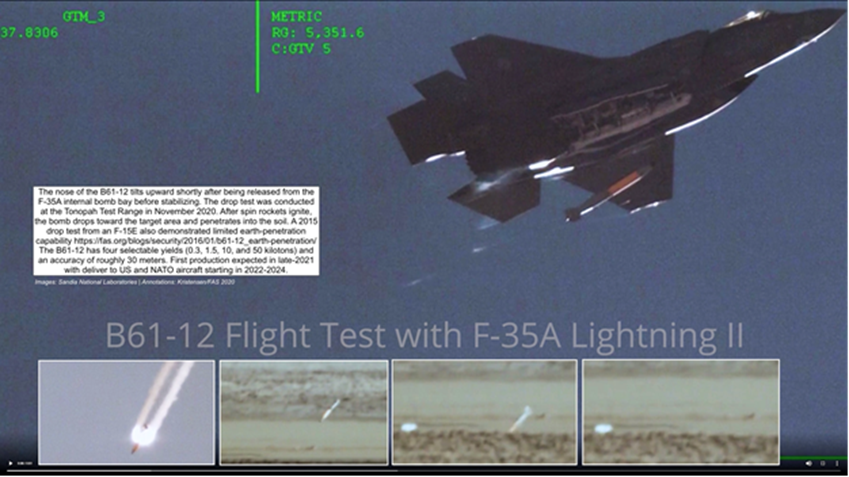
The United States owns various types of nuclear bombs with designs that are more advanced than in the past, such as the gun-type design like the “Little Boy” bomb, and the implosion design “Fat Man,” to more advanced designs like the “boosted fission” design, which uses a mixture of fusion materials as a neutron source to cause nuclear fission at a higher rate than can be achieved by traditional fission. The United States has thermonuclear bombs, sometimes called hydrogen bombs or fusion bombs, whose destructive power is 100 to 1,000 times greater than that of fission bombs, thus their destructive force is measured in megatons. Since the 1990s, the United States has consistently sought to provide its air force with a low-yield, precision-guided nuclear weapon by developing programs to upgrade its thermonuclear bombs. This pursuit is not new, but it’s real first steps date back to the Obama administration’s approval to upgrade the nuclear bomb “B-61” by using a new tail kit assembly, and a guided nuclear bomb known as the twelfth modification to the original design “B-61” (the highest setting for the new bomb’s power reaches 50 kilotons). The new type, known as “B61-12,” uses a new tail kit assembly to convert “B 61-4” into a guided nuclear bomb to increase the weapon’s accuracy, and the 50-kiloton warhead from “B 61-4” can be used to threaten the same targets that today require “B 61-7” with a higher capability. In November 2020, the F-35 fighter jet conducted training offensive missions by dropping the B 61-12 nuclear bomb from an altitude of 25,000 feet (7,620 meters), at a speed of 1 Mach (1,234.8 km/h) in the Tonopah training field. These improved bombs were also integrated into Dutch aircraft, which will allow them to be integrated into any aircraft operating in the Pacific theater of operations or any other theater of operations.
Confirmed Dangers and Future Threats
The integration of nuclear bombs, specifically by stealth fighter aircraft with low radar signatures – LO, poses a significant risk in offensive operations for two reasons; the first is due to their high ability to penetrate air defences by exploiting their design, which makes it difficult to continuously track the aircraft by radar (Tracking), and the second reason is due to their use of digital stealth concept, which is using the aircraft’s electronic warfare capabilities through the “AN/ASQ-239” system to jam/avoid air defence radars or fighter jets, especially “X-band” radars that direct missiles. It also possesses a revolutionary mission computer that works similarly to “Raid Assessment Mode,” but on an extended scale, resembling an operations room but in a miniature form as a command and control unit and communication link between different systems.
Most scientific estimates indicate that this type of bomb, in addition to the mentioned integration process, will increase the likelihood of using nuclear weapons, i.e., nuclear weapons may shift from “deterrence policy” to “direct use policy,” and major powers will seek to develop current nuclear weapons, which was indeed announced by the American military with plans to develop a new category of nuclear gravity bombs “B 61-13,” to replace the older generation “B 61-12,” which does not contain a sufficient payload to destroy underground hardened targets.
Effects of Using a Nuclear Bomb
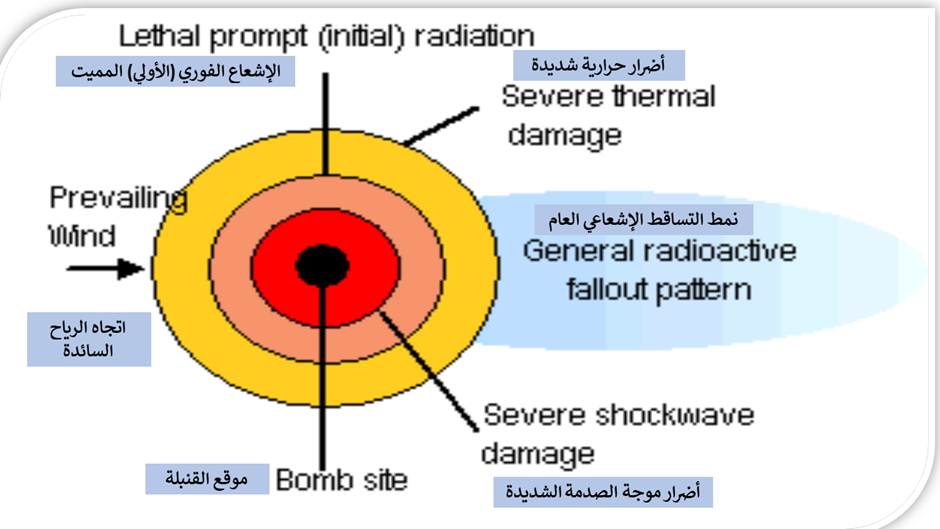
There is no clear way to estimate the impact of a single nuclear bomb, as this depends on several factors such as the weather on the day of its detonation, the time it explodes, the geographical nature of its landing site, and whether it explodes on the ground, in the air, or underground. However, there are a number of primary and subsequent impacts that are encountered. For example, the general patterns of damage resulting from a 10-kiloton ground nuclear explosion can be represented as follows, as illustrated in Figure 1:
- The destruction resulting from the primary effects; shock waves, thermal energy, and primary radiation expands in a circular pattern. Severe damage from the shock wave can extend to about half a mile, severe thermal damage can extend approximately one mile, and flying debris can extend a few miles. The primary nuclear radiation (immediate) from a 10-kiloton explosion can expose unprotected individuals within about 3/4 mile of the blast to a lethal radiation dose.
- Radiation fallout occurs in an irregular oval pattern in the direction of the wind, and lethal radiation can extend up to 6 miles.
Figure 1: Representation of the General Patterns of Damage Resulting from a 10 Kiloton Nuclear Explosion on the Ground
Source: The National Academies and the U.S. Department of Homeland Security.
Information indicates that about 35% of the energy from a nuclear explosion is released in the form of thermal radiation. Since thermal radiation travels at nearly the speed of light, the first thing to impact is a flash of blinding light and heat. The light itself is enough to cause what is known as “flash blindness,” which is usually a temporary form of vision loss that can last a few minutes. For example, in the event of a 1-megaton bomb explosion, which is about 80 times larger than the bomb that exploded over Hiroshima, people up to 21 kilometers (13 miles) away would suffer flash blindness on a clear day, and people up to 85 kilometers (52.8 miles) away would suffer temporary blindness on a clear night.
Heat is a problem for those closer to the explosion, where mild first-degree burns can occur up to 11 kilometres (6.8 miles) away, while third-degree burns – the type that destroys and ulcerates skin tissue – can affect anyone up to 8 kilometres (5 miles) away. Third-degree burns covering more than 24% of the body are likely to be fatal unless people receive immediate medical care.
Conclusion
Nuclear weapons are a category of weapons of mass destruction, the utilization of which carries significant risks that transcend the boundaries of both the employing state and the targeted state. Their repercussions reverberate across regional environments and have the potential to affect the entire globe. As the world is well aware of these dangers, especially the nuclear-armed states, treaties and agreements were formulated, with the Treaty on the Non-Proliferation of Nuclear Weapons at the forefront, which failed to maintain the number of nuclear-armed states as is; as four countries succeeded in joining the big five in the military nuclear club. Other nuclear agreements specifically dealing with nuclear warheads between major countries, especially Russia and the United States, only succeeded in reducing numbers, but the current military nuclear stockpile still poses a serious threat to peace and stability in the world, especially as it has been developed to be more efficient and deadly.
Between efforts to reduce the number of nuclear warheads and other efforts to develop the nuclear arsenals of major countries, diversify nuclear weapons between strategic and tactical, and develop weapons delivery methods, fears remain and questions are legitimate, which raises the question: can nuclear policy shift in the future from a policy of deterrence to a policy of direct use in light of the excessive use of the nuclear card or pressing the nuclear button? The answer to such a question cannot be provided in an article or in a laboratory, but rather it will be shaped by the closed policy rooms for the world to witness in its upcoming events.