








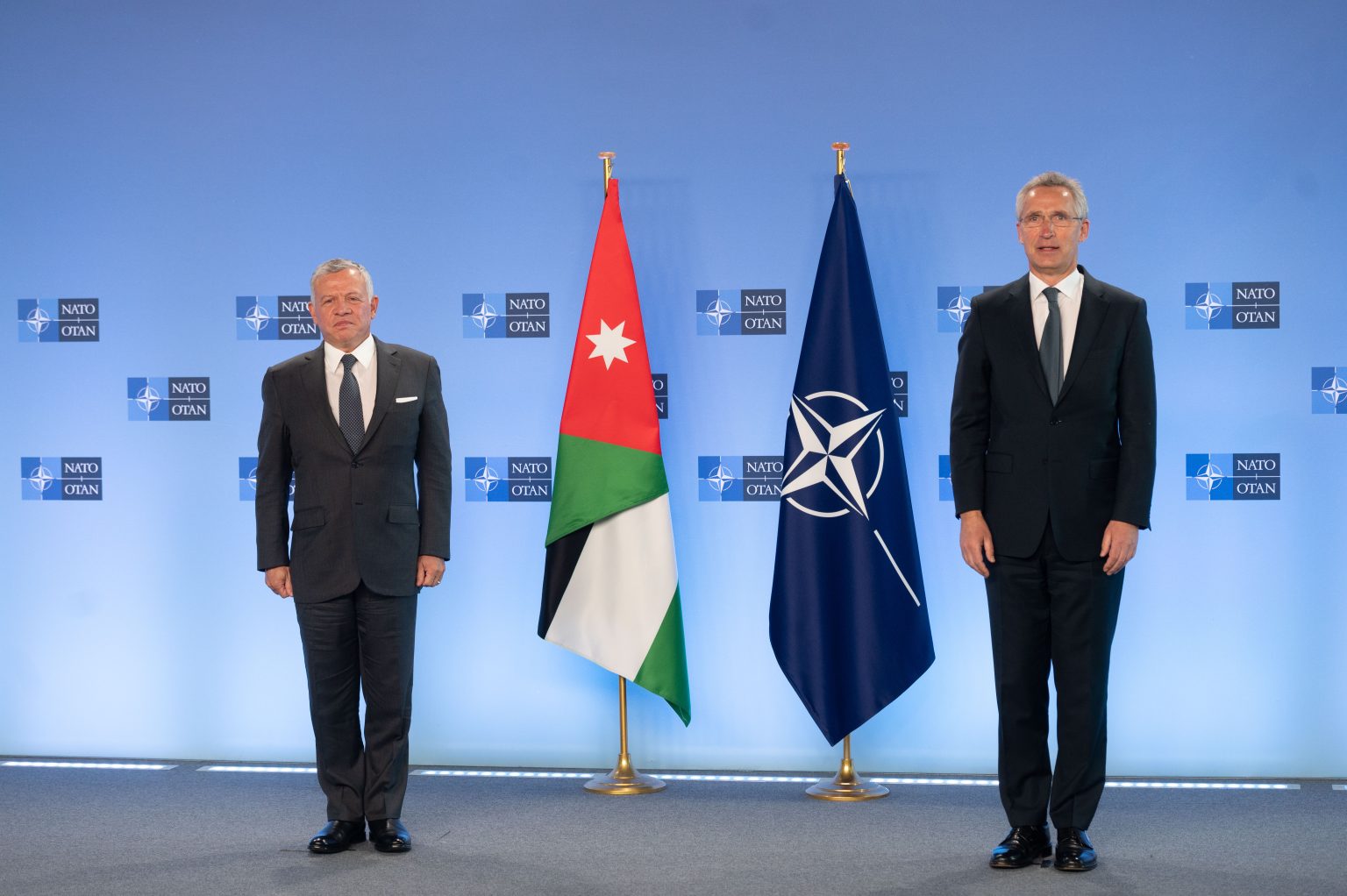
Recognizing the strategic importance of the Middle East, particularly Jordan, NATO announced at the 2024 NATO Summit in Washington D.C., held from July 9-11, the establishment of its first liaison office in the Middle East region, located in Jordan. Notably, plans for a NATO liaison office in Jordan were unveiled at the 2023 Vilnius summit as part of NATO’s efforts to deepen ties with countries in its Southern neighbourhood.
This development unfolds at a time when the region is undergoing rapid transformation, underscored by the ongoing Gaza conflict. Concurrently, the geopolitical landscape is being redefined through evolving regional and international partnerships. Heightened tensions along the Israeli-Lebanese frontier pose escalating threats, while NATO’s southern neighborhood grapples with deteriorating security, encompassing smuggling, arms trafficking, and illegal immigration. The internal instabilities plaguing Syria, Iraq, Lebanon, and Yemen, coupled with the specter of Israeli regional escalation and its potential ramifications for the Palestinian cause, introduce significant risks. Moreover, Houthi aggression in the Red Sea and the possibility of Mediterranean tensions further exacerbate the situation. Jordan, as a proximate neighbor to the West Bank, faces potential security implications.
Against this background, this paper seeks to explore the nature of cooperation between Jordan and NATO and the implications of opening the office in Jordan at this particular time.
I. Extended Partnership
Since 1995, Jordan has maintained a strong partnership with NATO as a member of the Mediterranean Dialogue, which includes Algeria, Egypt, Israel, Jordan, Mauritania, Morocco, and Tunisia. This Dialogue, initiated in 1994 as part of NATO’s strategy for cooperative security, has expanded over time, with Algeria joining in 2000. Its primary goals are to foster regional security and stability, strengthen friendly relations through political consultation and practical cooperation, and enhance joint efforts against common threats like terrorism, the spread of weapons of mass destruction, and international organized crime.
The Mediterranean Dialogue’s work program has expanded annually to include activities emanating from the Partnership for Peace program, such as military cooperation, civil emergency planning, and scientific and environmental collaboration. Beyond that, the Dialogue has advanced to practical engagement, enhancing the military personnel’s ability in the member countries to collaborate with NATO forces and aiding in the fight against terrorism through participation in Operation Active Endeavour—a NATO-led naval patrol detecting potential terrorist activities in the Mediterranean. Furthermore, cooperation under the Dialogue also includes defense reform and political dialogue enhancement through bilateral meetings at the ministerial level. The Dialogue countries also have access to support from the NATO Trust Fund, enhanced cooperation in disaster preparedness, and the possibility of requesting assistance from the Euro-Atlantic Coordination Center for Disaster Response.
In 1996, the United States designated Jordan as a major non-NATO ally. Jordan has supported NATO military forces in the fight against Daesh, including allowing NATO to use the Muwaffaq Salti air base. NATO considers Jordan a dependable partner and a key player in maintaining regional stability, particularly amid the ongoing turmoil. Furthermore, Jordan has been an active participant in the Global Coalition against Daesh and has contributed to NATO-led peacekeeping operations in Bosnia and Herzegovina, Kosovo, Afghanistan, and Libya.
Jordan became an Enhanced Opportunities Partner of NATO following the NATO 2014 Wales Summit. It has actively participated in NATO’s Defence and Related Security Capacity Building Initiative (DCB), focusing on areas such as counter-improvised explosive devices, cyber defense, maritime security, and border security. In 2021, a military training center for female military personnel was established in Jordan in cooperation between the Jordanian Armed Forces (JAF) and NATO. NATO has also played a significant role in supporting the Jordanian National Center for Security and Crisis Management in addressing the challenges posed by the Covid-19 pandemic.
In addition, cyber defense exercises were conducted between NATO and the JAF, with Amman hosting the first NATO exercise in the Mediterranean neighbouring countries, REGEX 2017. These exercises have significantly enhanced Jordan’s ability to confront cyber threats, including training 500 Jordanian experts and policymakers in cyber defense and providing awareness courses at tactical, operational, and strategic levels. In May 2023, the Jordanian city of Aqaba hosted a three-day workshop to identify maritime requirements and explore ways for NATO to improve the efficiency and sustainability of Jordan’s counter-terrorism capabilities. Aqaba also hosted NATO’s defense capacity-building training activities for Iraq at the King Abdullah II Special Operations Training Center (KASOTC).
II. Numerous Implications
The inauguration of NATO’s first liaison office in the region, based in Jordan, marks a significant advancement in the partnership between NATO and Jordan. This office is designed to bolster political dialogue and foster closer collaboration with Jordan. It will serve as a hub for cooperation through a range of activities, including conferences and training programs focused on strategic analysis, emergency planning, crisis management, cybersecurity, and climate change. The implications of this development can be detailed as follows:
1. Critical Timing
The timing of NATO’s establishment of its first liaison office in Jordan is crucial, given the regional unrest, the ongoing war in Gaza, and the threats on the Lebanese-Israeli border. The potential Turkish withdrawal from northern Syria further underscores the strategic importance of NATO’s presence in Jordan and on the southern border of Syria to strengthen its ability to address threats facing Israel and enhance its capacity to manage security challenges on Iraq’s western frontier, including those emanating from Baghdad.
On the other hand, regional tensions have heightened security instability in Jordan. The porous borders with Syria and Iraq have facilitated the trafficking of drugs and weapons into the country, impacting the structure of Jordanian society. Captagon smuggling gangs, active from Syria to Jordan, destabilize the Kingdom and its social fabric. This issue has been amplified by the ongoing war in Gaza, where the Muslim Brotherhood in Jordan collaborates with Hamas to facilitate the smuggling of weapons. Consequently, Amman faces a significant burden in maintaining internal security preparedness.
Thus, the establishment of the NATO office serves as a guarantee from NATO to ensure that stability in Jordan remains intact amidst the escalating protests since October 7, 2023. These protests have called for the Jordanian government to sever ties with Israel, nullify the 1994 peace treaty, and revoke the 2017 gas deal with Israel. Additionally, Jordan bears the burden of hosting approximately 2 million Palestinian refugees and no fewer than 650,000 Syrian refugees. The ongoing indecisiveness in Gaza may further exacerbate the refugee crisis, potentially pushing more Palestinian refugees into Jordan.
Despite its intended stabilizing effect, the presence of a NATO liaison office in Amman may exacerbate opposition voices within Jordan, especially considering the popular anger towards Israeli practices against Palestinians and attempts to displace them from the West Bank. Protests and calls for decisive measures to confront Israeli violations have intensified, alongside widespread rejection of the US military presence in Jordan and Washington’s support for Israel in the Gaza war. Furthermore, the parliamentary opposition has criticized the 2021 defense agreement between Jordan and the United States, viewing it as an infringement on Jordanian sovereignty.
2. Geopolitical Significance
Jordan’s geographical location is strategically significant, bordering Syria to the north, Iraq to the east, Saudi Arabia to the southeast and south, and the West Bank and Israel to the west. The West Bank lies approximately 27 kilometers from the Jordanian capital, Amman. This positioning underscores Jordan’s geopolitical importance for NATO, as it sits in a region that bridges the Middle East with North Africa and is central to countries of significant interest to NATO, including the Gulf States, Iraq, Syria, Lebanon, and Israel. Therefore, the opening of NATO’s first liaison office in Jordan signifies a strengthened influence in the region, bolstering support to confront threats and specifically supporting Jordan’s stability amidst its turbulent surroundings. Jordan’s geopolitical location, at the nexus of regional dynamics between Iran and its proxies and Israel and its allies, renders it vulnerable to such disturbances. This vulnerability was highlighted when Iranian-affiliated militias in Iraq and Syria attacked the US base in northeastern Jordan, Tower 22, near Syria’s al-Tanf area. The drone strike on January 28, killed three American soldiers and injured about 40 others. The Iraqi Kataib Hezbollah claimed responsibility for this attack, marking a significant escalation by extending conflict to the Jordanian-Syrian border.
These tensions posed a direct threat to Jordan’s security. On April 1, Israeli aircraft raided the Iranian consulate in Damascus, killing two Iranian generals and five officers, including General Mohammad Reza Zahedi, a Quds Force commander, and his deputy, General Mohammad Hadi Haji Raheemi. In response, Tehran launched hundreds of drones and dozens of missiles at Israel on April 13. Jordan’s air force intercepted and shot down dozens of Iranian drones that violated its airspace en route to Israel.
During these reciprocal attacks, Israel struck a military site in Isfahan, Iran, at dawn on April 19, using three drones, which Tehran intercepted and downed in the Tabriz region, approximately 500 miles north of Isfahan. Iranian forces then launched strikes against Israel through Jordanian airspace. Jordan played a defensive role, intercepting an Iranian drone that breached its airspace. This drone, coming from Iraq, traversed southern Jordan and Aqaba before aiming for the Israeli port of Eilat. Given the ongoing escalation in the West Bank, Jordan’s strategic location puts it on high alert, fearing it could become an arena for conflict.
3. Encircling Risks
The escalating threats arising from conflicts in the Middle East are a shared priority for NATO and Jordan. Jordan continuously faces tensions along its eastern border due to the presence of Iranian-backed militias in Iraq, its northern border with Syria, and its western border with Israel. Additionally, ongoing tensions in southern Lebanon and Yemen, along with the threats posed by terrorist organizations such as Daesh and al-Qaeda in the Arabian Peninsula, jeopardize internal stability in Lebanon, Iraq, Syria, Yemen, Libya, Jordan, and NATO’s Arab partners. Therefore, establishing this NATO office signifies a step towards enhancing Jordan’s military capabilities in addressing these surrounding threats. Furthermore, common security concerns like the proliferation of weapons of mass destruction, regional instability, the Arab-Israeli conflict, and threats to energy security—considering that 65% of Europe’s oil and natural gas imports transit through the Mediterranean—necessitate coordinated efforts between Jordan and NATO to address these challenges.
In conclusion, NATO’s first liaison office in Jordan marks a strategic step towards bolstering the Alliance’s influence in its Southern neighborhood. This development aligns with other strategic initiatives, including the DCB Initiative, the NATO-ICI Regional Centre in Kuwait, the Istanbul Cooperation Initiative, and the NATO Mission Iraq.