






While countries worldwide strive to accomplish Sustainable Development Goal 4, which aims to “ensure inclusive and equitable quality education and promote lifelong learning opportunities for all,” Israeli forces’ crimes in Gaza are depriving students of their right to an education. The Israeli forces persist in disregarding international declarations that prohibit attacks on educational facilities during times of conflict and war, resulting in the complete halt of education less than a month into the school year and the destruction of the majority of educational facilities. Some UN experts describe the situation there as “systemic obliteration of education system.”
How Has the War Affected Education in Gaza?
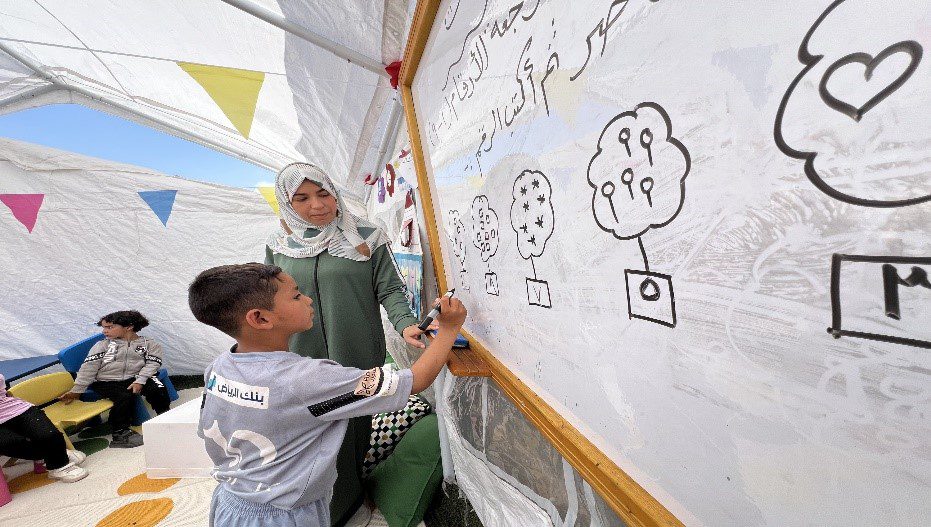
According to recent reports from the United Nations and international organizations operating in the Gaza Strip, over 87% of Gaza’s 563 schools have been either damaged or completely destroyed since the start of the war on October 7, 2023. A total of 212 school buildings were directly targeted and bombed, while an additional 282 school buildings suffered partial destruction. The interruption of education occurred due to both the direct bombing of schools, which violated international law, and the conversion of 320 school buildings owned by the United Nations Relief and Works Agency for Palestine Refugees in the Near East (UNRWA) into shelters for thousands of displaced individuals. Currently, over 503,000 students are deprived of education, while the remaining receive a rudimentary form of education in the makeshift tents located in the city of Rafah, where they were compelled to relocate.
As the Gaza war entered its seventh month, the number of Palestinian students and teachers who lost their lives reached a historically high level, surpassing the casualties of the Russian-Ukrainian war over two years. According to data from UNICEF, the death toll of Palestinian students in a span of 6 months exceeded 5,400 children, while the number of Ukrainian children who lost their lives in the war over a period of two years was at least 600. Approximately 8,000 Palestinian students were injured, compared to 1,350 children in Ukraine, highlighting the extent of indiscriminate crimes committed by the Israeli forces against Palestinians.
The extent of devastation in the Palestinian education sector encompasses not only schools and pre-university students but also universities, which have ceased operations since the onset of the conflict. Out of the total of 17 university buildings, ten suffered moderate or partial damage, while four were completely destroyed. As a result, the affected university facilities now make up more than 82% of the total number of buildings. Now, over 87,000 Palestinian youth who were set to begin their post-university careers have had their university experience cut short. Even though the Palestinian Authority is making an effort to facilitate the enrollment of Gaza Strip university students in West Bank universities via distance education, this effort is inadequate because the universities can only accommodate about a thousand students. Furthermore, the fate of the remaining students remains uncertain.
The Detrimental Effects of War and Denunciation of Israel
The Israeli military’s prolonged attack on educational institutions in the Gaza Strip has intensified the already dire state of the education system, which was already struggling due to the region’s poverty, overcrowded schools, and the population’s limited ability to provide necessary educational resources for their children. There is an immediate need to undertake the reconstruction of demolished school buildings and plan for their expansion in the near future. Furthermore, more than half a million children who are of school age also require educational resources.
In addition to the evident destruction of educational infrastructure, the war also resulted in a loss of educational opportunities. Throughout an entire academic year, the students did not gain any knowledge, and any progress made in prior years was irretrievably lost as a result of their prolonged absence from school.
In addition, it is anticipated that there will be a substantial surge in student dropout rates following the conclusion of the conflict, mirroring the situation in Iraq, where no students have returned to their schools in their entirety in the six years since Daesh was defeated. War has a long-lasting psychological impact on children, especially those who have experienced the loss of loved ones or have become permanently disabled due to the conflict.
Irrespective of the ongoing case brought before the International Criminal Court accusing Israel and its leaders of genocide and ethnic cleansing in the Gaza Strip, for which arrest warrants may be issued soon, the Israeli army has breached several legally binding international conventions that uphold the entitlement of children to receive education and to be protected during times of conflict, including the Geneva Conventions of 1949 and the Rome Statute of the International Criminal Court. Israel’s attack on schools in the Gaza Strip constituted a violation of Security Council Resolution 2601, which was issued in 2021 and mandated member states to implement measures aimed at preventing and countering attacks on educational facilities.
In addition, Israel has declined to endorse the Safe Schools Declaration, an inter-governmental political commitment aimed at preventing attacks on education and mitigating their consequences, which 118 countries have already signed since 2015. Israel’s decision not to sign the Declaration indicates that it opposes any political commitment that could limit its ability to deliberately harm children and civilians in educational establishments. International organizations involved in the Global Coalition to Protect Education from Attack have verified this information in reports that assess the situation in the Gaza Strip during the war. These reports called on the Israeli authorities to enforce the provisions of the Declaration to ensure the safety of schools and universities amidst the ongoing conflict. The Coalition emphasized the importance of holding accountable those responsible for crimes against educational facilities and providing compensation for the attacks.
The Right to Redress and Reparation: Who Will Compensate the Palestinians?
International law mandates that a state must provide appropriate and efficient means of redress to individuals who have suffered harm due to the state’s actions, particularly in cases where the violation of the right to education and other related rights has resulted in the denial of educational opportunities. Hence, the International Court of Justice’s condemnation of the Israeli transgressions pertaining to the Palestinians’ entitlement to education empowers it to issue a binding formula requiring Israel to compensate the Palestinians, rectify the situation, and eliminate the consequences of its violations. Nevertheless, the issuance of this binding formula is contingent upon the Palestinian Authority’s submission of a formal complaint to the International Court of Justice demanding that Israel offer redress.
Considering Israel’s ongoing human rights violations against the Palestinians and its blatant disregard for international conventions, the American government’s unwavering support for these violations makes the promise to compensate the Palestinians and restore their educational facilities to their original state seem like a pipe dream. The Palestinian Authority must thus take action to demand compensation from all parties—including the United States, the United Kingdom, and Germany—that backed the attack on educational facilities, which would allow for the restoration of the Gaza Strip’s schools to their previous state.
Additionally, international organizations may contribute to the compensation of Palestinians. For instance, Education Cannot Wait, which is a global fund established by the United Nations to address education in emergency situations and prolonged crises, has allocated around $50 million to assist children in Gaza. However, such funding will be insufficient in comparison to the devastation that Palestinian educational institutions have endured during the course of the conflict. This requires the cooperation of the international community in order to reestablish education for over 500,000 students. To ensure that all parties fulfil their obligations regarding the present circumstances, it would be advantageous for the Arab Group at the UN Security Council to endorse a preliminary resolution mandating that corporations that produce the weapons used in school shootings provide adequate compensation for the rehabilitation of these facilities and the reinstatement of students.
In short, with Israel’s determination to persist in its crimes against the Palestinians and obstruct efforts to end the fighting in the Gaza Strip, the hope of sending Palestinian children back to school appears distant. Nonetheless, in the event that a ceasefire agreement is established, the regional and international community must place a high priority on finding comprehensive and equitable solutions for Palestinian students to continue their studies. International institutions should prioritize the creation and execution of a plan to restart schooling based on a predetermined schedule while also offering suitable alternatives in case the conflict persists.