







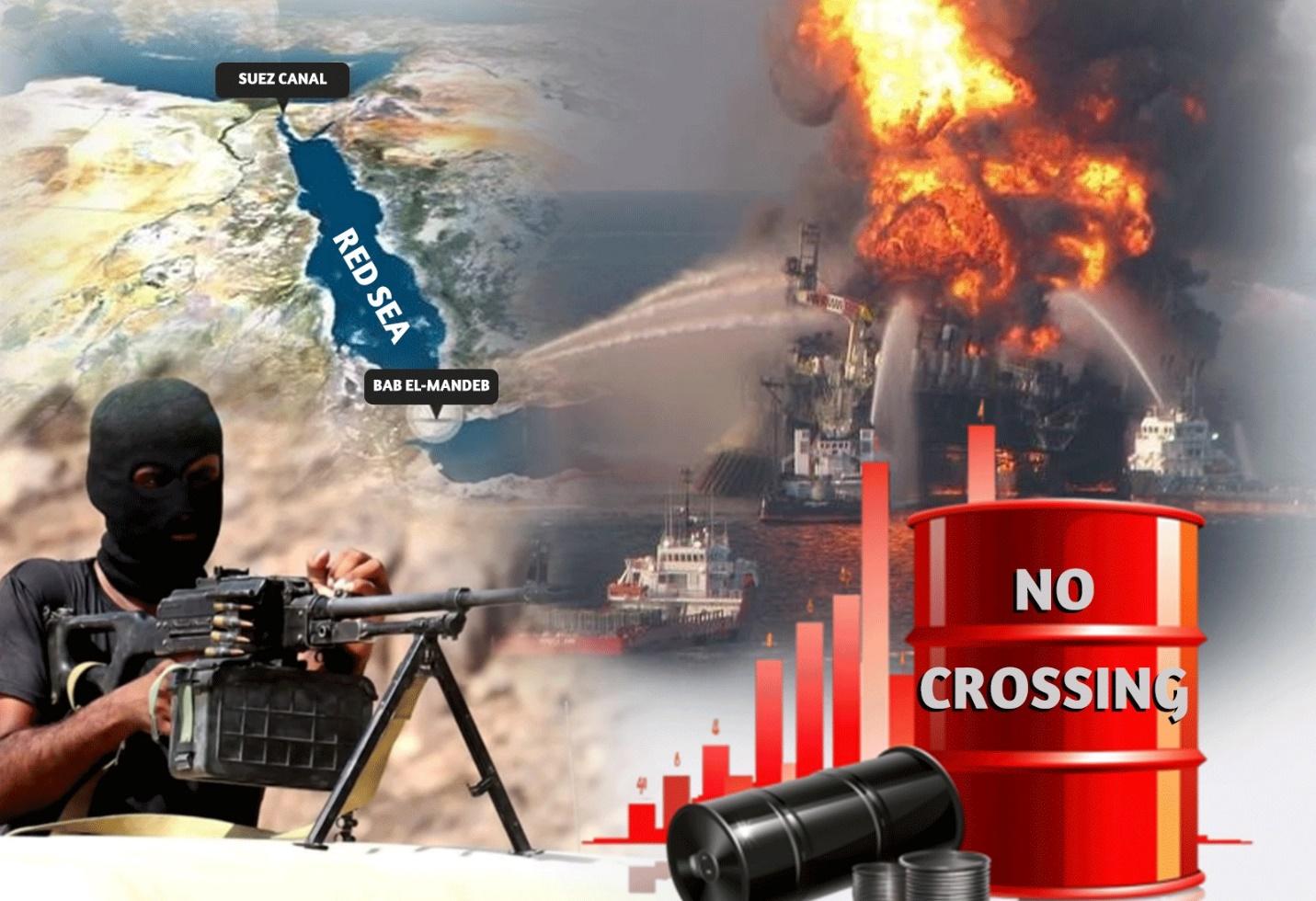
From a geopolitical and geo-economic standpoint, straits act as critical arteries for the flow of oil and liquefied gas from production hubs to global markets. Any disruptions or blockages in these routes could trigger a supply crisis in energy markets, driving up prices and depleting strategic reserves in key industrialized countries heavily dependent on fossil fuels. Given that a substantial portion of global oil production is concentrated near these straits, they effectively function as valves controlling the flow of energy supplies worldwide. Thus, securing these maritime routes is essential for maintaining the global oil and gas reserves, with two-thirds of the world’s crude oil being transported through them daily by massive tankers.
Introduction
The Bab el-Mandeb strait holds immense significance as one of the key international waterways due to its strategic location at the southern entrance of the Red Sea. Its position, bordering the territorial waters of Yemen, Djibouti, and Eritrea, has placed it at the heart of major powers’ strategic priorities and colonial ambitions since the 16th century. As such, since the Gaza conflict and the mounting threats to shipping and maritime traffic, the Bab el-Mandeb strait has garnered significant international and regional attention.
Spanning 30 kilometers in width, the Bab el-Mandeb strait is divided by Yemen’s Perim Island at its southern entrance into two distinct channels. The narrower Bab Iskender Strait to the east measures only 3 kilometers wide and reaches a depth of 30 meters, while the broader western passage, Dact-el-Mayun, extends 25 kilometers and plunges to a depth of 310 meters.
The Yemeni Houthi group’s involvement in the armed conflict with Israel—targeting vessels en route to Israeli ports through the Red Sea—has heightened disruptions in maritime traffic. This escalation has forced an increasing number of crude oil and liquefied gas tankers, along with cargo ships, to reroute via the longer and costlier Cape of Good Hope.
As such, in the wake of the October 7 events, global attention has fixated on the Bab el-Mandeb and the broader Red Sea region, as disturbances in this crucial area have raised concerns about global energy security. But what makes this strait strategically significant, and how does it influence the flow of crude oil and liquefied gas? This is what this article will look at.
Strategic Waterways: A Growing Concern
Maritime security holds strategic significance for global powers, especially given its close link to energy security. Waterways and straits, by their very geography, are critical choke points in military strategy, granting dominance to those who control them. These areas frequently become focal points of tension and conflict. Thus, international law extends its protection to all critical waterways. The Straits of Hormuz and Bab el-Mandab are strategically vital, serving as crucial channels through which Middle Eastern oil is transported to global markets, continuing its journey via the Cape of Good Hope, the Strait of Malacca, the Indonesian straits, and the Suez Canal, as shown in Figure 1, which depicts the key straits and waterways linking global regions.
Figure 1: Top strategic straits and waterways in the World

Ensuring energy supply security has emerged as a crucial factor shaping foreign and defense policies, particularly for major powers and rising economies. This concern has become a focal point in international security discussions. The ongoing struggle between current leading powers and emerging forces increasingly revolves around the energy infrastructure, including production and transit zones, as well as vital maritime navigation routes.
Given the escalating threats to maritime navigation and the tense geopolitical climate between regional states and both regional and global powers, the significance of straits and sea-lanes has never been greater, particularly in the Middle East. This heightened importance is underscored by the region’s vast reserves of crude oil and natural gas and the critical role these energy supplies play in the global economy. This dynamic likely accounts for the heightened interest of both major and regional powers in safeguarding these maritime routes, leading them to develop new initiatives and forge alliances for their security.
The Strategic Significance of the Bab el-Mandeb Strait
Globally, the Bab el-Mandeb strait ranks third in terms of energy trade volume, following the Straits of Malacca and Hormuz. It is a critical transit point for most crude oil and liquefied gas exports from the Arabian Gulf, which are routed through either the Suez Canal or the SUMED pipeline to Europe and North America. Positioned off the coasts of Yemen, Djibouti, and Eritrea, the strait links the Red Sea with the Arabian Sea and serves as a vital conduit for European refined products reaching global markets, as shown in figure 2.
Figure 2: Significance of Bab el-Mandeb strait

The Bab el-Mandeb Strait handles an estimated 21,000 tankers each year, averaging around 61 tankers daily. Closure of this vital route would force vessels to take the considerably longer Cape of Good Hope route, covering approximately 6,000 nautical miles, which would substantially increase shipping expenses.
Examining crude oil transit through the Bab el-Mandeb Strait reveals that in 2023 the volume of oil flowing through the strait reached approximately 8.8 million barrels per day, according to data from the US Energy Information Administration. This marks a significant increase from 2022’s 7.1 million barrels per day, 2021’s 4.9 million barrels per day, and 2020’s 5 million barrels per day, highlighting a substantial surge in oil flows over the past two years, as illustrated in figure 3.
Figure 3: Oil flow volume through the Bab el-Mandeb Strait, 2018-2023

Source: Energy Information Administration, 2024
In 2023, the Bab el-Mandeb strait saw the transit of approximately 4.5 million barrels per day of crude oil and condensates, up from about 3.3 million barrels per day in 2022. Additionally, petroleum products flowing through the strait reached about 4.4 million barrels per day last year, compared to 3.8 million barrels per day in 2022, according to the reported data.
Moreover, the daily flow of liquefied natural gas (LNG) through the Bab el-Mandeb strait was approximately 4.1 billion cubic feet in 2023, a decline from 4.5 billion cubic feet per day in both 2022 and 2021. In 2020, LNG flows reached approximately 3.7 billion cubic feet per day, slightly down from 3.9 billion cubic feet per day in 2019 but up from the 3.1 billion cubic feet per day recorded in 2018, as illustrated in Figure 4.
Figure 4: Liquefied natural gas volume flowing through the Bab el-Mandeb strait, 2018–2023

Source: Energy Information Administration, 2024
Notably, there has been a substantial drop in LNG tanker traffic through the Red Sea following the Houthi attacks in Yemen, which occurred in the aftermath of the Israeli war on Gaza. In the first half of 2024, no LNG tankers traversed the Bab el-Mandeb strait—the crucial corridor between the Arabian Peninsula and Africa—underscoring the significant disruption that regional violence has inflicted on global energy trade. Before the Gaza conflict, the Bab el-Mandeb strait saw dozens of tankers crossing each month. Yet, since mid-January, Houthi attacks have drastically reduced this traffic, bringing it down to nearly zero.
In response to the crisis, one proposed solution has been to redirect shipments. For instance, US LNG shipments have been rerouted to Europe, while equivalent supplies in Asia have fulfilled contractual commitments to buyers in that region. In the first quarter of 2024, Qatari LNG deliveries to Asia reached their highest level since 2017, while Russia increased its shipments of super-chilled fuel to Europe. In July 2024, Qatar emerged as the world’s leading LNG exporter, with a total of approximately 7.14 million metric tonnes, as depicted in figure 5.
Figure 5: Top LNG exporters, July 2024

Notably, the Red Sea and Suez Canal have historically handled around 10% of the world’s maritime trade and offer Qatar the quickest path to Europe, a market that has turned to LNG imports after Russian pipeline supplies were cut off.
The extended distances ships must now cover are cutting tanker availability, driving a 4% increase in global demand for shipping oil products and liquefied gas. Thousands of miles away, transit rates through the Panama Canal have also decreased following an unprecedented drought that disrupted traffic there, closing another shorter route for US LNG shipments to Asia during the first half of 2024.
The Conundrum of Energy Security in Straits
Among the pressing concerns in energy challenges is the stability of supply through the straits. Securing reliable energy flow is a critical strategic priority. The quest for oil security isn’t a new struggle; it has sparked numerous conflicts and, paradoxically, served as a catalyst for cooperation among countries. In this vein, a US Army general has highlighted the strategic importance of crude oil in military operations. He suggested that a significant reduction in oil supplies could severely compromise their operational effectiveness and that the distribution of the country’s oil resources would likely evolve into a politically contentious matter with far-reaching consequences. He added that the necessity of preserving sufficient strategic reserves warrants careful consideration, questioning whether the pursuit of deterrence can be justified at the expense of economic imperatives.
With key shipping routes being the only viable paths for crude oil and its derivatives, oil tankers often face the challenge of navigating through critical straits. These routes, especially those in regions plagued by tensions and instability, pose significant risks, with only a few holding considerable strategic importance.
Recognising the strategic significance of straits and sea-lanes, international law has established mechanisms to safeguard their security and protection. The 1982 United Nations Convention on the Law of the Sea affirms the right of transit passage and freedom of navigation for ships traversing straits. It outlines a legal framework governing the waters comprising such straits used for international navigation to ensure the unhindered passage of ships and aircraft through these straits, under provisions that balance the rights and obligations of coastal states and other countries. This includes the right of coastal states to exercise sovereignty and jurisdiction over relevant straits while respecting other principles of international law.
Arab states are actively countering attempts by various powers to expand their influence over the strategic straits and sea passages of the Middle East. They recognize that any threat to these vital waterways poses a direct challenge to their security, stability, and economic prosperity, particularly their oil industry. Towards that end, Arab states are coordinating with regional partners and major powers, as well as their Arab and Islamic neighbors.
Recent developments in Gaza have created a new geopolitical landscape, giving the Houthi an opportunity to leverage this new reality and pose a threat to global energy security. The Bab el-Mandeb strait, a hotspot of geopolitical tension, could significantly affect energy supplies from the region.
Economic Consequences of Regional Unrest
The Gaza conflict has heightened geopolitical risks for global markets, with investors wary of potential escalations involving other countries, especially in the Red Sea region. Such developments could drive up energy prices and deliver a fresh setback to the global economy. The broader implications for energy markets include:
1. Higher Prices for Energy
The conflict in Gaza has caused a modest increase in energy prices, with crude oil potentially surpassing $90 per barrel. This rise has notably affected countries dependent on crude oil for industrial use, raising concerns about inflation as higher energy costs ripple through various economic sectors. Should the conflict extend to the Red Sea, pressure on energy prices is anticipated to escalate further.
2. The Risk of Energy Shortages
Alongside rising prices, there is a genuine risk of energy shortages if the conflict persists and disrupts production in key areas. With transport routes for energy resources compromised, global crude oil and gas supplies have been notably impacted, placing clear strain on price fluctuations.
3. Effects on the Middle East Region
Although the anticipated increase in crude oil and natural gas prices boosts revenue and reduces deficits for Middle Eastern countries that produce and export these resources, it also brings challenges during crises. Persistent regional conflicts drive inflation, particularly in transportation costs, and foster an unfavorable climate for oil investments. Overall, the energy sector highlights the significant costs the region will incur if a broader conflict emerges, with some repercussions already observable in certain countries within the region.
To sum up, the strategic significance of oil transport routes through key international maritime lanes and straits, particularly in the Middle East, has become undeniable. These waterways serve as the linchpin of regional energy geopolitics. The security of global energy supplies is inextricably linked to the uninterrupted flow of oil through these routes. Any disruption to maritime traffic in these straits can have far-reaching consequences for the world’s energy security and safety.
Arguably, the Arab region’s vision for its future energy security hinges on safeguarding maritime routes, particularly the Bab el-Mandeb strait. This can be accomplished by adopting a pragmatic security approach that ensures global energy supplies are not subject to external control, whether during peaceful periods or wartime, and in response to both local and global threats. Notably, the security of the Arabian Gulf and the Red Sea are inextricably linked to Arab national security. Any threat to the security of navigation in these waterways poses a direct threat to the stability and security of global oil supplies and energy arteries.